The Haunting D’Alessio Glass Studio Where the Forms Went Slack
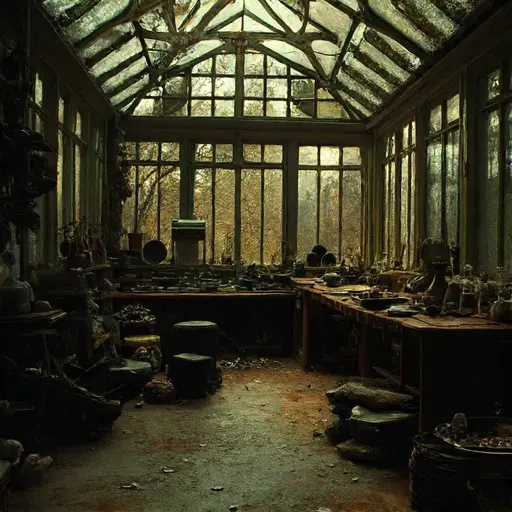
The glass studio keeps its warmth long after the fires died, a faint mineral scent rising from scorched planks. The air is heavy, as though it remembers how liquid shapes trembled on the verge of form. A ripple of light glances across a half-polished globe, arrested mid-curve.
Powdery ash drifts between the slats of the workbench. Nothing speaks here, save for the quiet suggestion that someone fled before the final twist of molten glass—before the artistry could hold or shatter.
The Artisan Who Taught Fire to Obey
This glass studio preserves the touch of Matteo Giovanni D’Alessio, lampworker and finisher born in 1870 near Naples. Raised in a household of modest traders, he apprenticed early, learning the breath-and-turn craft prized by Mediterranean artisans. His temperament lingers in the careful placement of tools: tweezers wrapped in thin linen, tapered rods ordered by temperature tolerance, and a cluster of mandrels resting cool beneath a cloth patterned with Italian vines. A folded kerchief embroidered with his sister’s name, Elena D’Alessio, lies tucked beside a chest of canes she once helped arrange.
Matteo lived by the rhythm of heat: dawn preparation, midday shaping, late-afternoon polishing. Every surface shows the memory of his diligence—the gradually darkened rafters, the neat markings on the bench where he aligned lengths for delicate filigree, the faint swirl of chalk near a cooling tray where he tested curvature before torching.
Brilliance Rising, Subtle Departures from Control
Matteo’s skill spilled into demand. Merchants sought his filigree lampshades, intricate perfume flacons, and tiny millefiori beads. He imported color canes from Murano; the wooden crates, still stamped in Italian script, sit under a rack of rods sorted by hue. A cast-iron stand holds prototypes of elaborate stems for goblets, some perfect, others harshly ground as though he rejected them with a shake of the wrist.
Yet strains reveal themselves in the inconsistencies: a marver smeared with uncleaned soot, tools placed askew, cooling ornaments crazed with fine cracks—mistakes he would never have permitted during steadier years. A ledger on the corner table lists orders for an upcoming fair, entries alternating between careful detail and abrupt dashes, as though he wavered between precision and impatience. A thin ribbon of copper used for decorative edging lies twisted, its coils uneven, hinting at a lapse in concentration.
The TURNING POINT That Bent His Composure
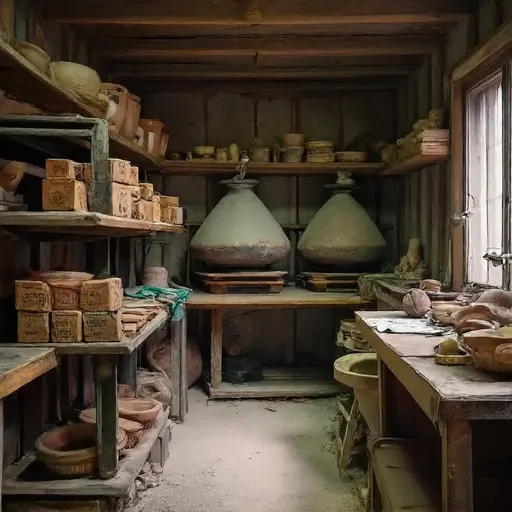
One night, something broke that no annealing schedule could mend. A scorched apron lies crumpled near the lampwork bench, its straps cut—whether from accident or haste is unclear. The bellows are jammed as if kicked or struck. A blown cylinder, shattered from thermal shock, remains on the marver’s edge, razor-fine fractures radiating like a sudden decision taken without care.
Whispers later suggested a commission gone awry: a wealthy patron accused Matteo of substituting cheaper glass or altering a design after payment. Another rumor claimed he inhaled toxic fumes from an overheated mix, trembling afterward, unable to trust his own hands. On a small slate board, a single note reads, “Not steady—Elena must not see,” the chalk smudged as if wiped violently.
A payment slip, torn into three pieces, occupies the ash near the furnace base. One fragment bears the patron’s initials; the others are illegible. A bowl of enamel powders has spilled into a mottled pile, blues bleeding into greens as though color itself collapsed under stress.
The Puzzle of What He Hid Away
A discreet panel behind the cooling racks, loose at one corner, reveals a hollow compartment. Inside rests a single unfinished stemware piece—its bowl absent, its stem twisted beautifully before ending in an abrupt, distorted knot. Wrapped around the stem is a slip of paper: “Will not pass inspection.” No explanation accompanies the judgment.
Alongside the flawed stem lies a thin silver chain with a tiny pendant—Elena’s by the engraving—its clasp broken. The placement feels deliberate, but nothing in the studio accounts for why he paired these objects. The chain’s break could suggest a quarrel, or a moment of fear, or simply misfortune. The silence refuses to specify.
The Last Quiet Fragment
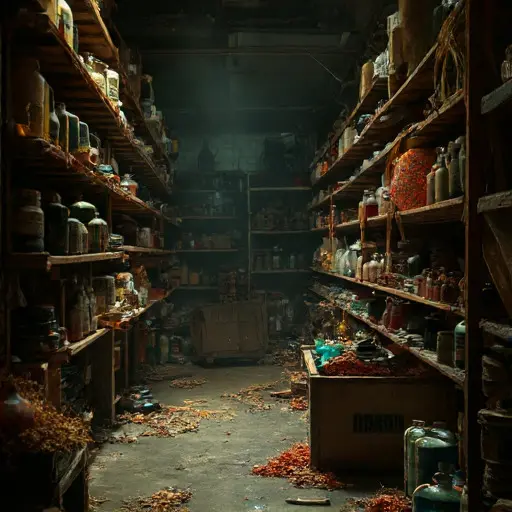
Within a folded cloth beneath the supply shelf lies a tiny globe fragment—thin as eggshell, colored in subtle gradients. Its surface bears a single hand-etched line, curving downward in what might have become a graceful rim. Beneath it, Matteo’s faint script: “For Elena—completed when balance returns.” No date. No further promise.
The fragment is light enough to tremble even in still air. Whatever balance he waited for—of skill, of reputation, of courage—never returned.
And the house around this abandoned glass studio remains abandoned.