The Haunting Valcázar Bindery Where the Spines Split
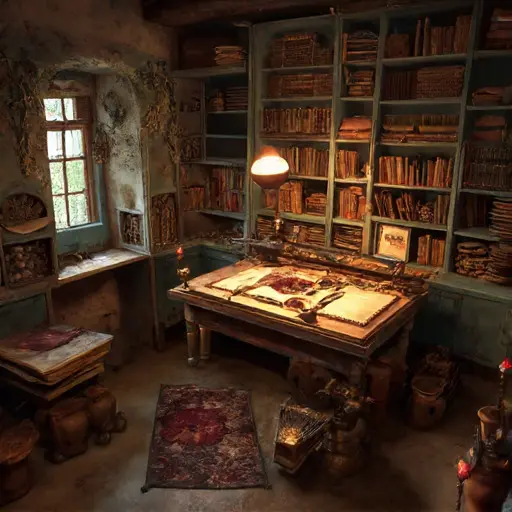
The bindery holds its breath, as though waiting for hands that will never return. Leather dust clings to the corners of the floorboards, and half-cut signatures lie fanned open on the main table. The smell of glue, faint but persistent, accompanies the soft creak of drying boards.
Quiet presses inward, the kind that settles only after pride is broken. Amid this stillness, the word grain comes to mind—the delicate direction of fibers that determines whether a spine will hold or fail.
The Maker Whose Hands Shaped These Tables
In this bindery, the life of Alejandro Tomás Valcázar, master bookbinder born in 1871 near Zaragoza, unfolds in objects rather than narrative. His craft shaped the entire room: bone folders arranged by size in an olivewood tray, a stack of Spanish almanacs awaiting rebinding, a copper pot for heating paste set beside a hand-painted tile depicting a running bull. Raised in a household of modest means, Alejandro apprenticed early, refining a temperament both patient and exacting.
His routines reveal themselves in the spaces he touched daily. A stool’s cushion is worn to a perfect oval where he leaned during long hours of sewing. A cord-bound notebook—left purposely blank for clients’ measurements—still carries the subtle indentation of his handwriting on its cover. His sister, María Valcázar, appears only through a pressed sprig of rosemary tucked among the marbled offcuts she once admired. At the bindery’s height, Alejandro’s custom leather spines were prized across the district for their durability and elegance.
A Flourishing Craft, Uneven Footprints
During his peak years, he expanded the room to manage commissions from merchants importing volumes from Madrid and Lisbon. He added a second sewing frame for complex projects; its tension cords now sag lightly, implying a last job interrupted. Decorative tools—sunbursts, vines, and tiny gilt dots—line a shelf near a set of Castilian dictionaries he repaired for a bookseller. A brass ruler engraved with Spanish numerals suggests he worked across both local and distant orders.
But small irregularities speak of strain: a misaligned stitching kettle; leather cut at a slant he would never have permitted in earlier days; and an imprinting die heated unevenly, leaving a warped fleur-de-lis on an otherwise perfect test spine. He had begun working late into the evenings, as shown by the wavering lamp wick near sheets of blotter paper stained with hurried experiments.
After the TURNING POINT, All Work Faltered
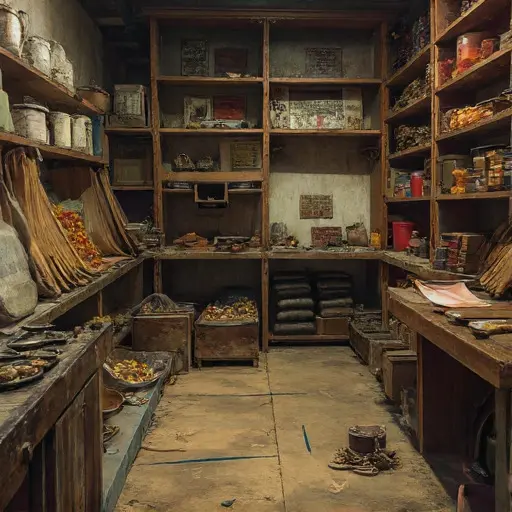
Something fractured one late autumn night. A heavy press—usually bolted to the corner—has shifted inches from its place, scraping the floor in a single straight line. The guillotine cutter’s locking arm is bent, though not violently; more like someone applied pressure beyond caution. A half-bound ledger lies open, threads pulled taut and snapped mid-signature.
Alejandro’s downfall seems rooted not in scandal or illness but in debt—whispers of unpaid shipments of goatskin, disputes with suppliers in Barcelona, and a commission returned by a patron who accused him of weakening the spine to mask inferior paper. Whether true or not, the bindery reflects his panic: a pouch of coins overturned, markers scattered, ledgers rewritten with numbers expanding then crossed out entirely. One drawer contains a rolled invoice stamped in red and a torn slip bearing only María’s name. A ribbon she had once braided hangs from a drawer pull, stiff with dried paste along one edge, perhaps used to mark a book she never received.
A spool of linen thread lies twisted around the leg of the sewing frame, as if yanked during a frantic attempt to finish a project he could no longer afford to delay. The wrong thread weight—too coarse for fine bindings—sits beside it, suggesting compromise or haste.
What the Silence Finally Offers
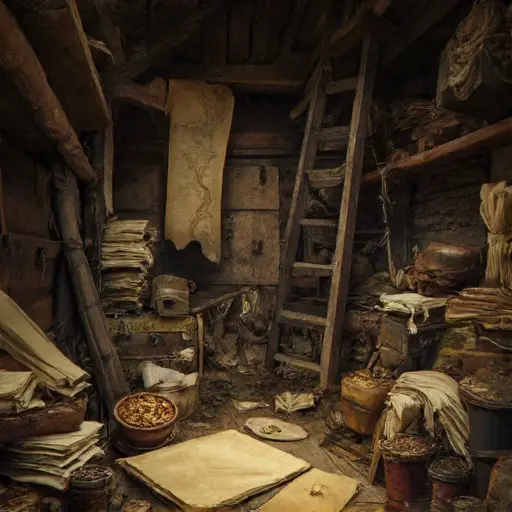
Behind the crate of vellum scraps, a narrow false panel comes loose with almost no resistance. Inside is a single unfinished binding: deep oxblood leather, corners sharpened, spine meticulously rounded but unlined. The cover boards gape open around an empty hollow, intended for a textblock that never came. Slipped inside the front board is a scrap of paper, bearing three trembling words in Alejandro’s hand: “Could not mend.” No title, no date, no addressee.
The leather smells faintly of rosemary—María’s sprig, pressed long ago. Whether he meant the words for her, for his craft, or for the debts that swallowed his livelihood, the bindery refuses to clarify.
The room settles into its patient quiet once more, tools laid out as if awaiting the next job. Yet nothing moves. The house, wrapped around its abandoned bindery, remains abandoned.