The Forgotten Kuroda Study and the Map That Shifted Overnight
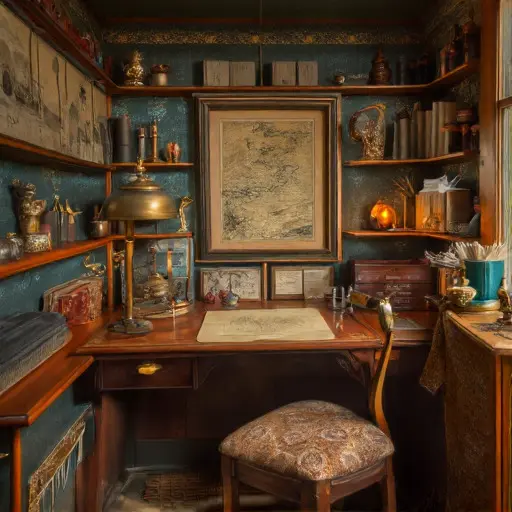
A muted light presses against the study’s walls, swallowed by its close corners. Every surface seems to hold the hush of a room that once vibrated with careful concentration. Paper fibers cling faintly to the air.
Near the hinge of the drafting desk, a single curl of shaven copper lifts in a whispering arc, as if the last cut somehow refused to fall. A faint chemical tang—ink mixed with oils—rests above the floorboards, and something subtler trails beneath it: the expectation of a missing contour, barely traced and never finished.
A Life Built on Lines and Discipline
The room preserves the habits of Hiroshi Kenji Kuroda, cartographer and copperplate engraver, born 1869 in Kyoto. When he settled here, across an ocean from his birthplace, he reshaped this study into an enclave for precise work: cherrywood drawers filled with nibs and burins, a lacquered box hiding tiny compass points, and regional charts from East Asia resting against a European globe. The soft thrum of his temperament is visible in the balanced arrangement of tools, each nested in cloth squares to prevent dulling.
Hiroshi’s early success came from his ability to join mathematical rigor with artistic sensitivity. On the modest rug—dyed a deep russet—lie chalk tracings he used to rehearse coastlines before engraving. A thin reed fan, broken along one rib, hints at the humidity he tried to manage during long nights of drafting. His cousin Naomi Kuroda is recalled in a delicately painted bookmark tucked inside a geography folio—her calligraphy looping with gentle discipline.
Ascending Craft and Unusual Ambitions
As commissions spread, the study evolved into a workshop for demanding clients. He installed a hinged magnifier on the desk’s edge, allowing close inspection of copperplates sourced from Marseille. European calipers, Japanese whetstones, and French-language atlases mix on a single shelf, implying a practice that bridged continents. Several rolled charts bear naval markings, though one is oddly reversed, its legend printed backward as if prepared for transfer but never completed.
The progression of his drafts reveals an arc from methodical precision to restless experimentation. Early plates show meticulous hatching; later ones drift into ambiguous coastlines and uncertain scale bars. A paperweight shaped like a tortoise—said to symbolize steady progress—rests atop a pile of corrections. Yet beneath the stack, a misaligned template for a coastal survey suggests hurry, or doubt, or both. This room once sang with the quiet rhythm of iteration: draw, correct, scrape, redraw.
Fractures Appearing After the TURNING POINT
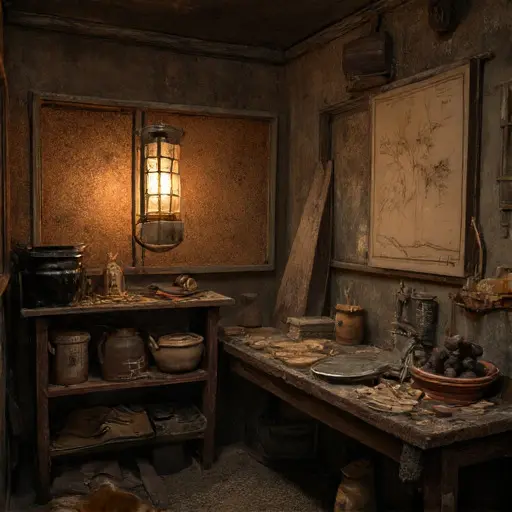
One evening, in some unspoken dissonance, Hiroshi’s disciplined world faltered. The proof pinned to his wall carries a streak of ink drawn too swiftly, slicing across two islands with careless force. A cracked burin lies in a lacquer tray: its tip snapped in a manner inconsistent with typical wear. The lamp’s silk wrapping is torn, exposing the raw glare he usually softened. Something startled him—news of a disputed commission, perhaps, or allegations of inaccuracy in a naval chart.
The decline reads in subtle misplacements. A compass is found inverted on the rug, needle trembling with a magnetism disturbed. A letter opener from Yokohama lies bent beside ledgers where entire columns have been scraped away with acid, leaving pale ghosts of numbers. A cotton cloth bearing Naomi’s stitched initials is folded too tightly, edges sharply creased, as though gripped in frustration. Rumors later whispered that a patron claimed his coastal delineation jeopardized a shipment or obscured a boundary. Nothing is confirmed. Yet here, the residue of accusation lingers like a bruise.
A sealed envelope—addressed but never posted—rests beneath a stack of trial prints. The ink on its front has bled in one corner, suggesting hesitation, handling, then abandonment.
Puzzling Hints Inside the Rafters
From the upper molding of the study, a thin seam yields to pressure, revealing a recess just large enough for a scroll. Inside lies a single copperplate wrapped in rice paper. Its etched coastline starts confidently, then dissolves into abrupt scoring marks that obscure orientation. Beside the plate sits a folded scrap bearing Hiroshi’s faint handwriting: “Shifted… not stable to present.” No context. No signature. Only a sense of something altered beyond repair.
He must have hidden it quickly. A faint wax stain under the recess suggests the scroll was once sealed, then opened in haste. The matching twine lies on the floor below, frayed.
The Quiet Piece That Remains
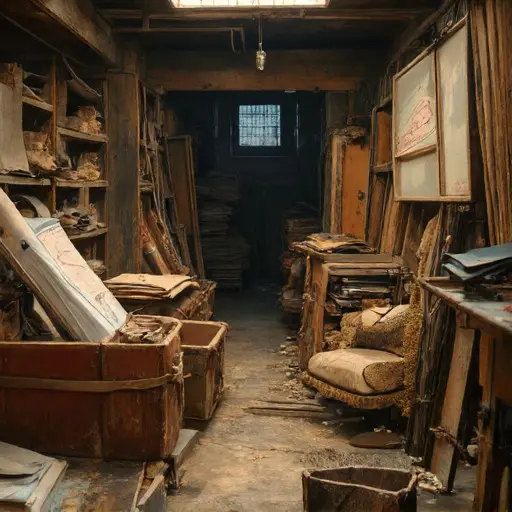
Behind a surveying manual, slipped sideways as though hidden on impulse, lies a small plate fragment wrapped in muslin. Its etched lines form the start of a harbor, but every reference point—every anchoring detail—is missing. Only a single latitude mark remains, ending in a broken stroke. Under it, in wavering ink: “For Naomi—could not finish.”
The fragment is cold, even after long handling. Whatever boundaries Hiroshi was asked to define, whatever truth or error pressed against him, left this room derailed in silence.
And the house, folded around its abandoned study, remains abandoned.