Thornmere Quillfell House and the Last Warmed Corridor
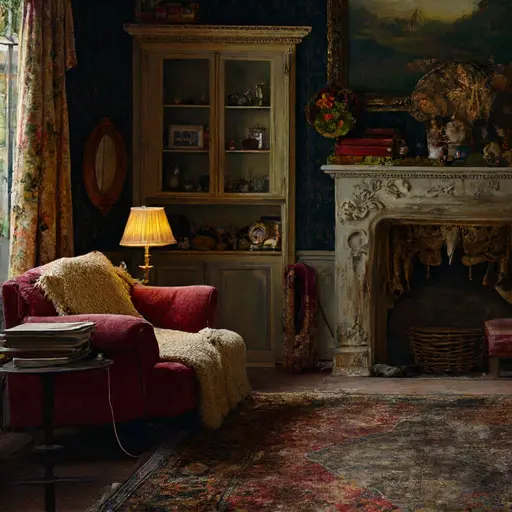
The parlour of Thornmere Quillfell House compresses time beneath stagnant lamplight. Upholstery sags where bodies once leaned, hearth tools lie scattered as though set aside for a moment that never resumed, and air hangs heavy with the faint tang of metal and old wool. Movement here faltered gradually rather than abruptly: drafts tracing along the floorboards, candles reduced to stubs, and rugs collecting the fine grit of seasons lived indoors.
The Quiet Labours of Henrietta Lorne Callow
Henrietta Lorne Callow, widowed seamstress and tutor, once shaped this interior through determined resourcefulness. Living with her niece Emmeline, she converted the reading room into a hybrid workspace—grammar primers stacked beside bobbins of thread, student copybooks intermixed with fabric remnants. Her temperament ran steady but strained; she often stitched late into the night to cover debts left by her late husband’s failed ventures. Chair cushions compressed under her habitual posture, scissors dulled where she hurried, thimbles rolled beneath baseboards during bouts of fatigue.
When Emmeline fell into prolonged illness, Henrietta’s income thinned. Lessons dwindled, sewing orders slowed, and bills amassed faster than she could answer them. The house mirrored her decline: curtain hems undone, the hearth unpolished, lamps burning low to ration oil. What had been a carefully maintained domestic rhythm slowly unraveled into quiet disarray.
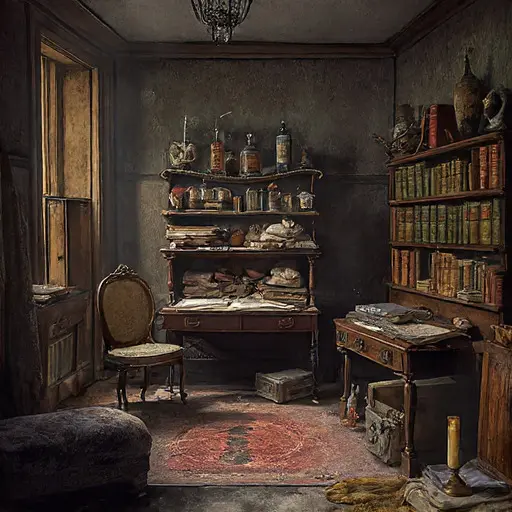
The Narrow Corridor Where Habits Broke Apart
In the south corridor, shoes sit where Henrietta last placed them for polishing, bristles of the brush worn flat. A coat remains slung over a hall chair, sleeves creased from repeated tugging. The corridor’s wavering lamplight reveals the slow surrender of tasks once tightly kept: dust layering over unfinished mending, loose thread coiled on the banister, a fallen hairpin wedged beside the stair rod.
The Kitchen Table That Stopped Being Set
Within the scullery, cracked bowls rest inside one another, spoons lie unwashed, and a kettle bears mineral rings from water boiled on colder mornings. Emmeline’s untouched medicine bottles cluster near the pantry door, their labels curling. A ledger of expenses—entries thinning toward the final pages—remains open beside a cooling brick of soap.
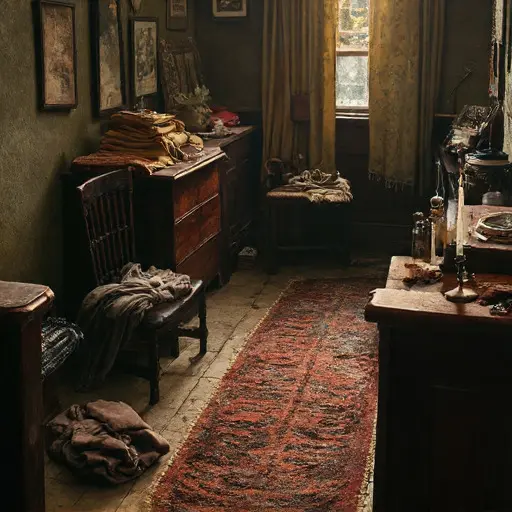
At the top of the stairs, a final stillness lingers. A half-folded tablecloth waits for hands that will not return, and Emmeline’s book lies open to a page she never finished. Thornmere Quillfell House remains unmoved, its rooms surrendering gradually to dust, to softened fabrics, to breathless quiet—its abandonment settling deeper with every unmeasured hour.