The Lindenwraithe House Ledger and the Tilted Velvet Chair
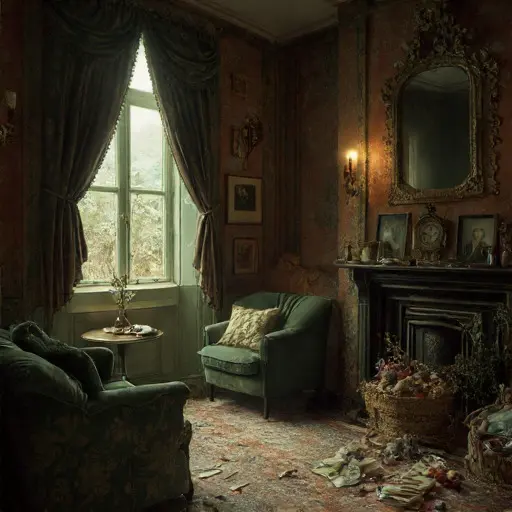
The parlour air is thick with the muted scent of softened varnish, old cloth, and the faint metallic tang of long-set ink. Lindenwraithe House feels paused rather than abandoned, as though its occupants intended to return before the dust had time to settle.
The Reserved, Steady Life of Graham Ellison Lindenwraithe
Graham Ellison Lindenwraithe, a municipal rate clerk of quiet precision, lived here with his wife, Adelaide, and their son, Rowan.
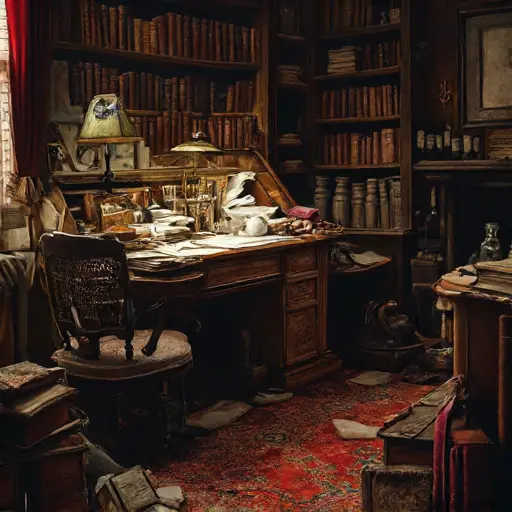
Graham’s even-tempered habits shaped the rhythms of the home. In the Study, his ledgers remain in straight, uncompromising stacks, envelopes arranged by month, receipts pinned according to a system only he fully understood. His handwriting, at first broad and assured, narrows in later entries—numbers pressed closer, revisions more frequent, margins more crowded.
Adelaide’s touch lies everywhere in the faint traces of a household kept with gentle discipline. Chore lists in her looping script rest behind pantry doors. Her mending pile remains organized by need, though the top garment still bears loose pins. A recipe card, stained at one edge, sits half-tucked behind the stove. Rowan’s scattered belongings—an incomplete alphabet board, wooden toys worn smooth, a child’s primer softened at its spine—wait in their last-used locations.
But change arrived gradually. Graham’s department faced new reporting requirements; hours stretched; ledgers thickened with corrections. Meals slipped late, laundry remained half-folded, dust claimed the corners. When Adelaide fell ill, the structure of the household unraveled. After her passing, Rowan was taken in by relatives, leaving his things in quiet disarray. Graham remained a while longer, pacing familiar routes with diminishing vigor, until he finally drifted away as softly as dust itself—no disruption, no farewell, only the quiet surrender of a man worn thin.
A Corridor Bearing Soft Echoes of Departing Steps
Upstairs, the corridor retains the imprint of a family’s gradual withdrawal. The runner rug lies folded into low undulations, its floral pattern blurred into near-monochrome. A hall table holds collar studs, a snapped spectacles arm, and a small notebook whose last entry ends mid-sentence. Pale rectangles on the wallpaper mark where portraits once hung, removed carefully, not urgently.
A Sewing Room Stilled Mid-Task
In the Sewing Room, Adelaide’s final projects remain perfectly paused. A half-mended smock rests beneath the treadle machine’s presser foot. Pincushions hardened by time bristle with rusted needles. Spools of thread sit toppled across the table, their colors faded into chalk-soft hues. Folded muslin intended for household repairs has stiffened until its creases resemble thin, brittle pleats.
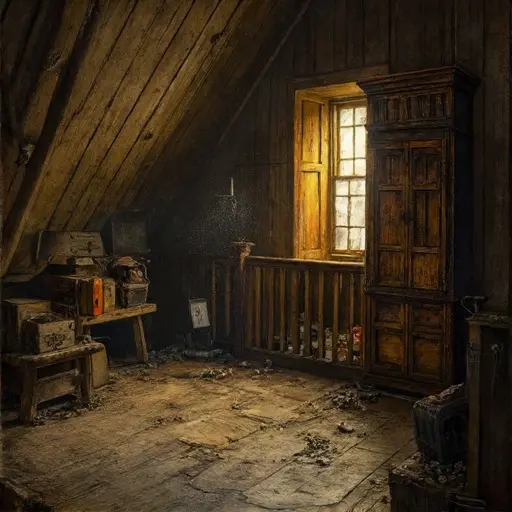
Behind the lowest crate lies a page in Graham’s distinctive script: “Review accounts—finish tomorrow.” Nothing follows. Lindenwraithe House remains entirely still, its tomorrow never reached.