The Briarvenn House Notes and the Ink-Dimmed Lamp
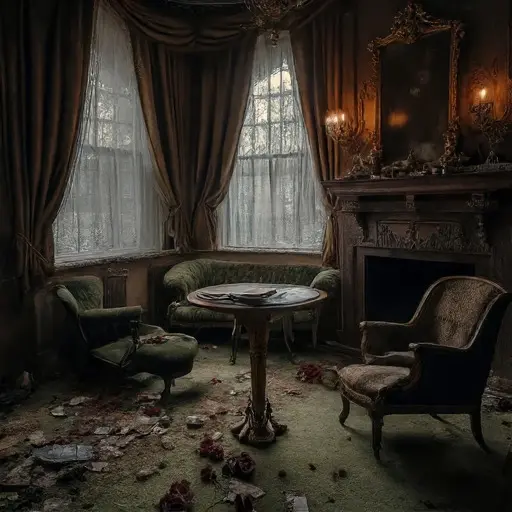
The parlour breathes a heavy quiet, soaked with the softened scents of old varnish, collapsed fabric, and ink long dried into papery halos. Nothing feels disturbed. Briarvenn House gives the impression not of abandonment but of a life simply paused—its routines gently exhaled and left to settle into dust.
The Quietly Disciplined Life of Hector James Briarvenn
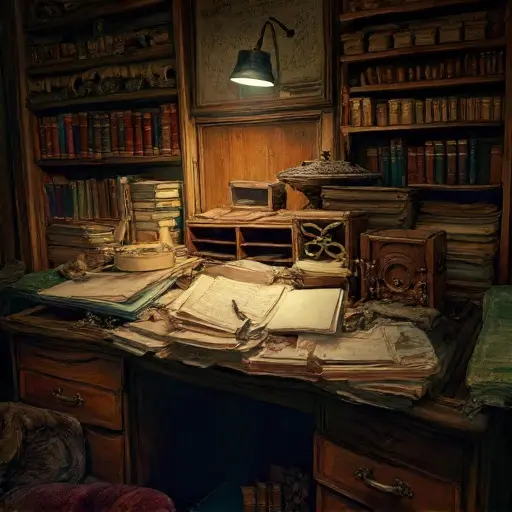
Hector James Briarvenn, a railway accounts examiner known for his meticulous tallies and reticent habits, lived here with his wife, Marian, and their son, Ellis. Hector’s temperament—orderly, even-tempered, exacting—threads through everything left behind. In the Study, his reports remain stacked by month, bound in linen tape; correspondence is sorted into labeled bundles indicating revisions, receipts, and dispatch.
Marian’s touch lingers throughout the house: sewing projects paused mid-stitch, recipe cards annotated in her narrow script, and neatly folded linens arranged in careful piles. Ellis’s belongings—wooden counting toys, chalk boards smudged with half-erased sums, a waistcoat awaiting alterations—suggest a childhood maintained steadily, even tenderly.
But Hector’s professional load increased as railway expansions demanded more frequent audits. His handwriting, once fluid, grew tense and compressed. Ledger margins filled with repeated corrections and notes written in paler ink where his hand hesitated. When Marian fell ill, household order began slipping: tasks delayed, meals missed, and mending paused indefinitely. After her passing, Ellis was sent to stay with relatives, leaving his belongings scattered like fading echoes. Hector remained for a few months more, drifting room to room with diminishing energy, before leaving the house exactly as he had last attempted to live in it—quietly, carefully, and then not at all.
A Corridor of Fading Footfalls
Upstairs, the corridor reflects the slow tapering of family presence. The runner rug has collapsed into shallow folds, smoothed only where footsteps once moved consistently from room to room. A hall table holds collar studs, a snapped spectacles arm, and an appointment book whose entries stop mid-month. On the wallpaper, paler rectangles mark where framed portraits were gradually removed during the household’s final months.
Threads Waiting for Hands That Never Returned
In the Sewing Room, Marian’s last gestures remain intact. A half-mended cuff rests beneath the treadle machine’s presser foot. Rusted needles protrude from pincushions hardened by time. Spools of thread lie scattered across the table, their fibers faded into soft, chalky pastels. Folded muslin, intended for Ellis’s next garment, has stiffened into brittle planes.
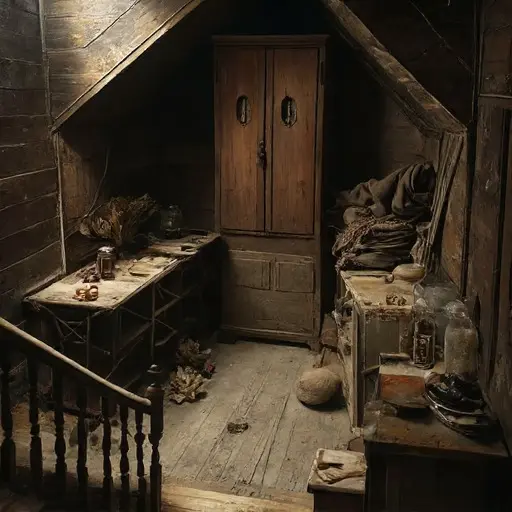
Behind the smallest crate lies a note in Hector’s careful script: “Complete tallies—finish tomorrow.” No date follows. Briarvenn House remains still, its rooms waiting through a tomorrow that never came.