The Elderwythe House Letters and the Burned-Ink Desk
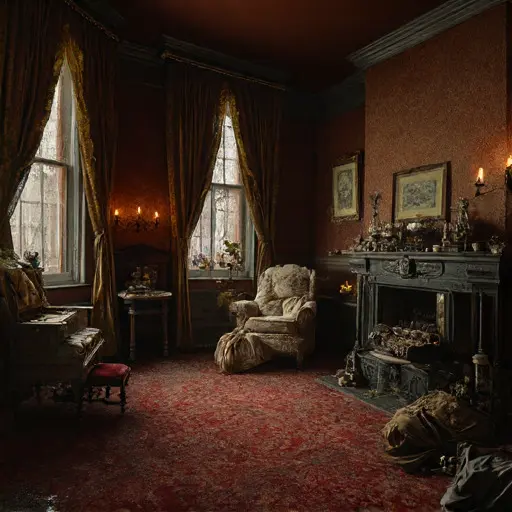
The parlour of Elderwythe House exhales a heavy quiet, thick with the scent of old polish, dried fabric, and the faint mineral tang of plaster long settled. Nothing hints at haste; rather, the room feels steadied in its abandonment, as though it paused mid-routine and simply never resumed. Every object appears exactly where last touched, gently sinking into the house’s slow and uninterrupted silence.
The Ordered, Restrained Life of Harlan Everett Elderwythe
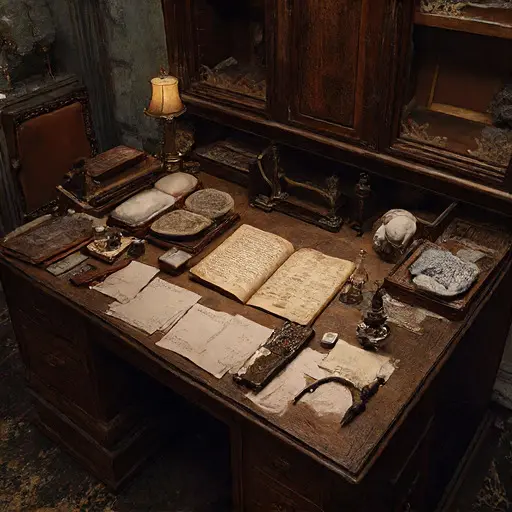
Harlan Everett Elderwythe, an accounts inspector for a regional printing company, lived here with his wife, Miriam, and their son, Tobias. Harlan’s work required meticulous consistency—verifying invoices, noting discrepancies, cross-checking shipment tallies—and the habits he carried home mirrored that discipline. In the Study, his ledgers remain stacked in precisely labeled bundles, each wrapped in linen and tied with twill. Ink pens lie arranged by nib width; correspondence sits sorted into neat piles according to month.
Miriam managed the rhythms of the household with patient precision. Her preserved shopping lists, pinned recipe cards, and meticulously folded textiles remain scattered through various rooms. Tobias’s belongings—mechanical toys with missing wheels, primer books annotated in Miriam’s slanted handwriting, a pouch of marbles dulled by grime—rest where they were last set aside.
But change crept slowly. Company reorganizations increased Harlan’s hours, reflected in the tightening of his handwriting and the growing number of ink blotches in his accounts. Margins once clean grew crowded with revisions. When Miriam fell ill, household order faltered: dishes unwashed, mending postponed, lessons left unfinished. After her passing, Tobias was sent to stay with relatives, and Harlan—exhausted, isolated—let the house drift into quiet disuse. Tasks remained suspended; letters half-written; garments half-mended. Eventually he left as well, not suddenly, but as though worn down by accumulating weight.
The Corridor Marked by Gradual Withdrawal
The upper hallway records the family’s slow disappearance. The runner is folded into soft humps where Harlan once navigated around weakened boards. A hall table holds a jumble of gloves, collar pins, and a broken eyeglass chain. Pale outlines on the wallpaper trace the shapes of portraits removed over months, perhaps years.
A Room of Unfinished Domestic Work
In the Sewing Room, Miriam’s halted tasks remain untouched. A half-mended apron rests beneath the presser foot of the treadle machine. A basket of fabric scraps—gingham, muslin, wool—sits arranged by intended project, now stiffened from disuse. Rusted needles protrude from a pincushion hardened by time, while a tape measure lies curled like a forgotten ribbon across the table.
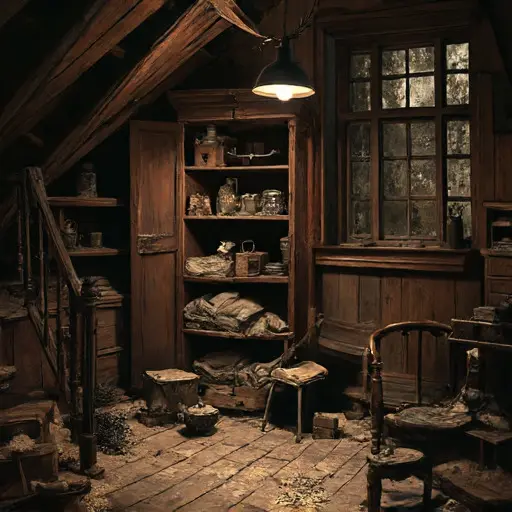
Behind the crates lies a small sheet in Harlan’s unmistakably neat script: “Tasks for tomorrow—sort receipts, mend Tobias’s cuff, finish letters.” There is no date, no further entry. Elderwythe House remains untouched, its rooms resting in the quiet weight of a life paused and never resumed.