The Harrinwell Notes and Their Hidden Hearth Fire
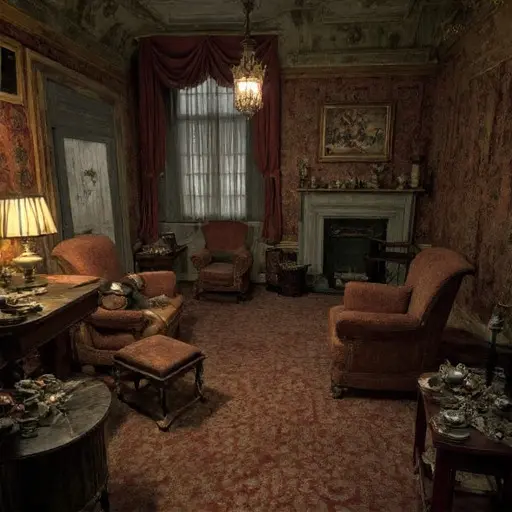
The parlour’s stillness presses inward, and it is here that the word hidden enters my notes almost unbidden. Dust lies in drifts beneath the skirts of furniture, and the scent is that of long-settled ash mingled with old varnish. Nothing suggests catastrophe—only the slow settling of a home that slipped from daily care into muted abandonment.
Objects remain exactly where last used, bearing the weight of habits interrupted rather than concluded.
The Tempered Life of Jonathan Pierce Harrinwell
Jonathan Pierce Harrinwell, municipal accounts clerk and reluctant inheritor of this house, built his routines around quiet consistency. His ledger work required precision, and his domestic life mirrored it: a narrow writing desk kept sharply ordered; correspondence sorted into labeled boxes; coins tallied nightly on a tray lined with felt. He lived here with his widowed sister, Miriam, and her son, Lionel, whose belongings still lie layered in the upstairs rooms—school primers, chalk boards, and a set of marbles tucked in a tin stamped with a fading storefront emblem.
Jonathan’s temperament was steady but encumbered by excessive self-scrutiny. Marginal annotations in his accounts show signs of sleeplessness—tightened handwriting, repeated corrections, and sums reworked beyond necessity. Miriam’s letters, bundled in a drawer of the Drawing Room bureau, speak gently of her concern: not panic, but quiet acknowledgment of a brother fraying under demands he never wished to claim. As municipal restructuring threatened his post, Jonathan grew reticent, pacing nightly along the corridor floorboards that now bear faint depressions beneath their patterned runner. His meticulous order became strained; papers left unfiled; receipts unpinned; meals untouched.
Miriam’s sudden illness left Jonathan without the counterweight that steadied him. When she passed, Lionel was sent to relatives, and Jonathan’s efforts to maintain the house collapsed inward. He retreated to the Study, leaving rooms in a state not of haste but of uncompleted work—mending left mid-stitch, documents half-sorted, domestic rhythms suspended indefinitely.
A Corridor of Gradual Retreat
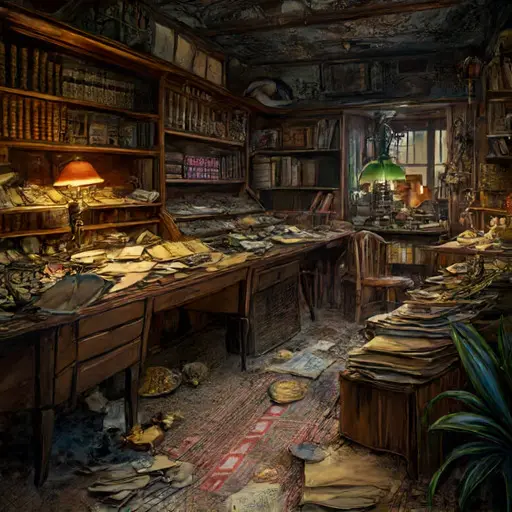
The upper corridor reveals the slow tapering of the Harrinwell household. The runner rug has creased into soft folds where Jonathan once stepped around laundry baskets. Faint outlines remain where portraits were removed during difficult months. A hall table holds a jumble of gloves, collar studs, and faded appointment cards. Dust-muted sconces cast dull halos that barely reach the far doorways.
Hidden Work Left Unfinished in the Sewing Room
In the Sewing Room, Miriam’s last efforts remain suspended. A treadle machine holds a hem anchored beneath its presser foot, thread still leading from the spool. A pincushion bristles with rusted needles; a basket beneath the table contains folded muslin ready for cutting. A narrow drawer reveals fabric swatches labeled in her handwriting—notes for garments never completed. The room carries no trace of panic, only a sense of steady work paused at the edge of fatigue.
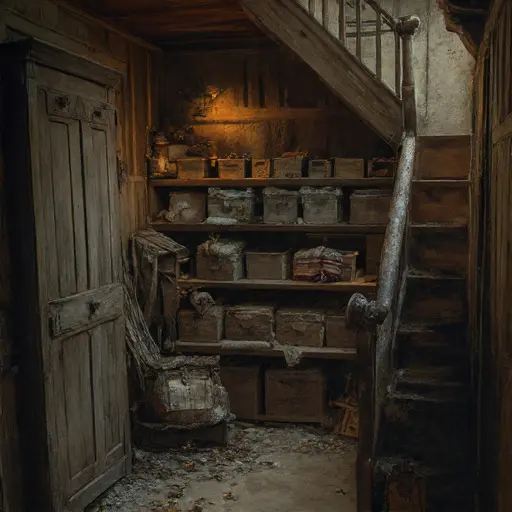
Behind a crate, a folded list in Jonathan’s hand notes “accounts to settle, garments to mend, letters to draft.” No dates, no closure—only the assumption of resuming tasks that were never resumed. It lies there still, the rooms around it surrendered to stillness, the house long abandoned.