Veylormere House: A Quiet Chronicle of Dust and Memory
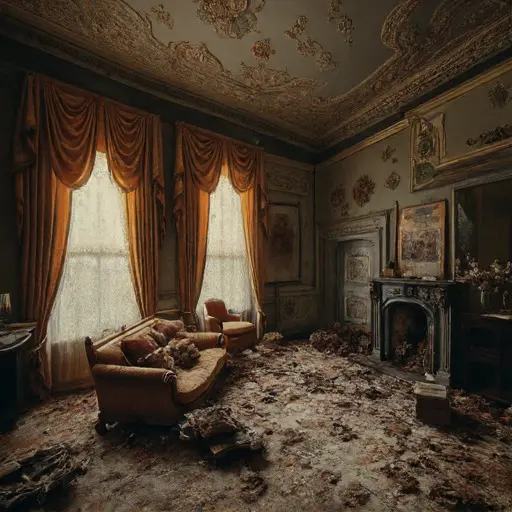
This house—Veylormere, a name appearing in no township record but etched once into an iron mantelplate—carries its history entirely through the rooms left behind. The first impression is quiet heaviness, the sort that collects when lives end not in spectacle but in slow attrition. Dust lies in soft drifts on piano keys never fully closed; a shawl remains folded on a chair as if its owner intended to return at dusk.
Everything suggests a household called away briefly, then indefinitely, until absence hardened into permanence.
The Life and Decline of Eleanor Brant, Mistress of Veylormere
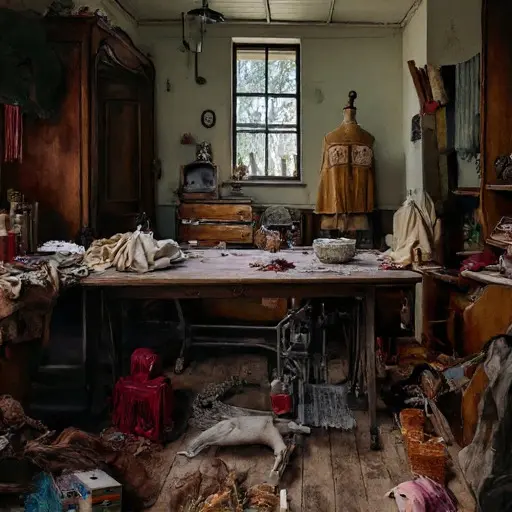
Eleanor Brant, a milliner by trade and later the widow of a modest textile merchant, shaped the interior of Veylormere House with her precise habits and guarded hopes. Her workshop once occupied the Front Sewing Room, where she stitched velvet trims and feathered facings for clients who admired her meticulous taste. Letters found in a ribbon-worn box record her steady business, her fondness for warm lamp-lit evenings, and her devotion to her only son, Thomas. She favored floral wallpapers, practical oak furniture softened with embroidered runners, and shelves arranged by height rather than theme.
Yet the correspondence also reveals her encroaching apprehension. A series of invoices—unpaid, folded with increasing tightness—marks Thomas’s struggle with mounting debts. Eleanor kept receipts sorted into envelopes labeled by month, her handwriting growing shakier as obligations rose. When Thomas left abruptly to seek work elsewhere, her entries ceased almost overnight. The domestic order she preserved for decades began fraying in noticeable increments: sewing supplies left unsorted, dishes left to dry without polish, newspapers stacked with no intention to reread. The house’s decline mirrors her own exhaustion, recorded not in drama but in soft neglect.
Corridors of Paper Trails and Unfinished Chores
The long central hallway forms the spine of the house’s inward collapse. The runner rug, once pinned neatly with brass rods, is now rucked into soft folds where the boards beneath have heaved. A series of hooks near the archway still holds Eleanor’s shawls—some mended, some frayed beyond use. A chipped ceramic bowl on a side table contains keys with no labeled purpose. Household ledgers lie open to blank pages, indicating a routine she meant to resume but never did.
The Pantry of Withheld Plans
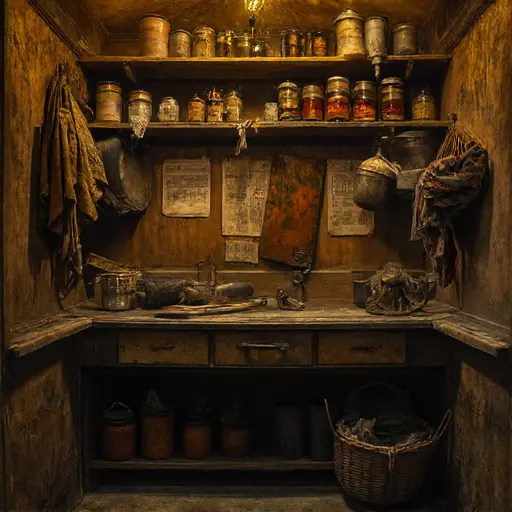
Past the dining room sits a small pantry whose cramped shelves bear witness to Eleanor’s waiting. Canning jars with clouded glass hold preserves long discolored; a handwritten recipe for plum cordial remains pressed beneath a milk-glass paperweight. A wicker basket still contains sewing scraps intended for a quilt she never finished.
Veylormere remains untouched, its rooms fully furnished yet unmoved, a quiet ledger of intentions paused mid-task. The house holds its stillness without resolution, continuing to settle inward, day by day, into the soft gravity of its own abandonment.