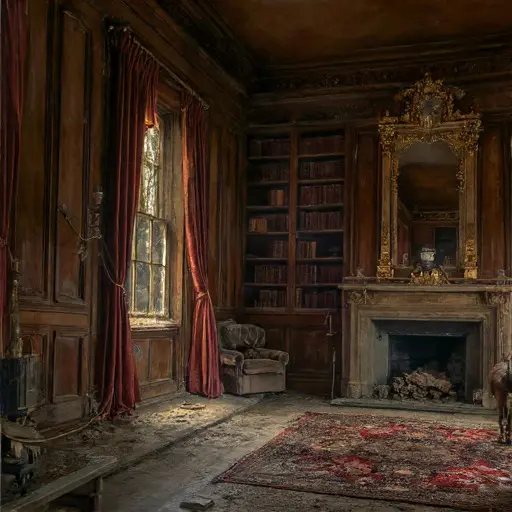
The moment I stepped into the front parlor of Verriton Hall, the word forgotten settled like plaster dust in my throat. Time had not merely passed here — it had congealed. The air was heavy with stale perfume and scorched gaslight, the scent of neglect soaked deep into every drape, cushion, and threadbare carpet.
I moved slowly, careful not to disturb the silence.
Built in 1874, the mansion was commissioned by Dr. Augustus Merren Verriton, a Cambridge-educated physician known for his early work in neurological disease. Verriton Hall was his sanctuary — and his prison. The estate’s decay has been absolute since it was shuttered in 1936, but the lives once lived here remain painfully traceable through ledger pages, overturned chairs, and worn-through carpets. No restoration was ever attempted. No heir returned.
The Physician in the Hall
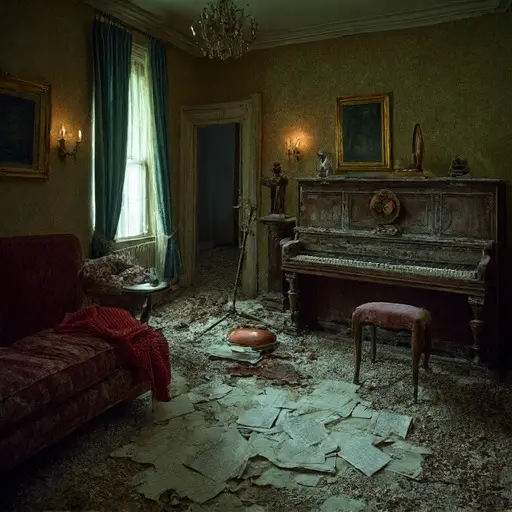
Dr. Augustus Merren Verriton was a man of method and sorrow. Letters found in the Green Library reveal a brilliant mind obsessed with control — over his household, his practice, and later, his own failing mind. Married to Clara Albrecht Verriton, a pianist from Bonn, the couple lived in tense silence after the stillbirth of their only child, which occurred in the West Nursery during a snowstorm in 1891. From that point forward, Clara rarely left the Music Room, where her final composition, “Étude pour L’enfant,” still sits unfinished on a cracked upright piano.
Dr. Verriton’s private study, sealed behind a double-locked brass door, was discovered in the 1970s during an illegal architectural survey. Inside were handwritten case notes, dissection diagrams, and — most disturbingly — journals chronicling his own descent into vascular dementia. His last entry, dated June 11, 1933, reads: “I have moved the clock hands to keep the house still. The child waits.”
Forgotten Dust in the Music Room
Decline Behind the Study Door
By the early 1930s, servants had all departed. Their rooms remain cluttered with newspapers, cracked basins, and empty cupboards. In the Servants’ Corridor, copper bells labeled “Master Room,” “Green Library,” and “Nursery” hang silent. Dust patterns suggest none have rung since at least 1934. The dumbwaiter still holds a tray of untouched scones — hardened to stone.
Inside the Master Bedroom, an untouched bed is coated in mildew. A physician’s coat, frayed and thin, hangs behind the door. In the drawer of a side table sits a silver watch, still ticking weakly, its engraving: To Augustus — May Time Heal All.
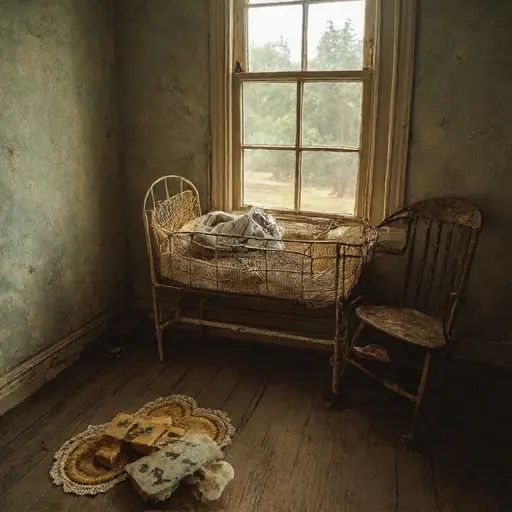
Most telling is the West Nursery, locked from the inside. The door’s brass knob is tarnished black. When opened, it reveals toys scattered mid-play — a porcelain doll with one eye, a rattle shaped like a swan, and a cradle lined with now-yellowed linen. Mold blossoms across the ceiling. The room smells of talcum and rot.
The Forgotten Note Beneath the Cradle
Today, Verriton Hall remains untouched — gated by rusted chains, protected by disinterest, and surrendered by time. The estate is absent from heritage registries. No family has claimed it. No local speaks its name aloud. And so, the dust gathers, the watch ticks faintly, and the rooms of Verriton Hall continue to forget — slowly, completely, forever.
