The Haunting Order of the Bellamy House
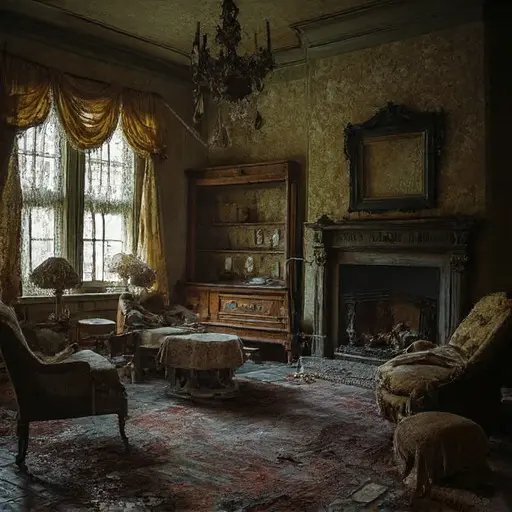
The dust here does not settle — it clings. Thick on every curled paper, along the seams of every overstuffed chair, in the woven roses of every long-rotted rug. The Bellamy House remains sealed by time, its air unmoved by wind or voice.
Each step into the rooms disturbs a thousand unmourned memories, its silence haunting not because of what it contains, but because of what it stubbornly remembers.
The smell is dry and sweet — old fabric, dried ink, faint mildew. Wallpaper curls inward like pages too long left unread. The house yields nothing quickly. It gives only clues: a brooch wedged between floorboards, an envelope sealed but never sent, a ledger opened to an unfinished entry.
There is no electricity. There is no light but what filters softly through torn fabric shades. What remains is not display — it is residue. The sediment of life once lived in full. One must read it as one reads the margins of an old diary: slowly, reverently, with care not to destroy the evidence of the ordinary.
The Needlepoint Legacy of Eleanor Bellamy
Eleanor Agnes Bellamy was born in 1861, and by 1885 she ruled this house in quiet discipline. The wife of Dr. Franklin Bellamy, a country physician with connections in Albany, Eleanor bore three sons in quick succession and managed the home with fastidious precision. She embroidered initials into every bedsheet, recorded each pantry inventory by hand, and insisted on silence after supper so the doctor might rest.
Letters found bundled in the sewing room chiffonnier reveal her anxieties — the price of coffee, the frailty of her second son, Thomas, and a quiet resentment at the increasingly erratic hours kept by her husband. She marked time in stitches, rows upon rows of lace-fringed antimacassars still resting on the chairs where no one now sits.
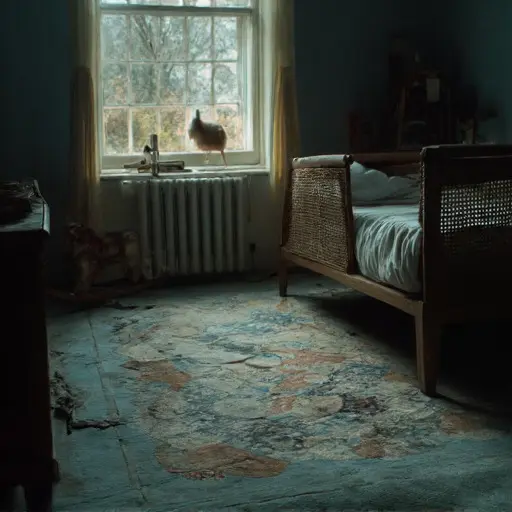
The nursery bears her fingerprints most plainly. A child’s quilt, each square hand-sewn, remains folded atop a wicker crib. A wooden rocking horse with one eye missing. A basket of mending, untouched. A final letter dated October 19, 1899, lays beneath a thimble: “He will not return by winter. I shall not stitch another season alone.”
Franklin never came back. Rumors said debts, or perhaps another woman in Albany. Eleanor stopped writing after that letter. She died in the master bedroom during a thunderstorm in 1910, the bed untouched by another since.
A Haunting in the Dining Room Molding
The dining room remains set for a meal that never arrived. A lace runner, stained with ink or wine, trails off the table. The heavy oak sideboard drawers are jammed with forgotten telegrams and silverware now tarnished to a dull gray-green. Beneath the table, a child’s fork lies wedged into the floorboards, never retrieved.
One letter, addressed to “Dr. Franklin Bellamy, c/o Bingham Hotel,” was never opened. The ink has faded, but the hand is Eleanor’s. Scrawled beneath in a second script: “Return refused — not at this address.”
The family’s decline was neither sudden nor cinematic. The eldest son died in the influenza wave of 1918; the middle boy disappeared into debt. The youngest, Richard Bellamy, inherited the house but never lived in it. Records show him residing in a series of boarding houses in Troy. A ledger in the study records failed attempts to sell the property through 1934, then ends abruptly.
Forgotten Drawers of the Second-Floor Linen Closet
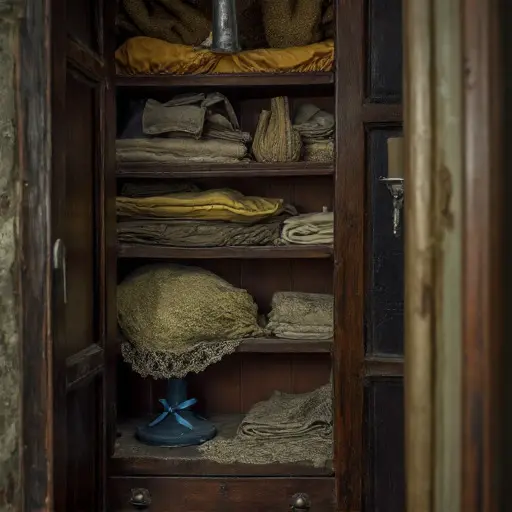
The upstairs linen closet remains shut tight, but the door gives with pressure. Inside, a chaos of folded and unfolded sheets, mildewed blankets, and half-used candles in rusted sconces. One drawer holds a brittle newspaper from 1921, another a girl’s braid tied with a blue ribbon. There was no daughter recorded in the census — only sons.
A monogrammed hairbrush. A note signed “C.L.” and nothing more. Whose things were preserved here, secreted in this silent alcove, will remain unanswered.
The Final Ledger in the Study
The study remains the most intact. A heavy desk, its leather top warped with time, holds a thick ledger. The entries detail coal deliveries, doctor’s appointments, correspondence sent. The final page is only a date: March 3, 1934.
On the floor beneath the desk: a bundle of keys, a torn cufflink, and a hand-drawn map of the cellar. There is no evidence anyone returned after that.
The house did not collapse. It faded. Dust, cloth, silence. No trespass, no looting. Just a house slowly absorbing the years.
The Bellamy House remains abandoned still.