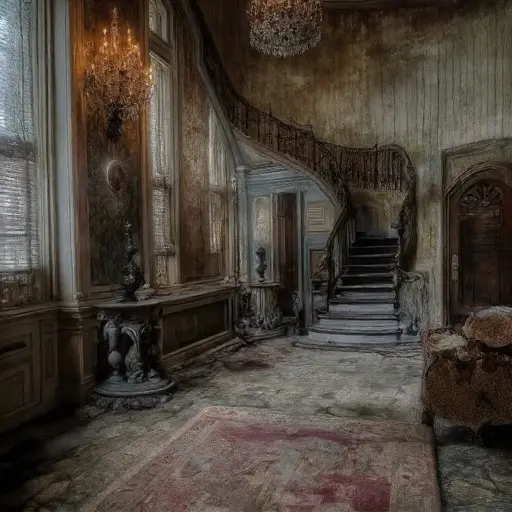
Nothing stirs in Grinmere House. No breeze enters. No scent escapes.
It is a sealed place, not by design, but by the slow consequence of years unvisited. The rooms have not decayed violently — they have simply congealed into silence, layered in sediment fine as ash. Objects remain not where they were dropped, but where they were last used — and never touched again.
Dust coats everything, not in haste but with solemnity. It has settled into the stitching of upholstery, pooled in the folds of curtains, and dulled every frame, knob, and key. The dust-locked quality of Grinmere is not neglect. It is time without witness.
Elias Dorring and the Quiet Collapse of Routine
Elias Abraham Dorring, born 1862, was a customs broker for the Port of Boston. In 1892, flush with inheritance and ambition, he constructed Grinmere House on a wooded slope miles from town, seeking retreat for his wife Evelyn and daughters Alice and Ruth. He was precise, conservative, and deeply fond of repetition — breakfast at 7, letters answered at 9, an evening cigar in the smoking room at 8:15 sharp.
His wife’s decline began in 1904, with entries in her daybook growing sparse and then ceasing. By 1907, Elias had hired no less than three private nurses. All left. Evelyn passed away in the yellow sitting room, the cushions of which remain sunken where her chair still waits.
The girls never married. Alice left for New York in 1911 and did not return. Ruth remained until 1924, then vanished from record. The housekeeper, Mrs. Eames, wrote a final letter to a solicitor, found unsent in a locked bureau: “He still sits in the smoking chair every evening, waiting for someone. I no longer light the fire.”
The Locked Cabinet in the Yellow Sitting Room
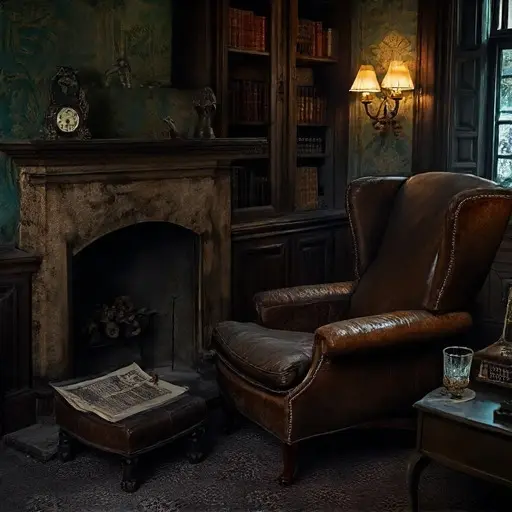
The yellow sitting room was once Evelyn Dorring’s private retreat. Pale yellow wallpaper with a fleur-de-lis pattern still clings to the walls, though in some places it has bubbled from damp. Her sewing basket remains beside a narrow settee, threads still knotted around rusting needles. The gramophone, covered in lace, still holds a record cued to play. The cushion of her armchair is heavily indented, with one button popped loose.
A small walnut cabinet sits beside the window. It is locked. Inside, as discovered by local surveyors in 1971, were Evelyn’s diaries — entries filled with repetition: “he left the bread out again,” “Ruth will not speak at dinner,” “no letter from Alice.” The final page reads: “Dust on the windows. I will not clean it anymore.”
A Final Envelope on the Upper Landing
At the top of the stairs, just outside Ruth’s old room, lies a sealed envelope marked “To be read only by the last to leave.”
It has never been opened.
No death records exist after 1932. No heirs claimed the property.
Grinmere House remains registered but uninhabited.
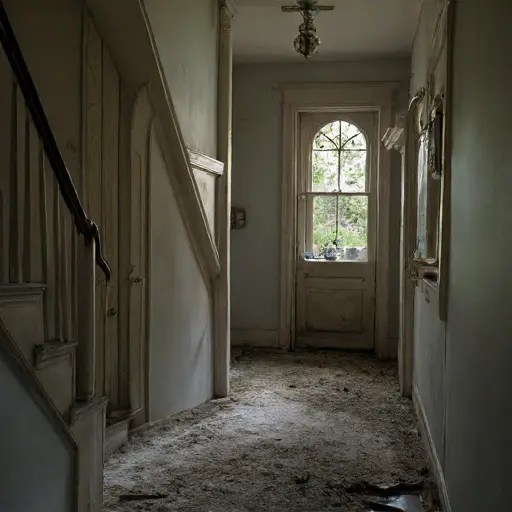
Grinmere House stands sealed by habit and silence.
It remains abandoned.
