The Silent Quarters of Eldhollow House
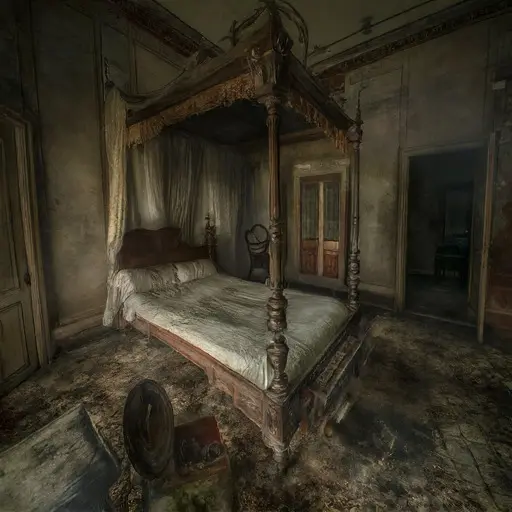
Eldhollow House does not creak. It exhales — long, slow, and nearly imperceptible. Each room lies sealed in a kind of dignified neglect, the air thick with forgotten routines and unspoken endings.
This is no ruin picked over by time; it is a residence holding its last pose. Dust here does not float — it rests, settled like ash across every polished surface, undisturbed for nearly a century.
The silence is absolute. A silence built not from fear, but from absence. From letters never answered, meals never served, keys never turned again. In Eldhollow House, lives ended not in fire or scandal, but in the quiet disintegration of habit.
Lillian Greaves and the Measured Dismantling of a Life
Lillian Esther Greaves was born in 1866 to a family of modest publishers in Baltimore. She married Archibald Greaves, a railway accountant, in 1889 and settled in the newly built Eldhollow House two years later. Records show a life of structured routine: Sunday dinner parties, piano recitals in the east hall, and precise housekeeping noted in her journals, several of which remain stacked in the drawing room cabinet.
Lillian had no children. Her letters to her sister Clara — still tied in twine inside a red biscuit tin — mention miscarriages only in coded lines: “The nursery remains quiet again this spring.” As the years passed, her handwriting changed. By 1918, the script is tight, repetitive, compulsive. Notes about the arrangement of the linen closet, the polish brand for the bannisters, the hour of the milkman.
When Archibald died of stroke in 1922, Lillian reportedly locked the front parlor and never entered it again. The room remains sealed, its door swelled shut from moisture. Her final journal entry, dated March 3, 1931, reads only: “The house listens.”
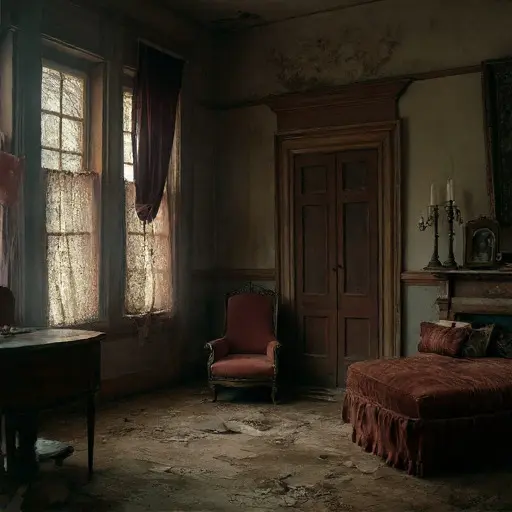
The Linen Room and Its Unopened Packages
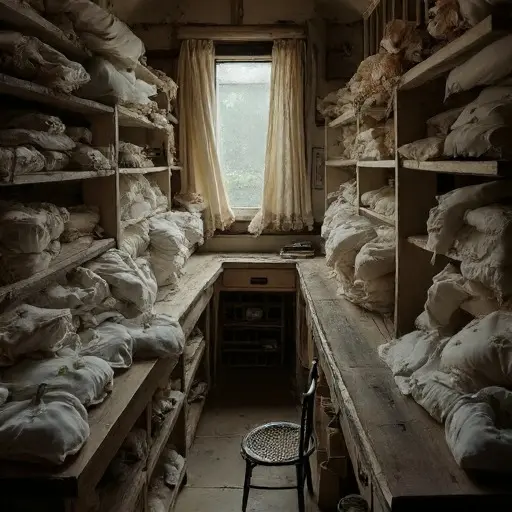
On the second floor, behind the servant’s stair, a small linen room reveals an unsettling sense of paused intent. Lillian’s obsession with order reached its peak here. Dozens of shelves hold precisely folded bundles wrapped in paper and twine. Some are labeled — “Guest Towels – East Wing,” “Spring Table Linens,” “Archibald’s Dressing Gowns.” Others remain anonymous.
A brass clipboard hangs on the wall with an inventory chart that ends abruptly in 1930. A soapstone dish contains dozens of keys, none labeled. In a drawer beneath the counter, pressed sachets of lavender still faintly emit fragrance when crushed.
The room smells faintly of old starch and lavender, sweet and sterile. The only disturbance: one package partially opened, revealing child-sized bedsheets embroidered with tiny birds. No child ever lived here.
The Silent Ledger in the Butlers’ Pantry
Within the butlers’ pantry, tucked behind a wall panel, is a ledger kept in Lillian’s hand. It lists deliveries, guests, correspondence, and notes on tea preferences. The final entry reads: “No callers this week. No bread ordered. No reply from Clara.”
She died three months later, alone in the house.
Eldhollow House remains, sealed not by force, but by meticulous hands that never returned.
It remains abandoned.