The Quiet Catastrophe of Veridian’s Ascent
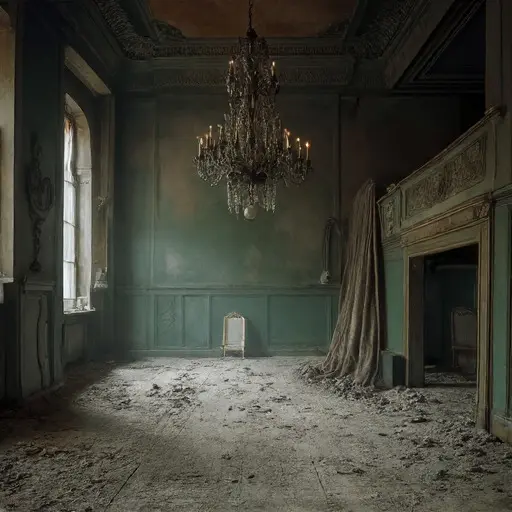
The atmosphere inside Veridian’s Ascent is heavy, cold, and intensely motionless, saturated with the dry, coppery scent of old velvet and the pervasive dust of slow ruin. The Main Entrance Hall is an immediate declaration of arrested time. A massive, intricately carved hall table stands near the sweeping staircase, upon which rests a bronze tray holding a scattering of brittle, yellowed calling cards, their corners curled, all addressed to the house’s owner.
The entire house serves as the silent, unedited chronicle of Arthur Veridian, a man whose life was defined by his obsession with public adoration and his final, catastrophic emotional collapse.
Arthur Veridian’s Vain Quest for Adoration
The proprietor who sealed the house’s fate was Arthur Veridian (1862–1914), a hugely popular but deeply insecure stage actor and theater owner. His profession was public performance and the command of attention; his personality was defined by intense charisma, a relentless need for applause, and a profound, secret sense of emotional emptiness. His social role was the celebrated artist and generous host, living with his quiet, supportive wife, Clara. Arthur’s single, all-consuming fear was the loss of his public adoration—the moment the applause stopped and he was left alone with his own identity.
The house, completed in 1908, was a lavish personal stage. The Ballroom and the Second Floor Salon were built on an immense scale to host society events that he used solely to bask in public attention. The house’s tragic decline began in 1913 when a disastrous, experimental play he wrote and starred in failed spectacularly, leading to widespread critical condemnation and financial ruin for his theater. His response was to retreat entirely into a feverish state of denial. He started spending hours alone in the Third Floor Costume and Memorabilia Room, a space filled with old, elaborate stage costumes and promotional materials, compulsively rearranging them—a futile, physical attempt to restore his lost fame.
The Untouched Script in the Salon
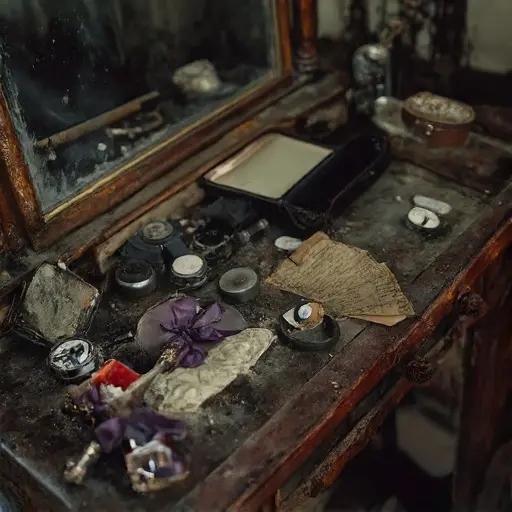
The most poignant evidence of Arthur’s internal collapse is located in the Second Floor Salon. On a delicate, inlaid writing desk, a leather-bound script rests open. It is the manuscript of his failed play, heavily annotated in his own hand, with the final page—containing the climax of the piece—torn violently in half. The broken script, covered in a permanent layer of dust, is a silent testament to the extreme self-hatred and disappointment that consumed him.
Clara’s Wedding Band in the Drawer
The final, catastrophic rupture occurred in the late autumn of 1914. Clara, utterly exhausted by her husband’s narcissistic withdrawal and the crushing debt, prepared to leave. Evidence of her final departure is found in the Master Bedroom. On the nightstand, a small, dark wooden jewelry box sits open. It is otherwise empty, save for a single, small, plain gold wedding band, placed neatly in the center of the velvet lining. Clara left the house that night, taking the children and a small valise, refusing to take the ring, a final symbol of a marriage that had been destroyed by her husband’s self-obsession. Arthur Veridian was found dead in the Costume Room the next morning, having succumbed to a sudden, fatal overdose of sleeping draught.
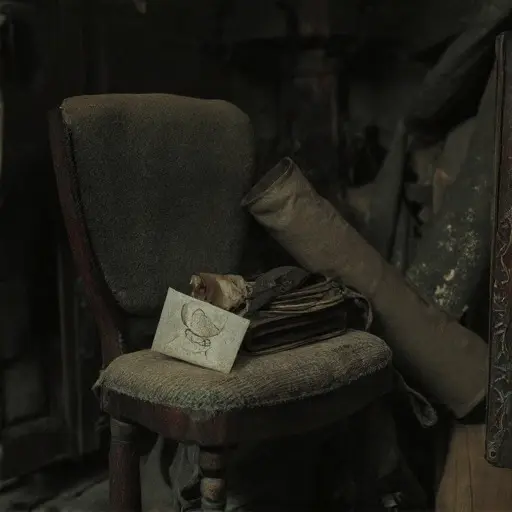
Clara was notified of her husband’s death but refused to re-enter the house, stating she could not face the scene of his final, self-imposed tragedy. She immediately signed over all claims to the house and its contents to the creditors. The bank seized Veridian’s Ascent in 1915, but due to the public scandal and the vast size and cost of the maintenance, it was deemed legally unsalable. The receivers simply secured the imposing doors and walked away. Veridian’s Ascent stands today, every room holding the material record of a life consumed by its own overwhelming, devastating fear of obscurity, forever silent and abandoned.