The Silence of Ironbound Sepulchre

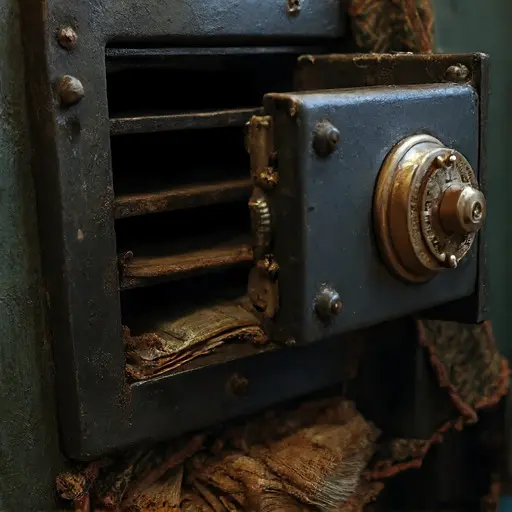
The air inside the Ironbound Sepulchre is intensely cold, a dense, particulate silence saturated with the dry, metallic scent of rusted steel and aging vellum. The Entrance Foyer is a formidable space, its massive, stone-tiled floor entirely masked by a thick, undisturbed carpet of fine grit. A large, antique, cast-iron strongbox, too heavy to move, stands bolted to the floor beneath the staircase, its surface heavily oxidized.
The entire house serves as the silent, unedited chronicle of Baron Edmund Ironbound, a man whose life was a ruthless pursuit of control, ultimately ended by the single, unexpected truth of his own private failure.
Baron Ironbound’s Financial Fortress
The proprietor who sealed the house’s fate was Baron Edmund Ironbound (1860–1913), a wealthy, deeply conservative industrialist and financier. His profession was the management of immense capital and factories; his personality was defined by an unshakeable adherence to financial prudence, absolute secrecy, and a chilling emotional distance. His social role was the unyielding, powerful patriarch, living with his wife, Cecilia, and their two adult daughters. Edmund’s single, all-consuming fear was the collapse of his financial security—the public discovery that his vast fortune was far more fragile than his reputation suggested.
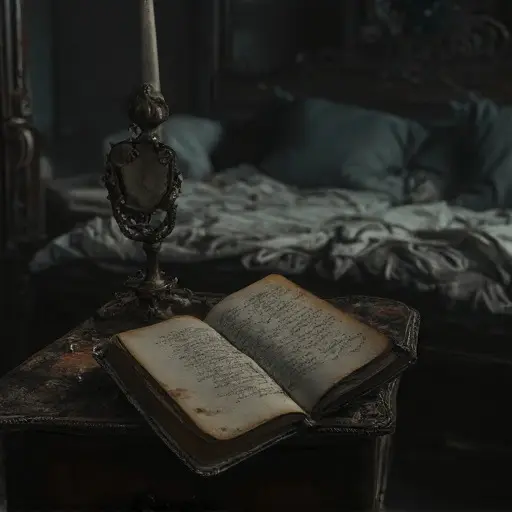
The house, completed in 1902, was built as a fortress. The Ground Floor Study contained his private archives and was protected by heavy, iron-clad doors, giving the house its name. The house’s tragic decline began with a series of massive, poorly hedged investments in an overseas war, which failed spectacularly in 1912. His response was a total, silent retreat. He started spending all his time in the Study, furiously working to conceal the catastrophic loss. The Master Bedroom was left untouched, his life now confined to his financial defense.
The Stack of Blank Letters in the Desk
The evidence of Edmund’s final, desperate state is found on the main desk in the Study. Here, amidst the chaos of loose papers, lies a neat stack of twenty sealed envelopes, each addressed to a different financial associate or business partner. When opened, the envelopes are found to contain only blank pages—a silent, final refusal to communicate the ruin or ask for help, a desperate measure to maintain control through silence.
Cecilia’s Music and the Final Note
The abandonment was total and immediate. Cecilia Ironbound, his wife, knew of the mounting anxiety but nothing of the financial failure. Evidence of her final days rests in the Music Room. On the open, dust-coated grand piano, a single sheet of music rests—a difficult Schubert sonata she was practicing. Tucked beneath the sheet music is a small, tightly folded, handwritten letter addressed to Edmund from his bank, dated the morning of his death, curtly stating that the final collateral had been exhausted. Baron Edmund Ironbound was found dead in his Study that same afternoon in 1913, having suffered a fatal aneurysm while working.
Cecilia and her daughters were notified of the death and the immediate insolvency by the bank. They retrieved only their clothes and immediately left the county. Cecilia refused to re-enter the house, stating she could not face the magnitude of his secret failure. The bank seized the Ironbound Sepulchre in 1914 but, due to the complexity of the overseas debts and the house’s association with a financial scandal, it was deemed legally unsalable. The receivers simply secured the imposing doors and walked away. The Ironbound Sepulchre stands today, every room holding the material record of a life utterly destroyed by an unbending fear of financial exposure and a catastrophic loss of control, forever silent and abandoned.