The Eerie Quiet of Veridian Croft
The air inside the Veridian Croft is heavy and cold, a peculiar mixture of dry dust and the faint, sweet-sour scent of mildewed textiles. It is the atmosphere of a space hermetically sealed by time, its contents preserved in a state of irreversible suspension. The Entrance Vestibule features an original, hand-painted ceiling fresco, now obscured by a cobweb of cracks and a chalky haze of plaster particulate.
A tall, darkened mirror on the wall reflects only the gloom and the stillness, showing no trace of the life that was once reflected within. The floor is lined with geometric mosaic tiles, where a solitary, overturned bronze boot-scraper rests, a small piece of order disrupted a century ago, symbolizing the chaos that consumed the life of Elias Veridian.
Elias Veridian’s Fear of the Future
The house was the creation of Elias Veridian (1845–1902), a retired railway magnate whose profession gave him immense wealth but left him deeply suspicious of modern trends and technology. His social role was the ultimate conservative; he believed his family’s security rested on preserving the past. Elias’s central character trait was a paralyzing, irrational fear of the future, specifically the impending 20th century and its accompanying social and technological upheavals. He systematically collected 18th-century furniture, art, and books, making his house a kind of luxurious, self-imposed historical quarantine.
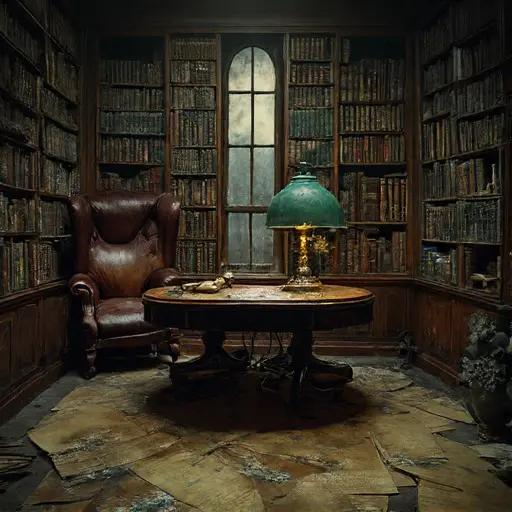
The Veridian Croft was therefore designed to resist change. The Formal Parlor and Dining Room were furnished exclusively with pieces predating 1800, creating an atmosphere of deliberate, heavy antiquity. Elias’s habits revolved around his private archive, the Library, where he spent hours cross-referencing old almanacs and diaries, convinced he could divine the stability of the future by studying the past. The house’s final, tragic change began with the death of his beloved wife, Clara, in 1900. Her absence destroyed his last emotional anchor, turning his conservative anxieties into a debilitating obsession with self-preservation, which he executed by entirely withdrawing from the world.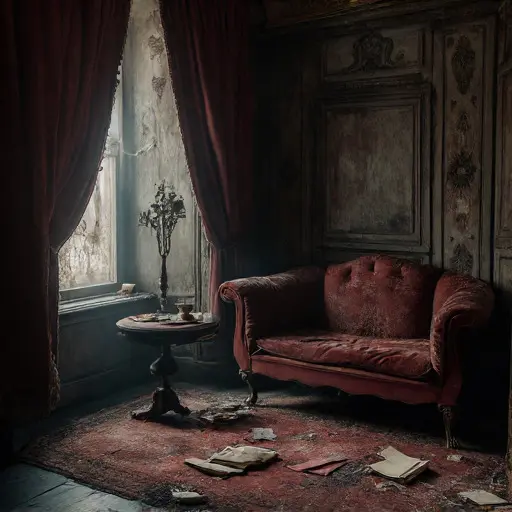
The Untouched Tea Service in the Boudoir
The most powerful evidence of the final, sudden abandonment rests in Clara’s Upstairs Boudoir. Elias, after his wife’s death, refused to allow any change to the room. On a small, inlaid writing desk, a partially written letter to Clara’s sister remains, the ink dried mid-sentence. The ultimate detail, however, is the tea service: a complete set of Wedgwood china rests on a tray in the corner, covered in a thick layer of dust. The sugar tongs are still positioned over the bowl, the tea leaves are dried solid in the bottom of the teapot, suggesting the service was simply prepared and then never used again—a ritual suddenly, violently broken.
The Sealed Closet in the Hall
After Clara’s death, Elias’s fear of the modern world intensified into a mania. He became convinced that the new century was bringing a plague. His final, desperate act, evidenced in the Upstairs Hallway, was to seal off a small linen closet near the master bedroom. Using rough carpentry and heavy bolts, he turned it into a temporary storage space for preserved foods and water, preparing for a self-imposed quarantine. Inside the sealed closet, now easily pried open, are dozens of tightly canned provisions, rusted solid, and a heavy family bible opened to the Book of Revelation. Elias Veridian died alone in his bed in 1902, not from a plague, but from heart failure brought on by anxiety and malnutrition.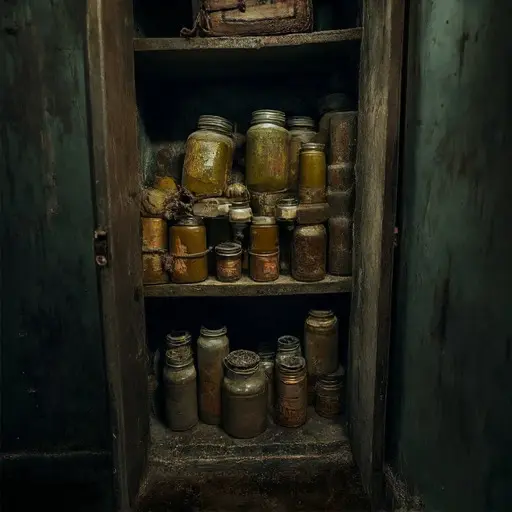
Elias had no direct heirs other than his deceased wife’s estranged family, who considered the estate a liability due to its remote location and vast maintenance requirements. They sold the property to a holding company without ever setting foot inside. The company simply locked the doors and ceased payment on the taxes in 1904. The Veridian Croft remains, its rooms perfectly preserved time capsules, still waiting for the catastrophic future that Elias feared to arrive, forever forgotten by the world he tried so desperately to escape.