Echoes of Ruin in Cendrillon Tower
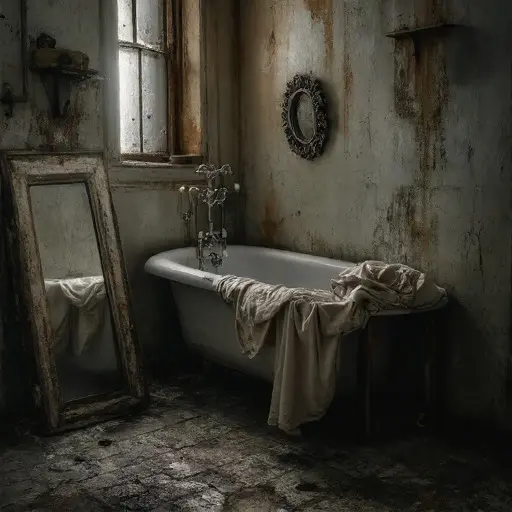
The silence within Cendrillon Tower was not merely stillness; it was an absolute, brittle vacuum, easily shattered by the smallest sound of decay. Stepping into the Ground-Floor Receiving Room was like entering a photograph long since turned sepia. The heavy velvet curtains were not merely dusty, but stiffened with decades of grime, locking the room in perpetual twilight.
The air, heavy with the scent of stagnant water and decaying plaster, seemed to cling to the elaborate, though now heavily water-stained, wall coverings. This mansion’s story was one of forgotten luxury and the sudden, unceremonious collapse of a carefully constructed social facade.
Alistair Shaw: The Financier of Form
The master of the house was Alistair Shaw, a highly successful stockbroker in the 1890s whose entire existence was dedicated to maintaining appearances. His wealth was newly acquired, and his greatest fear was the taint of the nouveau riche. His temperament was precise, nervous, and utterly dependent on social approval. He treated the house as his greatest asset, a physical proof of his belonging. He married Victoria, a woman known for her keen eye for art and design, and they had one daughter, Elara.
Alistair’s preoccupation with form is best seen in the West-Wing Gallery, a room he dedicated to displaying his hastily acquired collection of minor Dutch masters. His Ledger of Acquisition, found beneath a chipped marble bust, details not the artistic merit of the pieces, but the price paid and the name of the previous owner, revealing his true motivation: establishing pedigree. His greatest ambition was to secure a baronetcy, a final turning point of social ascent he chased relentlessly.
Elara’s Small, Defiant Room
Victoria Shaw found her life consumed by the endless task of curating her husband’s social image. She poured her genuine creative energy into their only daughter, Elara. The turning point of her defiance is preserved in Elara’s Small Bedroom—a top-floor room deliberately left unadorned by Alistair for lack of social significance.
This room, unlike the formality below, is full of life and art. The walls are covered not in silk, but in Elara’s own vivid charcoal sketches and watercolor portraits. On a small, paint-spattered artist’s easel, a canvas remains, depicting a sharp, unflattering portrait of Alistair. Hidden beneath a stack of colorful scarves in a wicker basket is Victoria’s private Sketchbook, filled with designs for theater costumes—an unfulfilled dream of escape into a world of pure, unconstrained color. The final pages contain frantic, dark sketches detailing her growing fear over Alistair’s desperate financial maneuvering to secure his social title.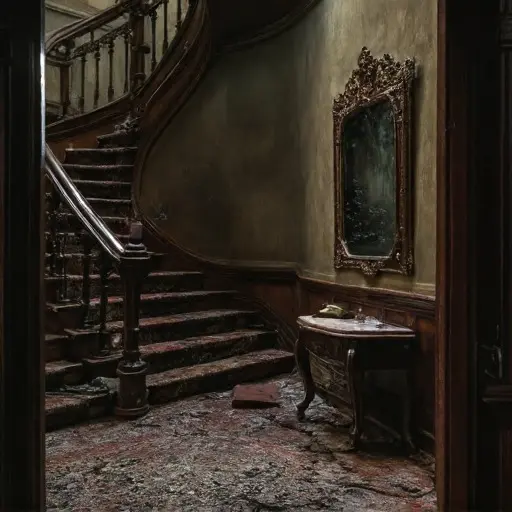
The Debt in the Billiard Room Safe
Alistair’s obsessive pursuit of the baronetcy led to reckless speculation, and the market crash of 1907 struck him with terminal force. He lost everything, but his pride prevented him from admitting his ruin. The final, brutal turning point is found in the Billiard Room, a space dedicated to male social rituals.
Concealed behind a loose section of the wainscoting near the hearth is a small, fireproof Wall Safe. Inside is not cash, but a single, folded, official document: a Warrant for Arrest for Fraud, dated January 1908. He had used client funds to buy influence. Faced with imminent public ruin and jail, Alistair did not confess or seek pardon. He simply left the mansion in the middle of the night, leaving his wife and daughter behind, abandoning his entire elaborate life and all his possessions.
Victoria and Elara found the warrant the next morning. Recognizing the finality of their social and financial ruin, Victoria took her daughter and left the house that same day, taking only Elara’s sketchbook. She locked the front door on the contents, knowing the mansion was instantly forfeit to the state and creditors. Alistair was never found. Cendrillon Tower stands today, utterly full, its luxurious interiors an eerie archive of a perfect life that was never real, now forgotten in the deepening dust.