The Eerie Dust of Veridian Hold
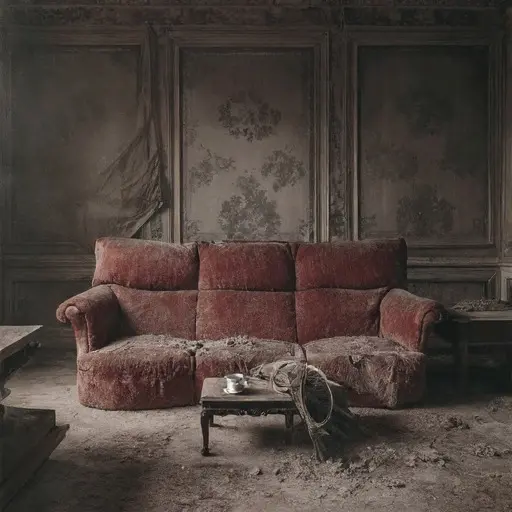
Stepping into the Veridian Hold was less an entrance and more a physical confrontation with silence. The atmosphere in the Main Hall was cold, dense, and utterly forgotten. The polished hardwood floor was visible only in patches, obscured by decades of fallen plaster, dust, and the skeletal remains of what had once been richly textured oriental rugs.
The mansion’s silence was absolute, amplifying the small sounds of the structure itself: the creak of settling timbers, the faint, repetitive drip of water somewhere deep within the walls. The house contained a narrative written not in journals, but in the material decay of its fixed objects—furniture, fabrics, and the stubborn persistence of personalized clutter.
Arthur Penhaligon: The Architect of Anxiety
The master of the house was Arthur Penhaligon, a third-generation textile mill owner in the 1890s whose wealth was built on the sweat of thousands. His character was defined by a paralyzing fear of failure. He saw every thread of his business—and his home—as a potential point of unraveling. His public role was one of unwavering confidence and civic leadership, but privately, he was consumed by detail. His wife, Beatrice, was a vibrant woman whose light was slowly dimmed by Arthur’s control. They had two young daughters, Iris and Flora.
Arthur’s Personal Study—a cramped, overly serious room lined with dark oak—was his sanctuary and his prison. Here, surrounded by heavy, locked file cabinets, he would spend nights meticulously calculating his holdings. He obsessed over security. In a wall safe hidden behind a large portrait, we find not cash or jewels, but reams of detailed, handwritten inventories of his entire personal estate, down to the number of teaspoons in the Kitchen. His obsession was not with accumulating, but with the detailed, fearful avoidance of loss.
The Secret Garden Room
Beatrice’s one act of defiance lay in the South-Facing Conservatory, which she secretly dubbed the Garden Room. This was her retreat from Arthur’s suffocating severity. Though the glass roof is now mostly shattered and the temperature inside mirrors the outside world, the room retains the structure of her attempt at life. Her prized collection of Victorian ferns and exotic orchids is long dead, reduced to desiccated husks in cracked terracotta pots.
The turning point of the family’s decline is documented here, not in paper, but in glass. On a rickety iron potting bench sits a small, tarnished silver thimble and a length of embroidered silk fabric, half-finished. Next to it, there is a cluster of small, stoppered glass vials—Beatrice’s amateur attempt at preserving plant cuttings. One vial contains a clear, yellowed liquid and a single, dried leaf. The date etched into the underside of the bench is 1897—the year Arthur’s mill suffered a catastrophic, uninsured fire, obliterating the basis of his wealth and his certainty. The stress immediately crippled Beatrice, who suffered a rapid, unexplained decline in health and died six months later. Arthur’s fear of loss had become a self-fulfilling prophecy.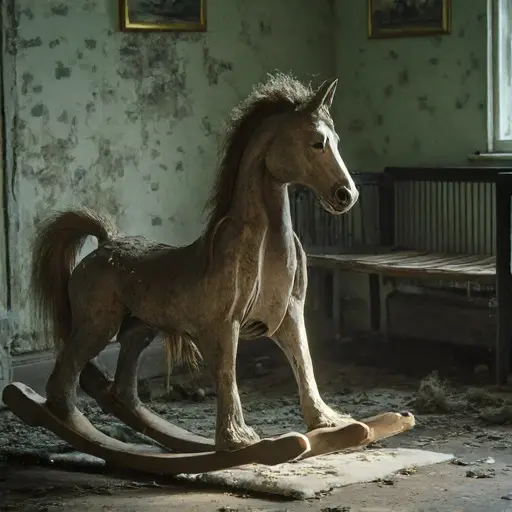
The Ledger of Ruin in the Pantry
After Beatrice’s death, Arthur was financially and emotionally broken. He tried to maintain the illusion of control, moving his fearful inventory efforts to the most domestic of spaces. The final, heartbreaking turning point is found not in the study, but in the Kitchen Pantry. Hidden behind jars of petrified preserves, we find a small, leather-bound book—his final, desperate Study Ledger. This book details not his holdings, but his expenditures on daily necessities—milk, bread, coal—tracking his dwindling cash reserves penny by penny. The entries stop abruptly on a Friday in July 1898.
Arthur Penhaligon was found to have boarded a train to a distant relative’s home, leaving the house empty save for his two young daughters, Iris (age 9) and Flora (age 7), who were briefly found alone in the Servants’ Quarters upstairs, eating biscuits from a tin. Arthur never returned. He left the house and all its contents—including the girls, temporarily—simply because he could no longer calculate the cost of a single day within its walls.
The children were eventually taken by a reluctant aunt, but Veridian Hold was never sold or cleared. It remains locked in its final act of abandonment, every room a complete, heavy inventory of a life consumed by its own fear of loss, now entirely forgotten save for the dust and the deep, abiding silence.