The Final Echo of the Prism-Gleam
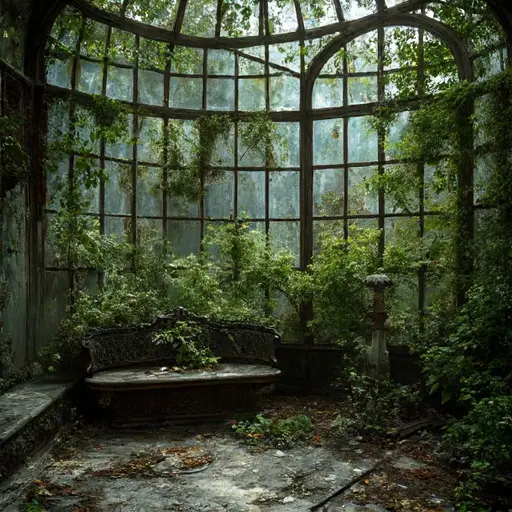
The Prism-Gleam, a sprawling, asymmetrical Neo-Jacobean mansion built in 1895, is defined by its dark red brick, extensive use of classical pilasters, and its long, prominent glass Sunroom. The name evokes the shattered light (prism) and deceptive shine (gleam) of its fragile beauty. To step across its decaying threshold is to encounter an immediate, penetrating coldness and a silence so deep it feels like pressure on the eardrums.
The Sunroom, once a beacon of vibrant life and color, is now a scene of spectacular, shattered decay, a clear statement that the house’s abandonment was not gradual, but absolute and final, leaving only a final echo of its former brilliance. Every rusted iron beam and every cracked pane of glass holds the history of an internal collapse.
The Anxious Visionary, Arthur Leland
The mansion was built by Arthur Leland (1855–1910), a man whose profession was rooted in the methodical, patient science of botany and experimental horticulture. He was not a traditional industrialist but an obsessive scientist, using his inherited fortune to pursue his research. Socially, he was painfully awkward, preferring the company of his rare plants to human interaction.
Arthur married Clarissa Selwyn in 1880, a practical woman who sought a quiet, stable life. They had two daughters: Edith and Flora. Arthur’s personality was defined by chronic anxiety and a compulsive need for order, particularly in his experiments. His daily routine revolved entirely around the Sunroom and the adjacent Laboratory, where he worked to cultivate delicate, temperature-sensitive hybrids. His ambition was to breed a new, resilient species of orchid; his greatest fear was the fragility of his plants and the volatility of the outside world, creating a perfectly controlled environment focused on the outward gleam of his work.
The Sunroom and Laboratory were his entire world, built as twin additions to the house, ensuring a perfectly controlled environment for his work.
The Exposure in the Laboratory
The tragedy that brought down the Leland family was a direct result of Arthur’s professional failure and his crippling anxiety. In 1909, after years of intense, isolated work, Arthur believed he had finally achieved his breakthrough: a new, deep-violet orchid hybrid. He planned a massive public unveiling—a rare venture outside his comfort zone—to secure funding for a research foundation, aiming for the ultimate prism-gleam of success.
However, a visiting scientist, reviewing Arthur’s data in the Laboratory, discovered a crucial, simple error in his temperature logging that invalidated the entire hybrid experiment. The orchid was not a new species; it was a known variant that had been manipulated by the faulty conditions. The failure was not a complex scientific one, but a basic, humiliating oversight caused by Arthur’s own isolation and stress.
The exposure triggered a total mental breakdown. Arthur, unable to face the public humiliation and the total invalidation of his life’s work, returned to the Laboratory. In a final, deliberate act of professional erasure, he methodically smashed every glass vial, every specimen jar, and every piece of scientific equipment in the room. He then walked into the Sunroom and quietly ingested a powerful poison he used for his most destructive pests, dying amidst the shattered light.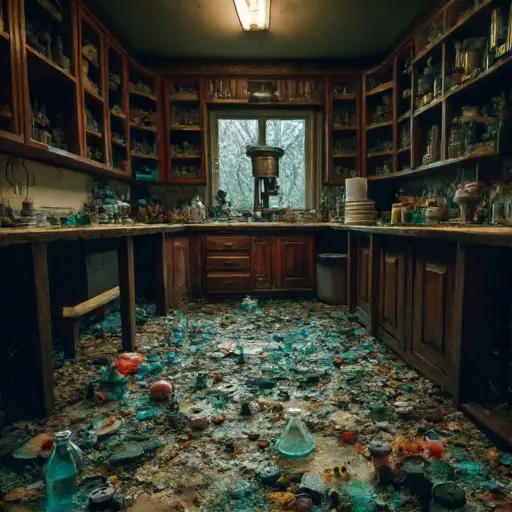
The Abandoned Notebooks in the Nursery
Clarissa Leland, the widow, was left with a wrecked house, the stigma of her husband’s suicide and professional disgrace, and two young daughters, Edith and Flora. She was emotionally annihilated by the years of catering to Arthur’s extreme needs.
She refused to remain in the house for even a week. She immediately sold off only the household linens and tableware to raise enough money for travel and accommodation. She took her daughters and fled to her sister in a different state, leaving the Prism-Gleam entirely full of Arthur’s useless, heavy scientific equipment and his destroyed collection of dead plants.
Clarissa’s final act was one of passive abandonment. She stopped paying the taxes immediately, ensuring the house would quickly become a problem for the authorities.
In the third-floor Nursery, where the two girls were raised, one object remains on the small, wooden desk: a stack of three school notebooks belonging to Edith. The notebooks are filled with her careful, childish sketches of her father’s beloved orchids and detailed, amateur taxonomic notes.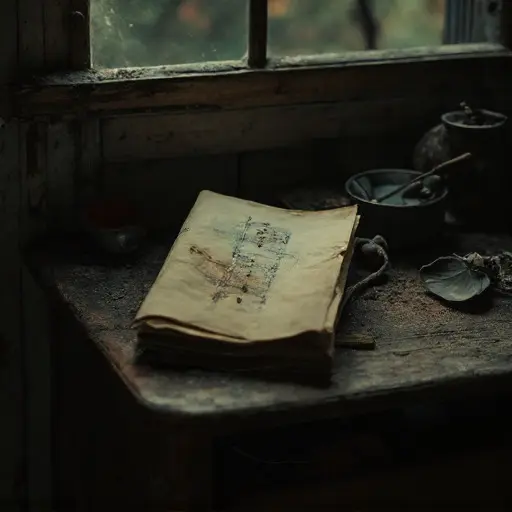
The Prism-Gleam was seized by the state for tax delinquency but proved unsaleable due to the extensive damage in the Sunroom and the contaminated state of the Laboratory. It stands today, its glass roof cracked and its iron skeleton rusting, a vast, eerie monument to a fragile ego and the destructive power of a single, simple, scientific mistake. Its silence is absolute, preserving the final echo of a life destroyed by its own ambition.