The Empty Altar of the Sepia-Strake
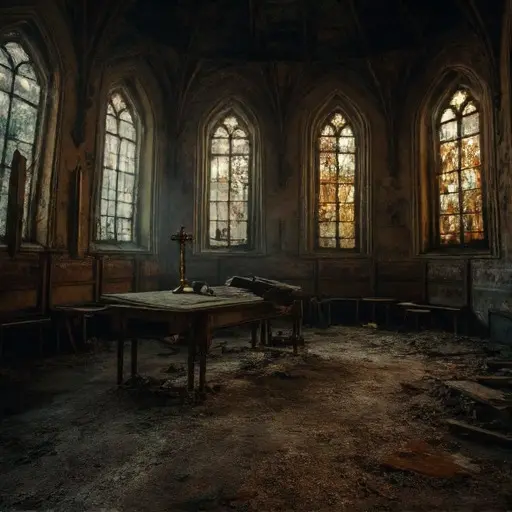
The Sepia-Strake, a formidable structure of dark brick and heavy, carved timber, was completed in 1888, intended to project an image of unshakeable moral and financial rectitude. Its high gables and deeply shadowed cornices give it a look of unrelenting gravity. The name suggests a solemn, sepia-toned streak in the landscape, a marker of somber purpose.
To step into the main hall is to feel an immediate, chilling drop in temperature and an unsettling pressure of silence. The small, private Chapel was the house’s spiritual core, now standing as a desolate echo chamber, its empty altar a chilling statement of a family’s abandonment of its core beliefs.
The Devout Financier, Caleb Thorne
The mansion was built by Caleb Thorne (1840–1908), a man whose profession was high-stakes international finance, a world of ruthless competition that he attempted to balance with fanatical, public piety. Socially, he was known for his generous church donations and his rigid moral codes.
Caleb married Martha Vance in 1865, a woman who sought comfort in their shared faith. They had one child, a daughter named Beatrice. Caleb’s personality was defined by profound hypocrisy; he publicly demanded absolute moral purity while secretly engaging in highly questionable, often illegal, financial deals. His daily routine revolved around morning prayers in the Chapel and afternoon plotting in his heavily secured second-floor Strong Room. His ambition was to achieve immense, unchallenged wealth while maintaining an immaculate spiritual façade; his greatest fear was the public exposure of his sins, thus leaving his faith an empty altar.
The house was his religious fortress. He installed a massive, brass-bound bible on a stand in the Chapel and placed a dedicated, fireproof Confession Box—a small, dark, internal safe built into the wall of his Strong Room—where he kept the signed proofs of his most illegal transactions.
The Revelation in the Confession Box
The tragedy that destroyed the Thorne family was the sudden, public revelation of Caleb’s financial sins, leading to the collapse of his moral authority. Beatrice, the daughter, grew up under the weight of her father’s suffocating moral demands, which contrasted starkly with the cold reality of his emotional detachment.
In 1908, a disastrous market crash jeopardized Caleb’s entire fortune. Facing an impending audit and arrest, Caleb knew he would be ruined. He retreated to his Strong Room to decide which proofs to destroy. Beatrice, observing his panic, saw her opportunity. She had always suspected her father’s hypocrisy. She accessed the Strong Room while he slept and broke into the Confession Box, finding the undeniable, signed evidence of his decades of fraud.
Beatrice immediately delivered the entire contents of the box to the authorities. Caleb, alerted to the betrayal, confronted his daughter in the Chapel. The shock of the total moral and financial collapse, delivered in his sanctuary, triggered a massive, fatal heart attack. He died on the Chapel floor, at the foot of the empty altar.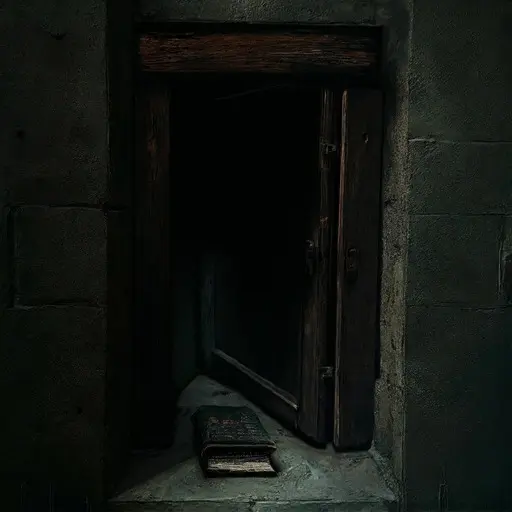
The Abandoned Rosary in the Vestry
Martha Thorne, the widow, was left with a deceased husband, the immediate, total social disgrace of the financial and moral scandal, and a daughter who had betrayed her father (however justified). Martha could not reconcile her faith with the reality of her husband’s life and death.
She immediately disowned her daughter, Beatrice, who subsequently left the country. Martha then walked out of the Sepia-Strake within a week, refusing to sell the house or liquidate the contents. She took only the religious items that were not associated with her husband’s use, leaving the vast, cold house to the state. Her final act was a profound rejection of the place where her husband’s lies were committed.
The Sepia-Strake quickly fell into tax delinquency. The grand home, tainted by scandal, was deemed too costly to restore and remained sealed.
In the small Vestry adjacent to the Chapel, where vestments and prayer books were kept, one final object remains. It is a set of beautiful, antique silver rosary beads, a gift from Caleb to Martha on their wedding day, intentionally left behind on a dusty, bare shelf.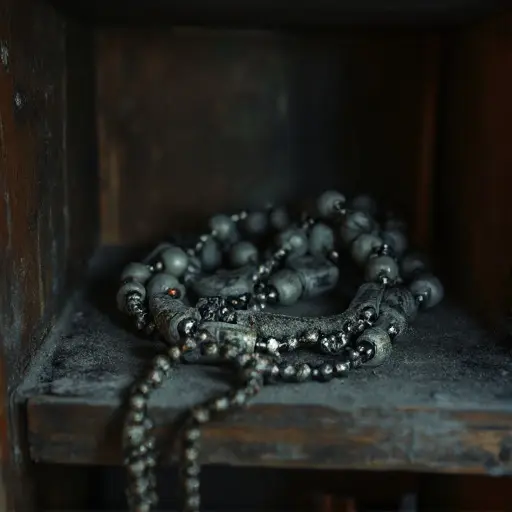
The Sepia-Strake stands today, its dark brick façade a somber sentinel against the sky. Its ultimate silence is the cold, physical fact of the empty altar—the final testament to a man who lived a lie, leaving his family and his fortress consumed by the truth of his hypocrisy.