The Lost Echoes of the Hemlock-Eaves
The Hemlock-Eaves, an elaborate and dramatic structure of Queen Anne and Shingle Style influence, completed in 1893, sits deep within a dense, shaded grove of evergreens. Its complex rooflines and wraparound porch give it a sense of intricate concealment. To step inside is to be met by a cold, dry atmosphere, heavy with the scent of aged wood and dust.
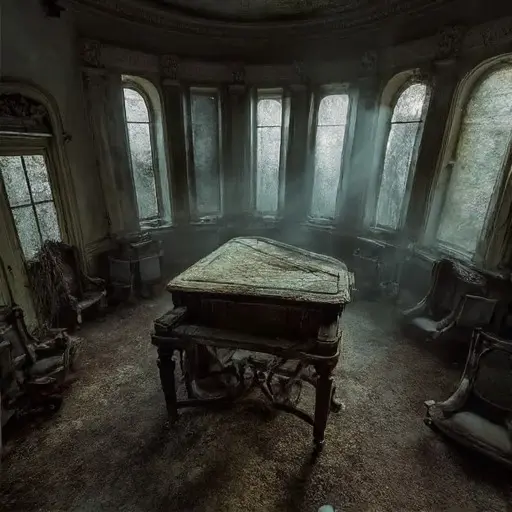
The Music Room, positioned in the largest turret, was clearly designed for performance, but it now holds a profound, absolute silence. Every detail—the dusting of fine gray powder on the piano keys, the mute velvet chairs—speaks of a life suddenly halted and a beautiful ambition permanently lost.
The Obsessed Conductor, Elias Wainwright
The mansion was built by Elias Wainwright (1858–1912), a man whose entire existence was dedicated to music. His profession was that of a renowned orchestra conductor and composer, a role demanding absolute creative control and an ego commensurate with the stage. Socially, he was charismatic but temperamental, a brilliant artist who struggled with the mundane aspects of life.
Elias married Eleanor Thorne in 1885, a dedicated amateur cellist who loved him despite his volatile nature. They had one child, a daughter named Clara. Elias’s personality was defined by artistic obsession; his daily routine was built around composing and rigorous rehearsals in the Music Room. His ambition was to create a single, universally acclaimed opera; his greatest fear was creative stagnation and falling into obscurity.
The Music Room was the heart of the home, built with specialized acoustic paneling. Crucially, Elias insisted on a separate, hidden Sound Vault—a small, air-tight, thickly insulated room off the music room—where he could store his precious, unique orchestral scores and compositions, protecting them from fire or theft.
The Silence in the Sound Vault
The family’s ruin was entirely internal, a tragedy of creative self-destruction. Clara, the daughter, was intensely sensitive and suffered deeply from her father’s emotional neglect, as he focused solely on his music. The pressure to live up to his artistic genius was immense.
In 1912, Elias finally completed his life’s work: the opera, The Aethelred Requiem. The score was his masterpiece, complex and vast. However, the initial reviews from his peers were devastating, panning the work as overly ambitious and technically impossible. The shock was existential for Elias.
The final, fatal act took place in the Sound Vault. Hours after reading the final, damning review, Elias locked himself inside the airtight, insulated room where his opera score was stored. He used a small, portable burner intended for heating sealant wax to rapidly consume the oxygen in the vault. He was found the next morning, having deliberately suffocated himself in the company of his lost masterpiece, which lay unburned beside him.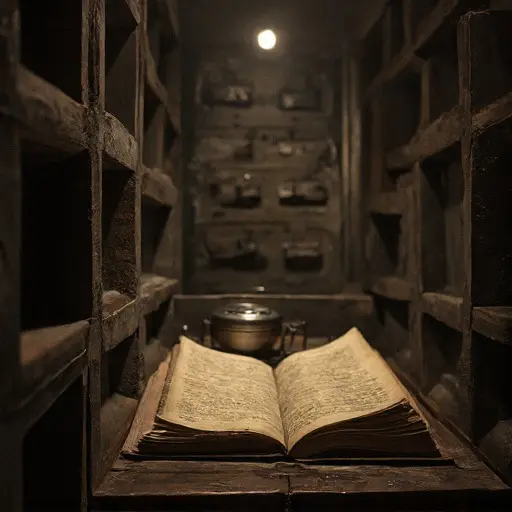
The Unused Cello in the Atelier
Eleanor Wainwright, the widow, was left with a massive house, a shattered reputation, and a crippling mortgage, as all Elias’s funds had gone into the failed opera production. Her immediate reaction was one of final, utter rejection of the house and the life of music it represented.
She refused to touch the scores in the Sound Vault and forbade any mention of music in the house. Her final act was one of deliberate, financial sabotage. She stripped the house of all small, salable items and fled to a distant city with her daughter, Clara, who was already severely traumatized.
Eleanor never paid the house taxes again. The Hemlock-Eaves, full of the heavy, dark furniture and the huge grand piano, quickly became a liability. The piano and the music room were too large to easily sell or move, and the surrounding estate was too complicated for a quick foreclosure.
In the small, sunlit Atelier on the third floor, where Eleanor used to paint, one item remains: Eleanor’s cello, left leaning against a wall, still in its cracked, leather case. It was the only instrument she did not sell, but she left it behind, unable to carry its weight or its memory.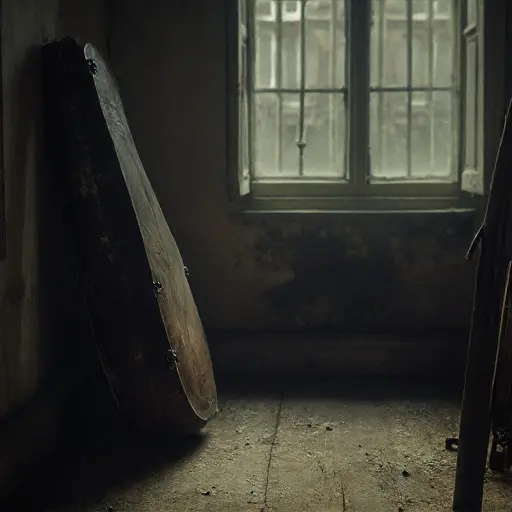
The Hemlock-Eaves stands today, its complex timber and shingle work rotting slowly under the deep shade. Its immense Music Room holds a profound, absolute silence, a cold, empty chamber where the lost echoes of Elias Wainwright’s final, tragic creation remain sealed with the composer’s remains in the vault beside it.