The Silent Burden of the Ashburn-Cottage
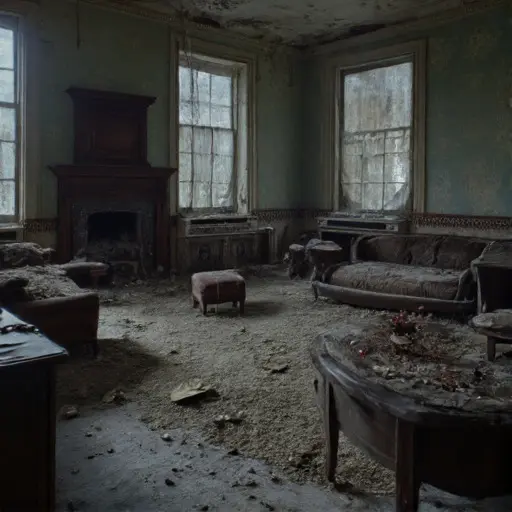
The Ashburn-Cottage, despite its deceptively modest name, is a large, rambling, late-Victorian home, built in 1902 with a sprawling, asymmetrical floor plan. Its architecture is characterized by heavy eaves and dark, varnished woodwork. To enter the front door is to immediately encounter a house that is not just abandoned, but suffocated by its own contents.
The cold, dry air is thick with the scent of aged fabric and the silent presence of countless discarded possessions. The main Drawing Room is a museum of objects, all frozen under a thick, undisturbed layer of dust, an enduring monument to a family that simply could not let go.
The Compulsive Keeper, Arthur Selwyn
The home was the property of Arthur Selwyn (1860–1930), a man whose profession was that of a mid-level government archivist. His life was devoted to cataloging, sorting, and preserving public records. His profession translated directly into a personal compulsion: he was a collector and a hoarder, incapable of discarding anything he deemed historically significant or personally sentimental. Socially, he was a quiet, almost invisible man who preferred the company of his papers to people.
Arthur married Lillian Harper in 1895. They had one child, a son named Paul. Arthur’s personality was defined by a deep-seated anxiety about history being silently erased; he believed everything deserved to be kept. His daily routine involved obsessive organization and categorization, often spending hours in the purpose-built, high-ceilinged Record Room on the second floor, which was essentially a fire-proof attic designed for paper storage. His ambition was to ensure his own life, and the life of his family, was perfectly documented. His greatest fear was disorder and loss of record.
The house evolved to accommodate his compulsion; every available space, including the wide upper hallways, was eventually lined with additional shelves and cabinets.
The Loss of Control in the Record Room
The tragedy that engulfed the Selwyn family was not external, but a slow, internal pressure that led to an emotional explosion. Paul, the son, was a free-spirited, rebellious young man who despised the heavy silent atmosphere of the house and his father’s relentless organizational needs. He longed to travel and escape the burden of his father’s collection.
In 1930, Paul applied to university abroad, a decision Arthur vehemently opposed, seeing it as an act of betrayal against the history he was preserving in the house. The final confrontation occurred in the Record Room—a space already overflowing with books, journals, and filing cabinets. Paul, in a fit of rage and frustration, deliberately threw a handful of his father’s meticulously labeled papers onto the floor, scattering them in an act of profound disorder.
Arthur, witnessing the collapse of his life’s work, suffered a massive, debilitating stroke. He did not die immediately, but was left entirely paralyzed and mute, a man whose mind was perfectly preserved but his ability to control his world was entirely gone.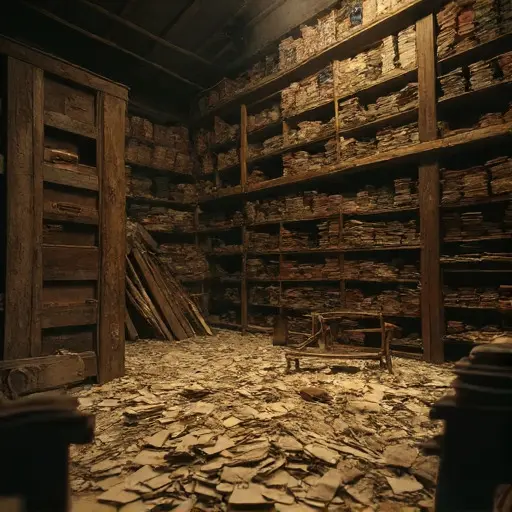
The Unclaimed Albums in the Bedroom
Lillian Selwyn, the wife and mother, was left to manage the aftermath. She sold none of the house’s contents, honoring her husband’s lifelong need to preserve them. She cared for the mute, paralyzed Arthur in his master bedroom for two years, the silent witness to his anguish and her son’s exile.
Paul, tormented by guilt, left the country immediately after his father’s stroke, taking a one-way passage to South America. He only ever sent one letter, instructing his mother to use his small savings to maintain the house until she died, ensuring nothing was touched. He wanted the house to stand as a monument to his mistake, a permanent silent penance.
Lillian, isolated and broken, died quietly in the master bedroom in 1932. The house, full of its own weight and complication, simply settled into a legal void. Paul never returned.
On the nightstand beside the heavy, four-poster bed in the master bedroom, a stack of four thick, leather-bound photo albums remains. They are unopened, their pages fused together by time and humidity. These albums, filled with the silent records of the family’s life, were the last things Lillian saw.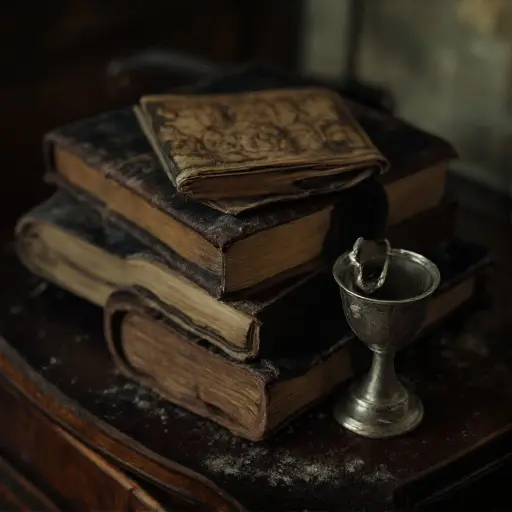
The Ashburn-Cottage stands today, utterly jammed with the material artifacts of a life that obsessed over its own record. Too full to be easily renovated and legally too complicated to claim, the house is permanently kept in a state of dense, atmospheric preservation. Its immense collection, the source of its ruin, now imposes a profound and eternal silent burden on the empty structure.