The Lost Elegance of the Raven-Holm
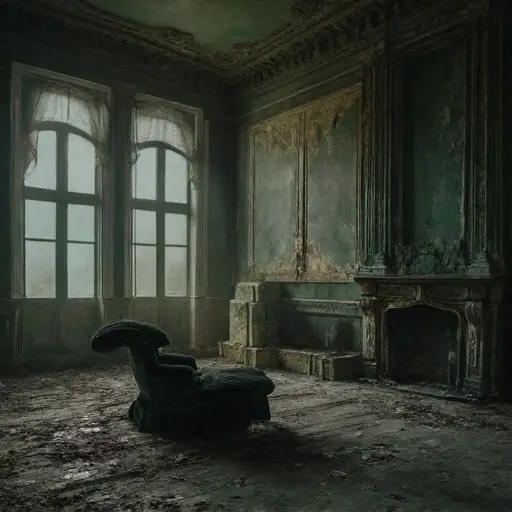
The Raven-Holm, a sprawling, asymmetrical Shingle Style mansion built in 1885, stands nestled deep in a coastal ravine, its weathered cedar shingles giving it a look of permanent melancholy. It was designed to withstand the harsh sea climate, but not the harsher climate of human despair. Stepping across the threshold, one is enveloped by a cold, saline air mixed with the sharp scent of decay and damp wool.
The Drawing Room, the central space for formal life, is now a study in entropy. It is entirely silent, preserving a history of internal collapse, where opulence gave way to rot, and all traces of its former lost elegance were slowly smothered by time and neglect.
The Social Climber, Lawrence Albright
The house was the property of Lawrence Albright (1848–1915), a man whose profession was rooted in the volatile world of international shipping and import-export. He was obsessed with elevating his family into the highest social strata, often masking massive debt with lavish displays. Socially, he was a relentless, charming showman whose outward confidence was always on the verge of cracking.
Lawrence married Vivian Hearst in 1875, a beautiful woman from a socially impeccable but financially diminished family. They had one daughter, Camilla. Lawrence’s personality was defined by his outward ambition; he lived entirely for appearances and the acceptance of the upper crust. His daily routine was a performance, culminating in the daily, tense, formal dinner in the Dining Room. His singular ambition was to secure a titled European match for his daughter, thereby validating his entire existence.
The Raven-Holm was built primarily to house his vast, but heavily mortgaged, collection of European art and statuary. He dedicated an entire top-floor Gallery to showcasing these pieces, a reckless investment intended purely for show.
The Tragedy in the Dining Room
The failure of the Albright family was a devastating confluence of financial ruin and a deliberate act of sabotage rooted in familial conflict. Camilla, the daughter, was secretly engaged to a local architect—a brilliant man, but one who Lawrence deemed utterly insufficient for his social plans. Lawrence’s emotional abuse and total control over his daughter were extreme.
In 1914, Lawrence’s shipping venture was exposed as being entirely leveraged, facing total collapse. Simultaneously, he had finalized the negotiations for Camilla’s engagement to an Austrian Baron, which she passionately rejected. The final confrontation occurred in the Dining Room during a brutally formal dinner. Camilla refused the Baron and revealed her engagement to the architect. Lawrence, consumed by rage and the sudden, complete failure of both his financial and social life, suffered a massive, debilitating stroke at the head of the table.
He lingered for a year, paralyzed and unable to speak, a silent, raging prisoner in his own master bedroom, watching the slow dismantling of his world.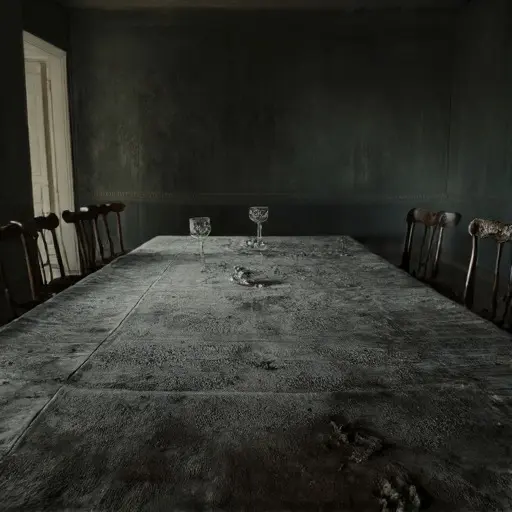
The Final Auction in the Grand Gallery
Vivian Albright, the widow, was left with an incapacitated husband and an estate choked with debt. She had no affection left for the house, which she saw as the symbol of her husband’s crushing ambition. The only way to save herself and Camilla from total ruin was to liquidate.
Vivian called in the creditors and forced an immediate, humiliating public auction of the Raven-Holm’s contents. She sold everything: the rugs, the furniture, the china, the silver, and crucially, all of Lawrence’s beloved European art collection from the top-floor Gallery.
Her final, decisive act of abandonment came in 1916. Having paid off the worst of the creditors with the auction proceeds and securing a small, private income for herself and Camilla, Vivian simply walked away. She refused to sell the building itself, leaving the mortgage holders to deal with the empty, debt-ridden shell. She wanted the Raven-Holm to remain a visible, permanent testament to Lawrence’s failure, stripped bare of all the lost material beauty he had amassed.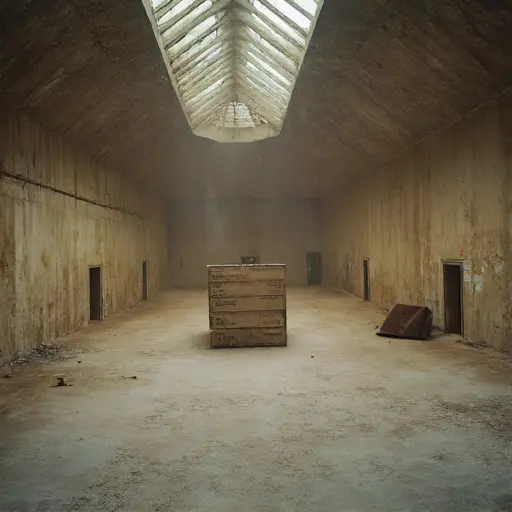
The Raven-Holm defaulted quickly thereafter. Too large and too compromised by its history of debt and emotional despair, it never found a solid buyer. It stands today, its cedar shingles weathered gray and its windows blank, a cold, empty stage where the final performance was one of total, irreversible collapse. The silence is the house’s final, lost sound.