Nemo-Aestus House: The Gardener’s Final Bloom
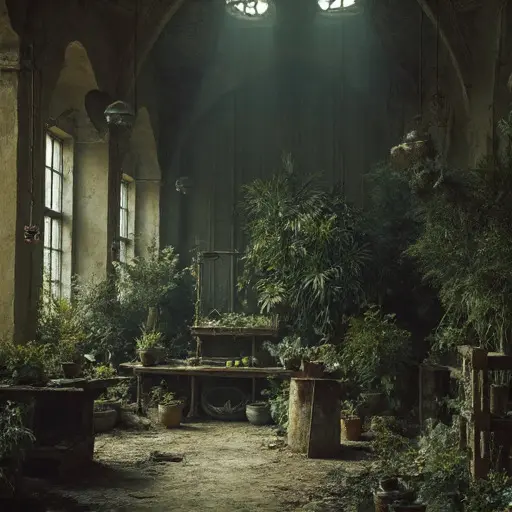
The moment the heavy, bronze-plated door to Nemo-Aestus House was carefully pushed open, the air rushed out—cold, dense, and heavy with the pervasive, unsettling odor of dry materials, mineral dust, and the sharp scent of heavy metals. The name, combining nobody/no one with summer/heat, perfectly captured the manor’s function: a physical space dedicated to achieving the ultimate truth of organic processes, now embodying its own absolute termination of life and warmth. This abandoned Victorian house was structured not for ordinary living, but for unwavering, controlled study, its internal layout a bewildering maze of small, isolated grafting cells, soundproofed seeding bunkers, and meticulously designed climate stabilizers intended to eliminate all external variables that might corrupt a pure organic constant.
The final inhabitant was Gardener Master Viridis Vacuum, a brilliant, but intensely reclusive master botanist and organic theorist of the late 19th century. Master Vacuum’s profession was the study of seasons, fertility, and the fundamental nature of flora, seeking to codify a single, unified, and perfectly consistent stasis that was free of all metabolism, senescence, or subjective change. His singular obsession, however, was the creation of the ‘Zero Bloom’—a single, perfect, flawless vegetative state that would, through the absolute synthesis of all known botanical principles, reveal the ultimate, objective truth of growth, free of all root, leaf, or measurable vitality. After realizing that the very act of growing required both sustenance and decay (a duality of life), proving that absolute, independent and secure simplicity was impossible, shattering his faith in fixed natural law, he retreated to the manor. He dedicated his final years to resolving this single, terrifying goal, believing that the only way to achieve the Zero Bloom was to understand the ultimate absence of all growth and change. His personality was intensely systematic, fearful of inconsistency, and utterly consumed by the pursuit of botanical finality.
The Fallow Chamber

Master Vacuum’s mania culminated in the Fallow Chamber. This secure, sealed room was where he spent his final days, not cultivating, but deconstructing the act of growth itself, attempting to define the ultimate objectivity by isolating the point that offered no detectable organic content. His journals, written in a cramped, precise hand that eventually gave way to complex equations concerning non-cellular organization and the theoretical limits of absolute anti-life, were found sealed inside a hollow metal seed packet. He stopped trying to define the perfect plant and began trying to define the un-grown, concluding that the only way to achieve the Zero Bloom was to eliminate the need for any form of growth or vitality whatsoever. “The root is a reliance; the flower is a deception,” one entry read. “The final bloom requires the complete surrender of all vitality and all change. The truth must be a single, self-evident, unstated conclusion, contained in a fundamental, perfect void.”
The house preserves his systematic rigor structurally. Many internal passages are fitted with small, precisely calibrated acoustic dampeners and total thermal isolation barriers built into the walls, now all rusted and frozen, remnants of his attempts to create a universal, absolutely fixed and non-interfering environment for abstract botanical contemplation.
The Final Seed in the Abandoned Victorian House
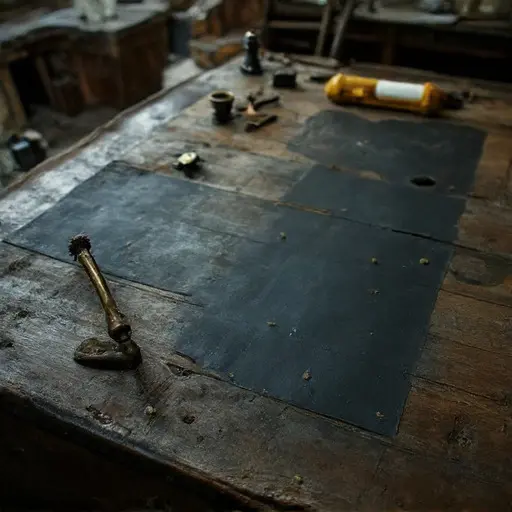
Gardener Master Viridis Vacuum was last heard working in his atrium, followed by a sudden, intense sound of heavy copper bending and iron snapping (from the watering can and the ventilator) and then immediate, profound silence. He did not leave the manor. The next morning, the atrium was cold, the Fallow Chamber sealed, and the man was gone. No body was found, and the only evidence was the singular, physical alteration to his final philosophical work.
The ultimate chilling clue is the small hole in the black rubber. It is the final seed—the Zero Bloom achieved, representing the cessation of all vegetative existence and the perfect, objective truth found in a single, un-dimensioned point of pure, absolute nothingness. The broken dibber and blank rubber ensure no further attempt could be made to chart the flawed, growing world. This abandoned Victorian House, with its silent chambers and broken tools, stands as a cold, imposing testament to the master gardener who pursued the ultimate, pure form of growth, and who, in the end, may have successfully defined the Perfect Non-Seed, vanishing into the un-cultivated, objective finality that he engineered as his final, terrifying statement of pure existence.