Amnio-Sculpt: The Modeler’s Fused Clay
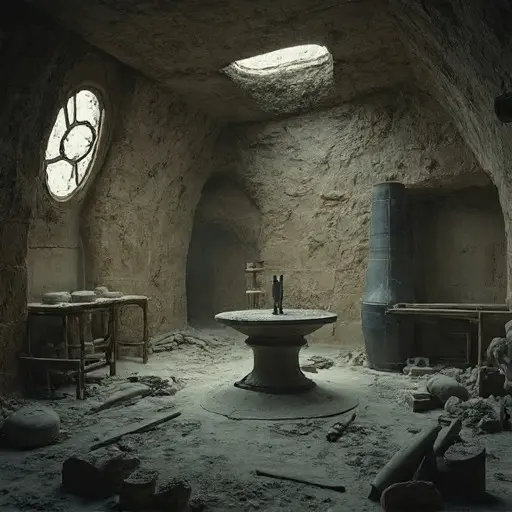
The moment the heavy, iron-strapped door to Amnio-Sculpt was finally breached, the air rushed out—cold, dense, and heavy with the pervasive, unsettling odor of silicate dust, gypsum, and the fine powder of pulverized earth. The name, combining a fetal membrane with the act of carving, perfectly captured the manor’s function: a place dedicated to the creation of form from a primal, shapeless material. This abandoned Victorian house was structured not for ordinary living, but for unwavering, manual precision and durability, its internal layout a bewildering maze of small, constant-humidity rooms designed to manage the delicate curing process of clay and plaster.
The final inhabitant was Mr. Augustus Claymore (a name he ironically earned), a brilliant, but intensely reclusive master modeler and sculptor of the late 19th century. Mr. Claymore’s profession was the creation of highly detailed, anatomically perfect models and molds for museums and academic institutions. His singular obsession, however, was the creation of the ‘Final Mold’—a single, perfect, flawless negative space that would, when filled, yield the Platonic Ideal of the human form, free of all natural asymmetry or defect. After years of struggling with the unavoidable shrinkage and cracking of his materials, he retreated to the manor. He dedicated his final years to resolving this single, terrifying goal, believing that the only way to perfect the positive form was to perfect the ultimate void that defined it. His personality was intensely rigorous, fearful of material flaw, and utterly consumed by the pursuit of structural finality.
The Kiln Chamber
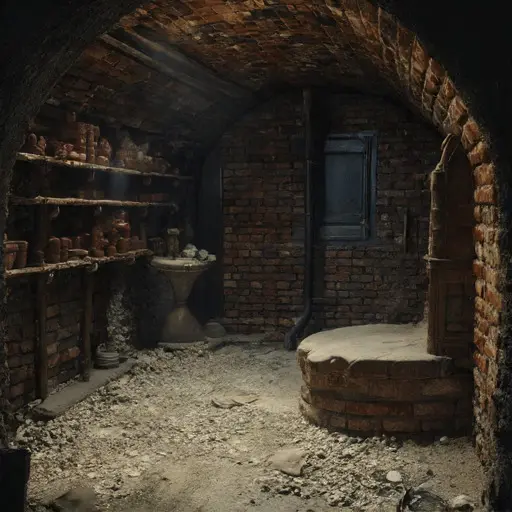
Mr. Claymore’s mania culminated in the Kiln Chamber. This secure, insulated room was where he spent his final days, not firing his models, but firing his tools and materials—attempting to purge them of all organic flaw. His journals, written in a cramped, precise hand that eventually gave way to complex diagrams of geometric solids, were found pinned beneath a broken wooden mallet. He stopped trying to create the mold and began trying to create the ultimate material, concluding that the only way to achieve the Ideal Form was to forge a clay that contained no organic life. “The flaw is in the hand that shapes, and the clay that lives,” one entry read. “The final structure requires the complete surrender of all mutable life. The self must become the final, sterile medium.”
The house preserves his meticulous nature. Many internal door frames and archways are marked with small, pencil-thin, anatomical measurements and notations, reflecting his constant attempt to compare the house’s structure to the ideal human form.
The Final Mold in the Abandoned Victorian House
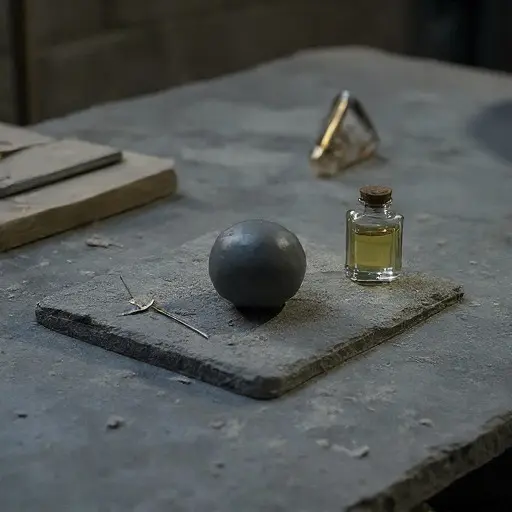
Mr. Augustus Claymore was last heard working in his workshop, followed by a sudden, intense grinding sound—like stone turning against stone—and then immediate, profound silence. He did not leave the manor. The next morning, the workshop was cold, the kiln door sealed shut, and the man was gone. No body was found, and the only evidence was the singular, physical alteration to his final workspace.
The ultimate chilling clue is the perfectly formed clay sphere. It is the Final Mold in its most fundamental, abstract state—the perfect, unblemished form of pure matter. This abandoned Victorian house, with its dusty studios and silent kilns, stands as a cold, imposing testament to the master modeler who pursued the ultimate, flawless shape, and who, in the end, may have successfully sculpted the Ideal Form, vanishing into the absolute, unmoving perfection that he engineered as his final, ultimate artistic statement.