Chord-Nulla: The Musician’s Final Silence

The moment the thick, heavy door to Chord-Nulla was carefully pushed open, the air rushed out—cold, dry, and heavy with the pervasive, unsettling odor of aged wood, stale air, and the faint, sweet decay of old horsehair padding. The name, combining a harmonic tone with nothingness, perfectly captured the manor’s function: a place dedicated to the composition of sound, now eternally silent. This abandoned Victorian house was structured not for ordinary living, but for acoustic perfection, its rooms featuring elaborate sound traps and dampening materials designed to isolate the composer from the outside world.
The final inhabitant was Maestro Silas Gremory, a brilliant, but intensely reclusive composer and music theorist of the late 19th century. Maestro Gremory’s profession was the creation of complex musical symphonies and concertos. His singular obsession, however, was the creation of the ‘Ultimate Dissonance’—a single, final, complex chord that would contain all musical notes and, when played, would instantly and permanently resolve all auditory chaos into absolute silence. After a catastrophic public failure of his final symphony, he retreated to the manor. He dedicated his final years to resolving this single, terrifying goal, believing that the universe’s ultimate truth lay hidden in the tension and resolution of a single, final vibration. His personality was intensely passionate, sensitive to the extreme, and utterly consumed by the pursuit of auditory finality.
The Tuning Chamber
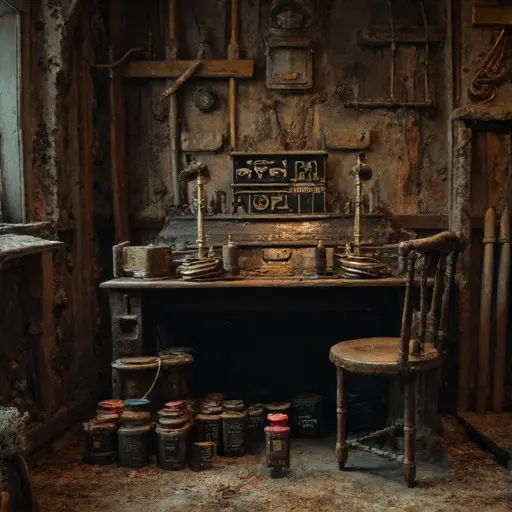
Maestro Gremory’s mania culminated in the Tuning Chamber. This secure, insulated room was where he spent his final days, calculating and trying to physically construct the Ultimate Dissonance on a custom-built, small-scale apparatus. His journals, written in a cramped hand that gradually gave way to mathematical equations and musical staves, were found beneath a pile of discarded sheet music. He stopped trying to compose music and began trying to engineer silence, concluding that the final chord required the complete, simultaneous sounding of every single possible frequency. “The resolution is not in the quiet,” one entry read, “it is in the chord that contains all sound, thereby neutralizing it. The instrument must be perfect, and the player must be the final resonance.”
The house preserves his auditory anxiety structurally. In the main hall, certain floorboards are designed to be acoustically loose, producing a sudden, subtle squeak when trod upon, an intentional auditory “false note” that continually tested the listener’s awareness.
The Final Chord in the Abandoned Victorian House
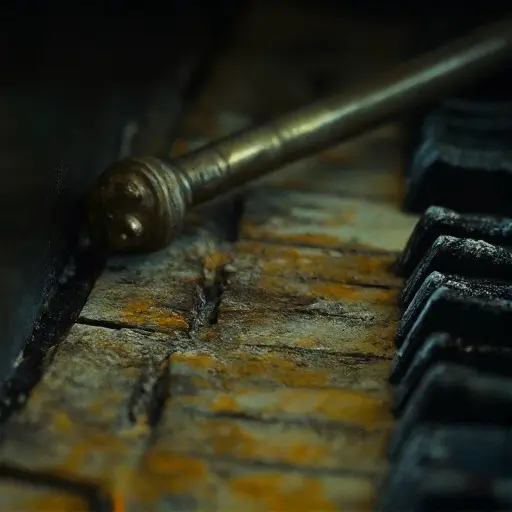
Maestro Silas Gremory was last heard working in the music room, followed by a brief, incredibly loud, complex collision of notes, which was instantly cut off by an absolute, profound silence. He did not leave the manor. The next morning, the music room was still, the piano closed, and the man was gone. No body was found, and the only evidence was the singular, physical alteration to the piano.
The ultimate chilling clue is the depressed chord. The complex, six-note cluster is held down, perpetually silent, the Ultimate Dissonance achieved. This abandoned Victorian house, with its padded walls and silent instruments, stands as a cold, imposing testament to the composer who pursued the final, all-encompassing sound, and who, in the end, may have successfully constructed the chord that rendered all further sound, including his own existence, permanently null.