Miridia-Shell: The Biologist’s Fated Form
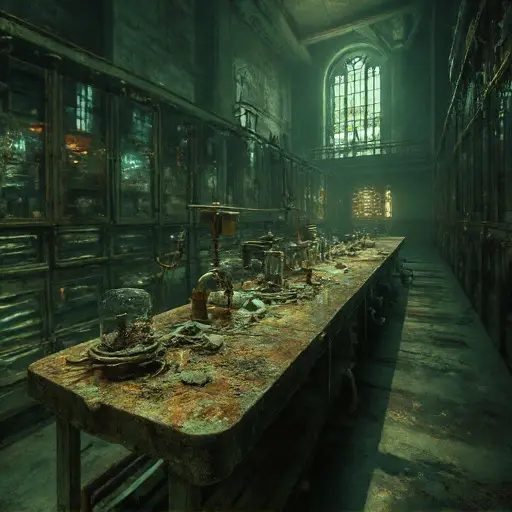
The moment the heavy, iron-bound door to Miridia-Shell was forced open, the air rushed out—cold, damp, and carrying the unsettling, pervasive odor of preservative chemicals and deep, organic stillness. The name, combining a sense of wonder with a protective casing, suggested a fragile, valuable interior hidden from the world. This abandoned Victorian house was structured not for warmth, but for clinical, solitary investigation, its rooms featuring smooth, easily sterilized surfaces and efficient drainage systems, transforming it into a vast, silent laboratory.
The final inhabitant was Dr. Julian Vance, a brilliant, but intensely reclusive anatomist and comparative biologist of the late 19th century. Dr. Vance’s profession was the study of biological structure, focusing on the fundamental similarities and divergences in the forms of various species. His singular obsession, however, was the creation of the ‘Platonic Ideal Form’—the existence of a single, perfect, and ultimate biological blueprint from which all life was an imperfect deviation. After failing to reconcile the inherent flaws in his research subjects, he retreated to the manor. He dedicated his final years to constructing this ultimate form, believing that by assembling the perfect biological structure, he could transcend the fatal flaws of the flesh. His personality was intensely rigorous, cold, and utterly consumed by the pursuit of structural, biological immortality.
The Ossuary
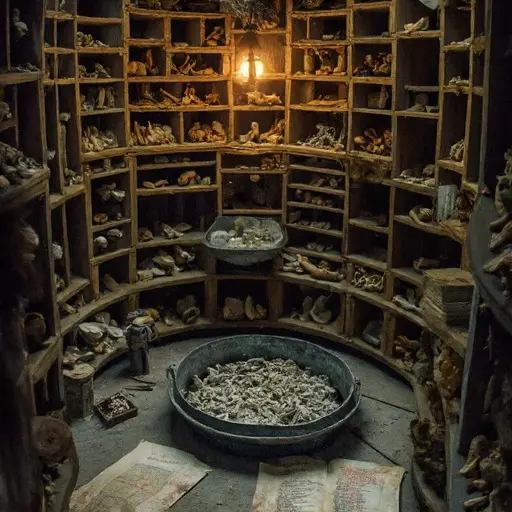
Dr. Vance’s mania culminated in the Ossuary. This secure, windowless room was where he sorted, cleaned, and cataloged the thousands of biological fragments used in his pursuit of the Ideal Form. His journals, written in a cramped, clinical script and found pinned beneath a heavy, empty beaker, detailed his final, terrifying conclusion: the Ideal Form required the absolute purity of its components, and that the only truly flawless part was the concept itself. He decided the final form must be assembled using only his own, self-perfected, final components. “The structure is ready, but the foundation is flawed,” one entry read. “The only perfect sample remaining is the self, once stripped of its chaotic consciousness.”
The house preserves his scientific methods. Many internal stairwells feature small, low brass railings and hooks, remnants of a pulley system he used for safely transporting fragile, large specimens between the different laboratory levels.
The Final Vessel in the Abandoned Victorian House
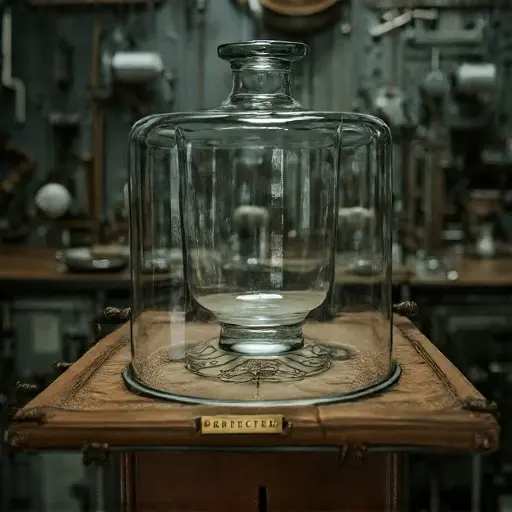
Dr. Julian Vance was last seen working late in his laboratory, the sound of running water and glass-on-metal scraping reported by the local night watchman, followed by absolute silence. The house was found entirely locked from the inside. The laboratory was clean, the Ossuary locked, and the man himself was gone.
The ultimate chilling clue is the display vat. It is immaculate, drained of its preserving fluid, and stands ready, but empty. The inscription on the brass plaque remains. This abandoned Victorian house, with its sterile laboratories and organized fragments of life, stands as a cold, imposing testament to the biologist who sought to build the ultimate, flawless form, and who, in the end, may have succeeded in assembling and then inhabiting the perfect, silent structure he desired, vanishing into the flawless, eternal vessel.