Glyph-Cinder: The Linguist’s Unspoken Word
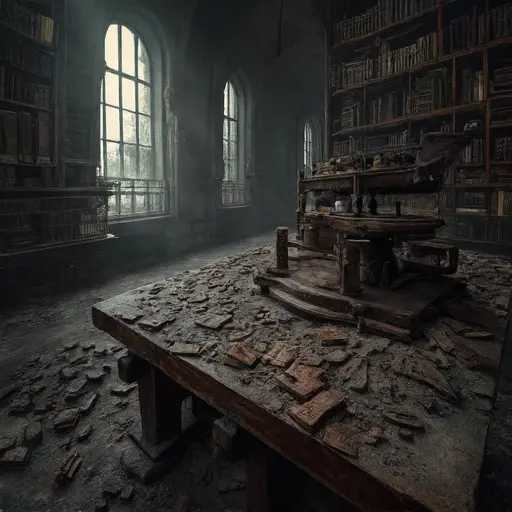
The moment the heavy, sound-dampening door to Glyph-Cinder closed, the air was immediately cold, dry, and held the distinct, faint odor of dry paper, old leather, and a sharp, metallic tang, like oxidized typefaces. The name, combining a carved character with the residue of fire, suggested a hidden, burned-out meaning. This abandoned Victorian house was structured not for conversation, but for silent, meticulous deconstruction of communication, its massive library walls acting as a vault for thousands of forgotten words. The silence here was the heavy, scholarly quiet of an archive, filled with the mute history of human thought.
The final inhabitant was Professor Lysander True, a brilliant, but deeply reclusive philologist and linguist of the late 19th century. Professor True’s profession was the study of language structure, etymology, and the evolution of communication. His singular obsession, however, was with the ‘Primal Lexicon’—the existence of a single, foundational, perfect language that contained the unadulterated truth of the universe. After dedicating decades to comparative linguistics, he retreated to the manor. He dedicated his final years to deciphering the ‘Ultimate Word,’ a single, lost syllable that he believed held the key to all human understanding and existence. His personality was intensely logical, fearful of semantic error, and utterly consumed by the pursuit of absolute, uncorrupted meaning.
The Etymology Archives
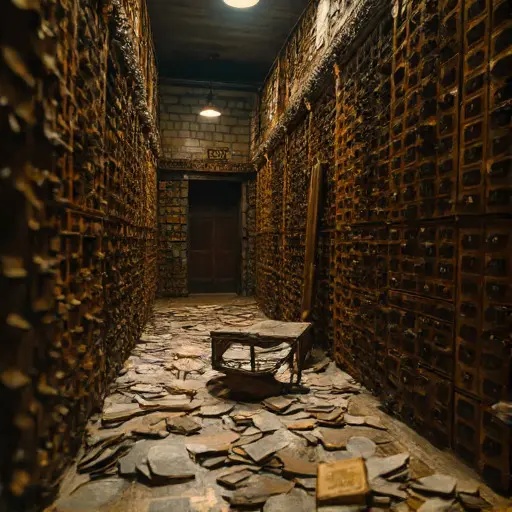
Professor True’s mania was revealed in the Etymology Archives. His journals, written in seven different, alternating languages and found tucked beneath the floorboards, detailed his descent. He stopped analyzing existing languages and began trying to synthesize the Primal Lexicon from the fragments of lost tongues. He became convinced that the Ultimate Word was not a sound, but a glyph—a visual symbol that contained its meaning intrinsically. “The Word is a key, but the tongue cannot turn it,” one entry was written in archaic Greek. “The truth is visual. The final symbol must be drawn, not spoken.”
The house preserves his meticulous nature. Many internal door frames and lintels are scratched with small, barely visible futhark runes and Phoenician characters, used by the Professor as personalized, symbolic labels for the functions of each room.
The Final Glyph in the Abandoned Victorian House
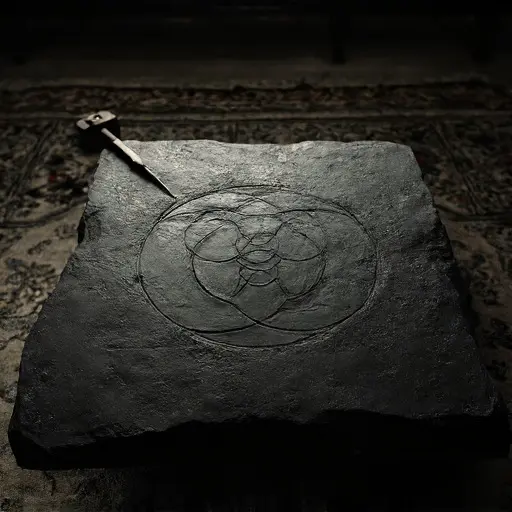
Professor Lysander True was last heard making a loud, rhythmic hammering sound from his study, followed by an immediate, profound quiet. He did not leave the manor. The next morning, the study was found entirely silent. No body was found, and all his writing instruments and paper were left untouched.
The ultimate chilling clue is the carved stone slab. It bears the single, final, complex glyph—the Ultimate Word, rendered visual and permanent. The Professor found his perfect, uncorrupted meaning. This abandoned Victorian house, with its silent archives and hidden scripts, stands as a cold, imposing testament to the master linguist who pursued the absolute truth of language, and who, having finally created the final, unspeakable symbol, removed himself entirely from the realm of human words.