Aura-Tessera: The Photographer’s Negative Truth
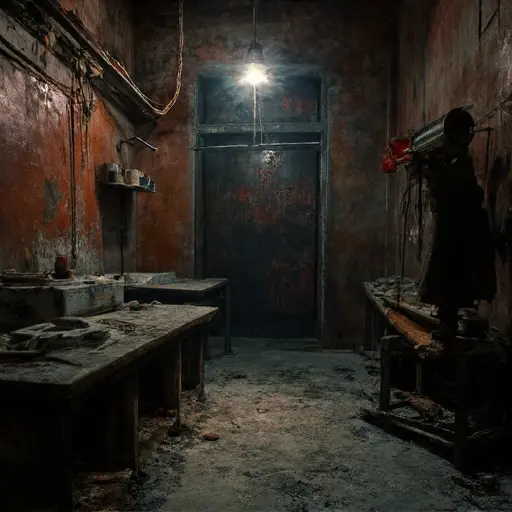
The moment the heavy blackout curtains of Aura-Tessera were pulled aside, the light revealed not a room, but a cavern dedicated to shadow. The name, combining a sense of radiant light with a small mosaic piece, suggested a fractured, luminous whole. The air inside this abandoned Victorian house was thick with the faint, persistent scent of fixer and silver halide, a sharp, chemical aroma that clung to the velvet draperies and wooden fixtures. It felt like a space where light itself was a controlled, precious, and highly dangerous commodity.
The final inhabitant was Mr. Silas Crofton, a brilliant, reclusive portrait photographer of the late 19th century. Crofton’s profession was the delicate, meticulous art of capturing human likeness, but his obsession went deeper. He believed that the photographic process—the chemical interaction of light and silver—could capture not just the image, but the emotional residue of the subject. He built Aura-Tessera specifically for its north-facing light and for its vast, labyrinthine network of darkrooms. His personality was intensely focused, quiet, and increasingly convinced that his negatives were revealing unpleasant truths hidden just beneath the surface of the human visage.
The Negative Vault
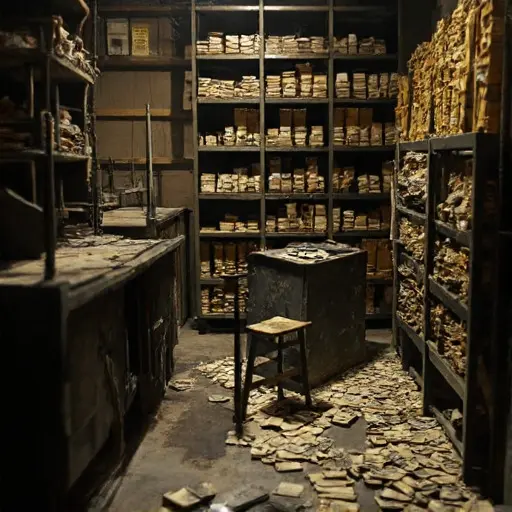
Crofton’s true life was spent not in the light of the studio, but in the dark of his Negative Vault. His private journals, tucked inside a wooden box labeled ‘Faulty Plates,’ meticulously documented his descent. He stopped taking commissions, focusing only on photographing himself and the empty rooms of the manor, trying to capture the house’s “memory.” He believed his final self-portrait, taken daily, revealed a shadow-self taking over. “The developing process reveals the lies,” he wrote. “I am no longer seeing myself; I am seeing what the silver requires me to become.”
The house preserves his intense visual focus. The walls of the main studio are riddled with tiny pin-prick holes, marking the precise locations where he moved his camera and lighting equipment, a constant, silent record of his endless repositioning.
The Final Exposure in the Abandoned Victorian House
Mr. Silas Crofton vanished silently. The only sign was the intense, bitter smell of spilled cyanide fixative that temporarily lingered in the darkroom. The house was locked from the inside, his massive camera left aimed at an empty chair.
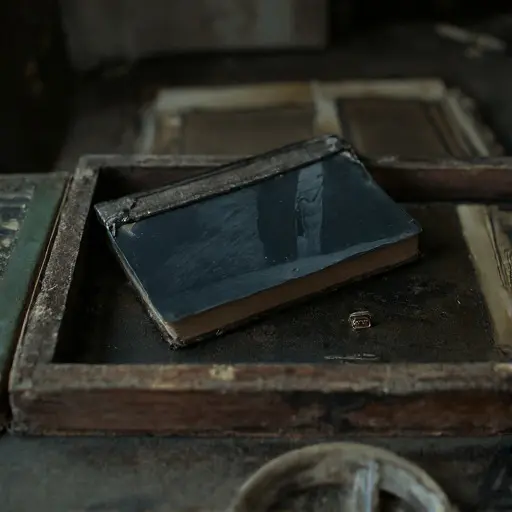
The ultimate chilling clue is the printing frame found in the darkroom. It holds a single, newly fixed negative—a portrait not of the man, but of a dark, ill-defined shape retreating into a doorway. The exposure is near-black, suggesting the photographer was running from the light he sought to control. This abandoned Victorian house, with its labyrinthine darkrooms and vaults of trapped expressions, stands as a cold, chemically scented tomb to the man who pursued the image of the truth so fiercely that he finally photographed his own complete negation.