The Final Truth of Anamnesis-Rivet Keep
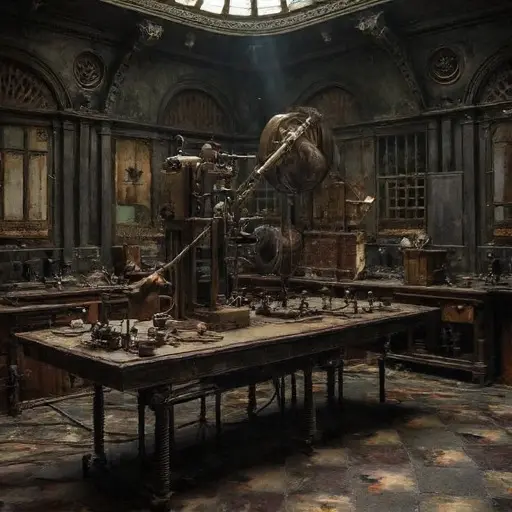
Anamnesis-Rivet Keep was an architectural statement of cognitive nullity: a massive, symmetrical structure built of pale, smooth granite, characterized by numerous internal chambers designed to eliminate all subjective recall, emotional association, and personal history for concentrated contemplation of Oblivion. Its name suggested a blend of recollection/remembrance (Anamnesis) and a heavy metallic fastener/stabilizer (Rivet). The house stood on a remote, exposed plateau, giving it an isolated, almost monastic presence, perpetually dedicated to the singular pursuit of Absolute Non-Remembrance. Upon entering the main psychology lab, the air was immediately thick, cool, and carried a potent, mineral scent of aged metal, fine dust, and a sharp, metallic tang of brass. The floors were covered in heavy, smooth tiles, now slick with dust and grinding residue, amplifying every faint sound into an unsettling echo. The silence here was not merely quiet; it was an intense, mnemonic stillness, the profound hush that enforces the memory of a past perfectly erased, waiting for the final, unassailable statement of non-history. This abandoned Victorian house was a giant, sealed diary, designed to achieve and hold a state of absolute, unchangeable, fixed non-history.
The Analyst’s Perfect Void
Anamnesis-Rivet Keep was the fortified residence and elaborate laboratory of Master Analyst Dr. Elias Vane, a brilliant but pathologically obsessive memory theorist and cognitive engineer of the late 19th century. His professional life demanded the relentless analysis of mnemonic traces, the flawless elimination of subjective recall, and the pursuit of absolute non-existence of the past—a state of consciousness so perfectly free of history, reference, or prior event that it existed as pure, unadulterated, fixed, moment-to-moment awareness. Personally, Dr. Vane was tormented by a crippling fear of regret and the burden of history and a profound desire to make the chaotic, accumulating nature of memory conform to a state of pure, silent, permanent, objective present. He saw the Keep as his ultimate anti-archive: a space where he could finally design and induce a single, perfect, final, unmoving state of pure forgetting that would visually encode the meaning of eternal, fixed, non-historical existence.
The Oblivion Vault
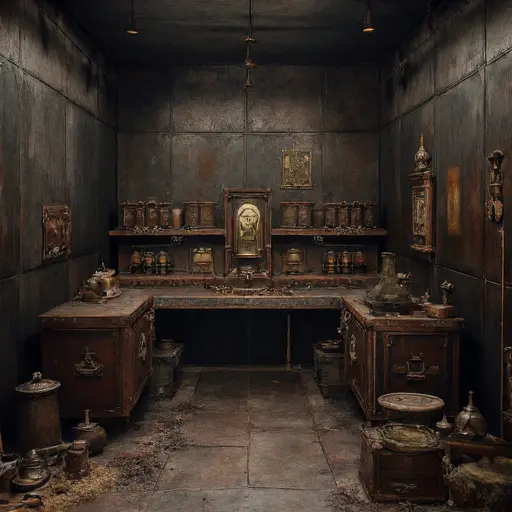
Dr. Vane’s Oblivion Vault was the engine of his obsession. Here, he worked to isolate and stabilize his final, most critical parameter: the past. We found his final, detailed Mnemonic Compendium, bound in thick, heavily embossed leather. His entries chronicled his escalating desperation to find the “Zero-History State”—a mind so perfect it contained simply the present, without the reference of a past. His notes revealed that he had begun to believe the most chaotic element was the presence of subjective experience itself, which introduced the necessity of narrative and thus, memory. His final project, detailed meticulously, was the creation of a massive, unique, internal “Master Forgetting”—a final, absolute psychological condition of total amnesia, designed to contain a single, pure, eternal, unbroken, perfectly unremembering identity.
The Final Sentiment
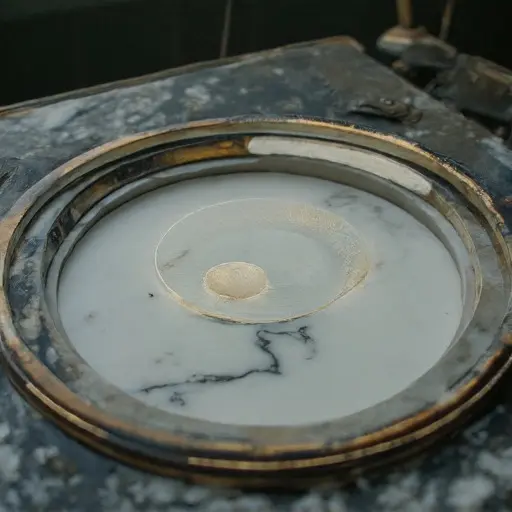
The most chilling discovery was made back in the main psychology lab. Tucked carefully into the viewing port of the Recollection Isolation Chamber was the Master Forgetting. It was a single, immense, perfectly smooth slab of white marble, sealed with a heavy brass frame. The slab contained a massive, perfectly formed empty circle (◯)—the final sentiment. The circle was the fixed boundary of the mind, and its emptiness was the pure, singular, unmoving confirmation of absolute, total non-recall. The mark was utterly flawless, representing the absolute perfection of the command to Forget Everything. Resting beside the slab was a single, small, tarnished stylus, frozen at its point of final contact. Tucked beneath the chamber was Dr. Vane’s final note. It revealed the tragic climax: he had successfully created the conditions for the “Master Forgetting,” achieving the absolute non-memory he craved. However, by eliminating all past reference, all historical context, and all potential for recall to achieve perfect oblivion, he had created a state of mind that was utterly meaningless and static—a perfect non-experience that was fundamentally indistinguishable from an object without consciousness, as selfhood requires memory. His final note read: “The symbol is fixed. The forgetting is absolute. But the truth of the self is in the history it carries.” His body was never found. The final truth of Anamnesis-Rivet Keep is the enduring, cold, and massive featureless symbol on the marble slab, frozen inside the chamber, a terrifying testament to an analyst who achieved mnemonic perfection only to find the ultimate, necessary flaw was the removal of the very history, context, and recall that gives meaning and reality to consciousness and selfhood, forever preserved within the static, psychological silence of the abandoned Victorian house.}