The Final Stitch of Calico-Rivet Keep
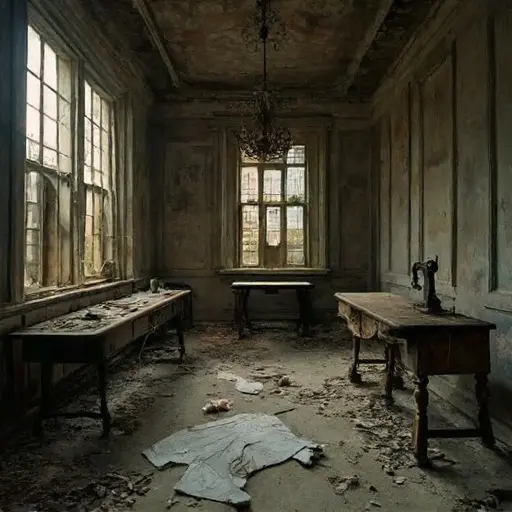
Calico-Rivet Keep was an architectural statement of dimensional certainty: a massive, symmetrical structure built of dark, heavy granite, characterized by numerous internal chambers designed to stabilize fabric and isolate measurement errors. Its name suggested a blend of printed cotton and a metallic fastener. The house stood low in a remote, heavily wooded valley, giving it a muted, shadowed appearance. Upon entering the main studio, the air was immediately thick, cool, and carried a potent, almost dusty scent of aged felt, dry cotton, and a sharp, metallic tang. The floors were covered in heavy, smooth tiles, now slick with dust and dried sizing residue, amplifying every faint sound into an unsettling echo. The silence here was not merely quiet; it was an intense, dimensional stillness, the profound hush that enforces the memory of a form perfectly measured, waiting for the final, unassailable fit. This abandoned Victorian house was a giant, sealed mannequin, designed to achieve and hold a state of absolute, unchangeable, physical conformity.
The Tailor’s Perfect Form
Calico-Rivet Keep was the fortified residence and elaborate workshop of Master Tailor Dr. Elias Thorne, a brilliant but pathologically obsessive dimensional theorist and garment engineer of the late 19th century. His professional life demanded the precise measurement of the human body, the flawless construction of complex patterns, and the pursuit of absolute dimensional fidelity—a garment that fitted its wearer so perfectly it became a second skin, without wrinkle, stretch, or gap. Personally, Dr. Thorne was tormented by a crippling fear of human asymmetry and a profound desire to make the chaotic, unpredictable nature of the body conform to a state of pure, silent, permanent geometrical truth. He saw the Keep as his ultimate template: a space where he could finally design and stitch a single, perfect, final, unyielding garment that would visually encode the meaning of eternal, fixed form.
The Fitting Chamber
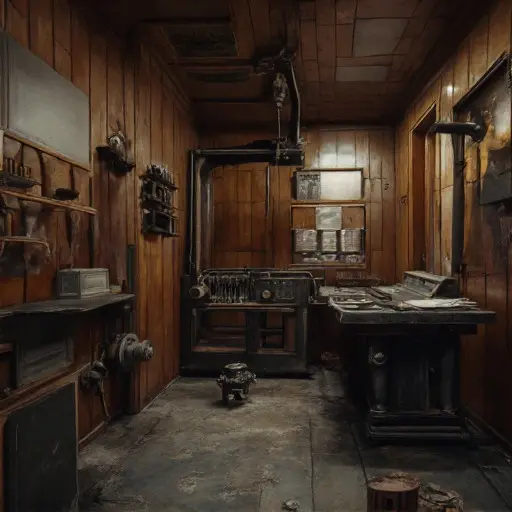
Dr. Thorne’s Fitting Chamber was the engine of his obsession. Here, he worked to isolate and stabilize his final, most critical patterns. We found his final, detailed Dimensional Compendium, bound in thick, heavily varnished wood covers. His entries chronicled his escalating desperation to find the “Zero-Movement Garment”—a suit so perfect it prevented all non-essential movement. His notes revealed that he had begun to believe the most chaotic element was the act of breathing and the slight, continuous expansion and contraction of the human form. His final project, detailed meticulously, was the creation of a massive, unique, internal “Master Suit”—a final, massive, single-piece garment stitched from the most stable, non-stretch materials, designed to perfectly encase a subject and permanently fix their form in a state of absolute, static perfection.
The Final Garment
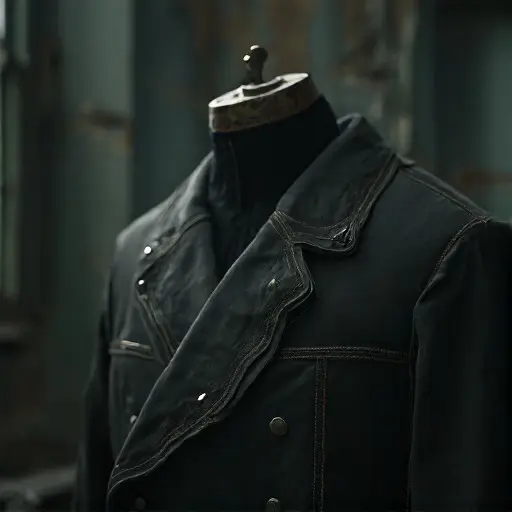
The most chilling discovery was made back in the main studio. Tucked carefully onto the rotating mannequin stand was the Master Suit. It was a massive, single-piece garment of dark, tightly woven treated canvas, stitched with unnaturally small, perfect seams, and reinforced with tiny, visible brass rivets at every stress point. The suit was utterly flawless, showing no sign of crease or wrinkle, but its form was unnervingly rigid and empty. Tucked into the collar, where the final securing stitch would be, was a single, small, tarnished steel thimble, its surface worn smooth. Tucked beneath the mannequin stand was Dr. Thorne’s final note. It revealed the tragic climax: he had successfully stitched his “Master Suit,” achieving the absolute, unyielding garment he craved. However, upon completing the final seam, he realized that a garment that perfectly eliminates all natural movement and asymmetry is a garment that can never truly contain life; it is merely a perfect, rigid shell. His final note read: “The stitch is final. The form is fixed. But the truth of a body is in its yielding.” His body was never found. The final stitch of Calico-Rivet Keep is the enduring, cold, and massive, empty canvas suit, a terrifying testament to a tailor who achieved dimensional perfection only to find the ultimate, necessary flaw was the removal of the very organic fluidity that defines existence, forever preserved within the static, sterile stasis of the abandoned Victorian house.}