The Final Weft of Punctus-Knot Keep
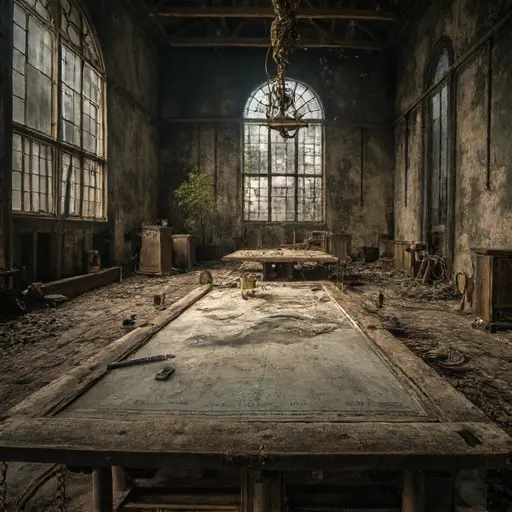
Punctus-Knot Keep was an architectural study in directional certainty: a massive, symmetrical structure built of dark, wind-battered granite, characterized by numerous small, external cupolas and a single, towering, empty flagpole. Its name suggested a blend of precise marking and binding fastening. The house stood on the very tip of a narrow, exposed peninsula, giving it an unparalleled view of the treacherous ocean. Upon entering the main chart room, the air was immediately cold, thin, and carried a potent, mineral scent of aged parchment, oxidized salt, and a subtle, metallic tang. The floors were rough, uneven stone, amplifying every faint sound into an unsettling echo. The silence here was not merely quiet; it was an intense, navigational stillness, the profound hush that follows the failure of all wind, all tide, and all directional certainty. This abandoned Victorian house was a giant, sealed compass, designed to achieve and hold a state of absolute, unchangeable, physical fixation.
The Navigator’s Absolute Anchor
Punctus-Knot Keep was the fortified residence and elaborate workshop of Master Navigator Alistair Thorne, a brilliant but pathologically obsessive cartographer and ship captain of the late 19th century. His professional life demanded the precise plotting of coordinates, the flawless tying of complex knots, and the pursuit of absolute, irrefutable directional certainty. Personally, Master Thorne was tormented by a crippling fear of drifting—both geographical and emotional—and a profound paranoia that all human endeavor was doomed to inevitably lose its way. He saw the Keep as his ultimate anchor: a space where he could finally design and execute a single, perfect, unchangeable knot that would ensure his existence was permanently fixed to a single point in time and space.
The Sealing Chamber
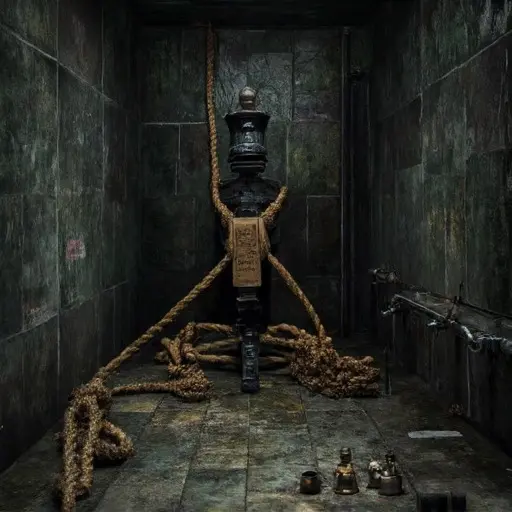
Master Thorne’s Sealing Chamber was the engine of his obsession with fixation. Here, he tested his knots to the point of catastrophic failure, seeking a knot that would literally never break or loosen. We found his final, detailed Binding Log, bound in thick, heavily waxed canvas. His entries chronicled his escalating desperation to create a “Zero-Slip Knot”—a fastener so perfect it would become an extension of the rope itself. His notes revealed that he had begun to view his own heart as the last unanchored point of weakness, the emotional center that always threatened to “drift” from certainty. His final project, detailed meticulously, was the creation of a massive, unique, internal “Master Knot”—a final, absolute physical knot designed to permanently bind the core foundation pillars of the house together, ensuring the entire structure could never shift its coordinates.
The Final Knot
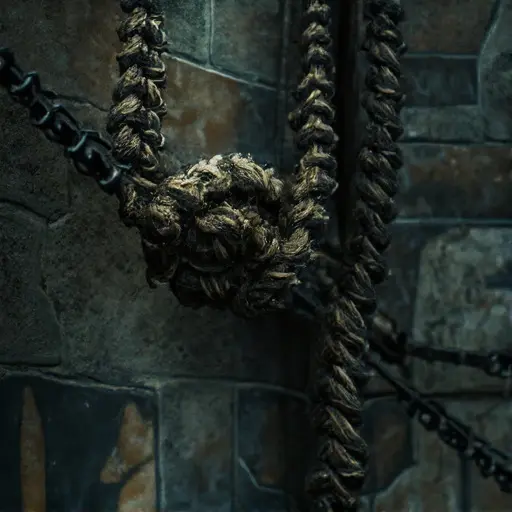
The most chilling discovery was made deep within the foundation, in the central cistern room where the main granite pillars met. Here, wrapped around the two massive, damp granite pillars, was the Master Knot. It was an immense, complex, flawless knot made of heavy, woven steel cable, secured so tightly that the metal fibers had bitten into the granite. Tucked into the precise center of the knot, where the final securing tuck would be, was a single, small, tarnished brass key, its head wedged deep within the woven metal. Tucked beneath the knot was Master Thorne’s final note. It revealed the tragic climax: he had successfully tied his perfect, unassailable knot, achieving the permanent, fixed connection he craved between the foundation and the earth. He realized, however, that a knot so perfect could never be untied, and that in securing the house forever, he had permanently locked himself into a single, unmoving coordinate, making the entire world outside irrelevant. The brass key was the key to his life-long treasure, but its purpose was now moot. His final note read: “The knot is final. The coordinate is fixed. The freedom was always in the ability to cast off.” His body was never found. The final weft of Punctus-Knot Keep is the enduring, cold, and utterly massive steel knot, a terrifying testament to a navigator who achieved absolute fixation only to find the ultimate, necessary flaw was the loss of all potential for journey, forever preserved within the immovable silence of the abandoned Victorian house.}