The Captive Bloom of Verdant-Cairn Hall
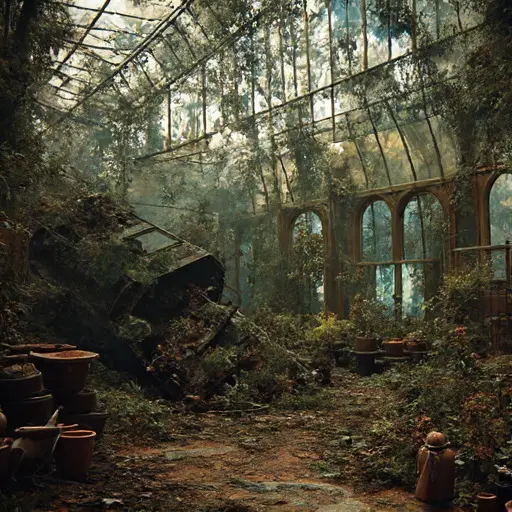
Verdant-Cairn Hall was an architectural blend of fragility and containment: a sprawling mansion of pale yellow stone and numerous attached, sealed glasshouses. Its name suggested a blend of rich green life and a burial mound. The house sat high on a remote, exposed coastal hill, making it perpetually vulnerable to harsh, shifting weather. Upon entering the main conservatory, the air was immediately cold, thin, and carried a potent, almost dusty scent of aged peat moss, dried bark, and a subtle, sterile aroma of chemical preservatives. The floors were covered in heavy, smooth flagstones, now slick with dust and dried soil, amplifying every faint sound into an unsettling echo. The silence here was not merely quiet; it was an intense, biological stillness, the profound hush that enforces the memory of vibrant growth suddenly and permanently stopped. This abandoned Victorian house was a giant, sealed greenhouse, designed to achieve and hold a state of absolute, unchangeable, botanical perfection.
The Botanist’s Absolute Stasis
Verdant-Cairn Hall was the fortified residence and elaborate workshop of Dr. Alistair Thorne, a brilliant but pathologically obsessive botanist and horticultural chemist of the late 19th century. His professional life demanded the relentless study of plant pathology, the meticulous control of microclimates, and the pursuit of absolute, permanent floral perfection—a flower that never wilted, a leaf that never yellowed. Personally, Dr. Thorne was tormented by a crippling fear of natural change and a profound desire to make the fleeting, vulnerable beauty of the natural world static and immune to the cycle of decay. He saw the Hall as his ultimate living laboratory: a space where he could finally engineer and preserve a single, perfect, unchanging bloom that would visually encode the meaning of eternal life.
The Germination Vault
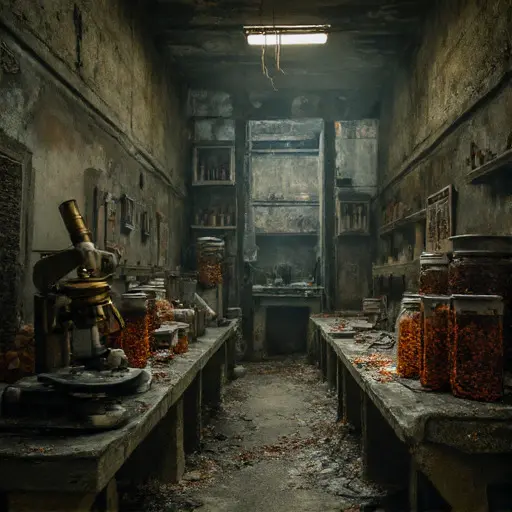
Dr. Thorne’s Germination Vault was the inner sanctum of his obsession. Here, he chemically treated seeds to force them into a state of “eternal dormancy.” We found his final, detailed Stabilization Compendium, bound in heavy, wax-coated canvas. His entries chronicled his escalating desperation to eliminate all biological variability, which, by the end, included the very sunlight and water necessary for life. His notes revealed that he had begun to believe the only perfect plant was one that was perfectly frozen in the moment of its greatest potential: the unsprouted seed. His final project, detailed meticulously, was the engineering of a massive, unique, internal “Eternal Bloom”—a single, massive flower grown under highly controlled, toxic conditions, designed to reach a state of flawless, perpetual, living stasis.
The Final Specimen
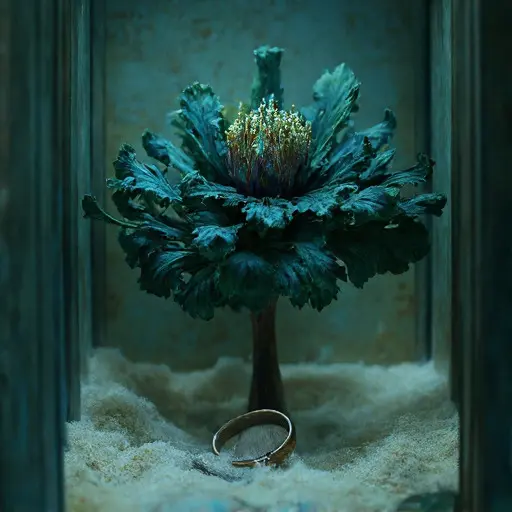
The most chilling discovery was made back in the main conservatory. Near the center, a tall, iron-framed glass case stood slightly ajar. Inside, planted in a bed of sterile white sand, was the Eternal Bloom. It was a single, towering flower, massive in scale, its petals and leaves perfectly formed and unnaturally vibrant in color. It was visibly intact, but utterly dry and brittle, having been preserved by a flash-drying and chemical process. Tucked into the sterile sand at the base of the plant was a single, small, tarnished copper wedding band. Tucked beneath the ring was Dr. Thorne’s final note. It revealed the tragic climax: he had successfully engineered his perfect, unchanging bloom. But in the final, toxic stage of the preservation process, his wife, Elara, who had tried to save the plant with water, was caught in the fumes, forcing him to choose between saving her and securing his final, perfect specimen. He chose the specimen. His final note read: “The Bloom is absolute. The life is perfect only in the absence of breath. I achieved stasis, but the water failed.” His body was never found. The captive bloom of Verdant-Cairn Hall is the enduring, cold, and unnaturally vibrant single flower, a terrifying testament to a botanist who achieved life’s perfect form only by making his final, heartbreaking sacrifice permanent and visible, forever preserved within the brittle silence of the abandoned Victorian house.}