The Final Curve of Locus-Spine Keep
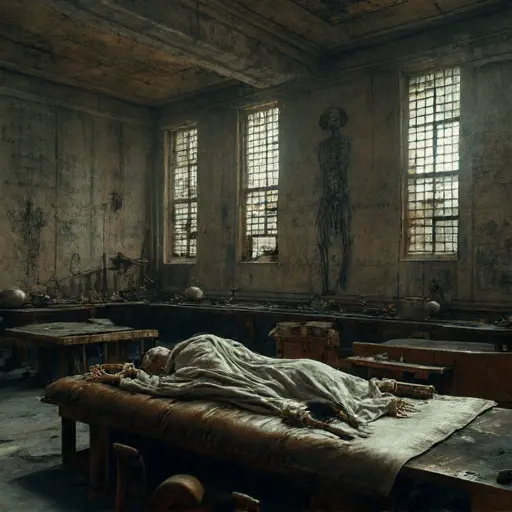
Locus-Spine Keep was an architectural statement of functional rigidity: a massive, symmetrical structure built of pale, smooth limestone, characterized by numerous internal columns and load-bearing walls that mirrored the verticality of a spinal column. Its name suggested a blend of specific position and core skeletal structure. The house stood on a rise, highly exposed to the sun, yet the interior felt unnaturally cold and sterile. Upon entering the main laboratory, which was devoted entirely to orthopedics and neuroanatomy, the air was immediately cold, thin, and carried a potent, almost dusty scent of dried gypsum, bone glue, and a subtle, metallic odor. The floors were covered in heavy, smooth tiles, now slick with dust, amplifying every faint sound into an unsettling echo. The silence here was clinical and absolute, the unnerving quiet that follows the halt of intense, life-altering surgical labor. This abandoned Victorian house was a temple to the human frame, designed to achieve and hold a state of perfect, unchangeable physical alignment.
The Surgeon’s Absolute Fixation
Locus-Spine Keep was the fortified residence and elaborate workshop of Dr. Alistair Finch, a brilliant but pathologically obsessive orthopedic surgeon and anatomist of the late 19th century. His professional life demanded the relentless study of skeletal disorders, the flawless execution of corrective surgery, and the pursuit of absolute, symmetrical physical form. Personally, Dr. Finch was tormented by a crippling fear of deformation and a profound paranoia that all human life was fatally flawed by the slight, inevitable curvature of the spine. He saw the Keep as his ultimate laboratory: a space designed to filter out all human frailty and establish a single, pure, irrefutable “Zero-Degree Curvature” in the human form.
The Bracing Chamber
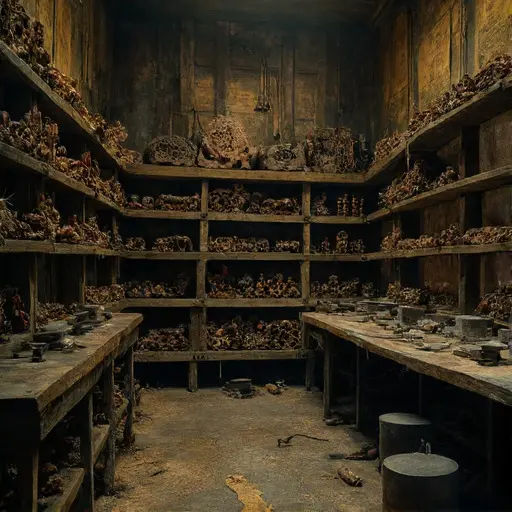
Dr. Finch’s Bracing Chamber was the core of his corrective work. Here, he crafted the devices meant to force the body into his desired alignment. We found his final, detailed Subject Case Log, bound in stiff, treated leather. His entries chronicled his escalating desperation to achieve a permanent, internal correction. He began to believe that the external braces were merely a temporary fix and that the will of the subject was the only thing capable of enforcing the Zero-Degree Curvature. His notes revealed that he had begun to focus exclusively on his final, ultimate patient: his wife, Lady Elara, whom he believed had a slight, but unacceptable, curve in her upper spine. His final project, detailed meticulously, was the creation of a massive, unique, internal “Spine of Truth”—a final, absolute record of the body’s true alignment.
The Ultimate Diagram
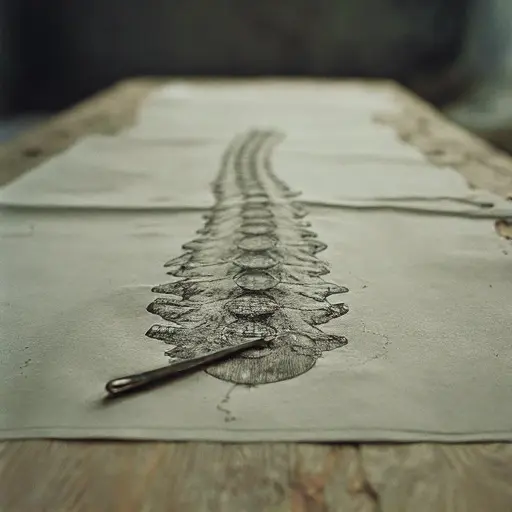
The most chilling discovery was made back in the main laboratory. Tucked beneath the glass case holding the articulated skeleton was a massive, fragile sheet of tracing paper. This was the Master Anatomical Diagram. The map was not of a whole body, but an intensely detailed, life-sized drawing of a single human spine, rendered in micro-detail. Tucked beneath the diagram was a single, small, heavy surgical scalpel, its blade tarnished and dull. Tucked beneath the scalpel was Dr. Finch’s final note. It revealed the tragic climax: he had finally realized that the only spine in the world capable of achieving the Zero-Degree Curvature was a spine that no longer supported a living, moving body. He had found that his wife’s actual spine, when examined post-mortem (her disappearance having been noted weeks prior), was in fact perfectly straight. His final note read: “The curve is life. The line is finality. I achieved the perfect structure, but the subject was lost.” His body was never found. The final curve of Locus-Spine Keep is the enduring, cold, and terrifyingly straight spine on that Master Diagram, a testament to a surgeon who achieved structural perfection only by accepting the ultimate stillness of death, preserved within the clinical silence of the abandoned Victorian house.}