The Echoed Step of Phasma-Sole House
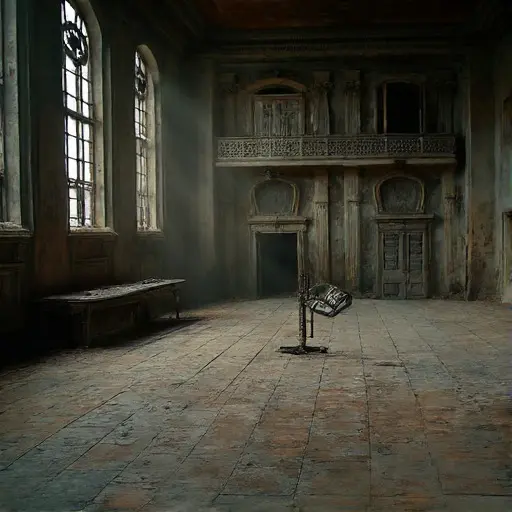
Phasma-Sole House was an architectural contradiction: a mansion of heavy, dark brick built around a massive, resonant central wooden floor. Its name suggested a blend of spectral apparition and the solitary bottom of a foot. The house sat low in a valley, perpetually prone to fog, giving it an ethereal, half-seen presence. Upon entering the main ballroom, the air was immediately cold, thin, and carried a potent, almost dusty scent of old velvet, floor wax, and a subtle, sickly-sweet perfume. The floors were highly polished wood, now dull and slick, making every faint movement sound unnaturally loud. The silence here was not merely quiet; it was an intense, rhythmic stillness, the profound hush that enforces a memory of motion, suggesting that the very air still waits for the beat to recommence. This abandoned Victorian house was a giant, sealed echo chamber, designed to capture and hold the perfect pattern of a single, beautiful dance.
The Choreographer’s Permanent Movement
Phasma-Sole House was the fortified residence and elaborate rehearsal space of Maestro Julian Thorne, a brilliant but pathologically obsessive choreographer and dance master of the late 19th century. His professional life demanded the precise plotting of movement, the flawless execution of complex steps, and the pursuit of absolute rhythmic perfection—a dance without error, stumble, or spontaneous variation. Personally, Maestro Thorne was tormented by a crippling fear of temporal decay in art and a profound desire to make the ephemeral beauty of human movement permanent and visible. He saw the House as his ultimate stage: a space where he could finally record and preserve a single, perfect sequence of dance steps that would ensure the emotional and physical moment was eternally safe from error.
The Step Notation Studio
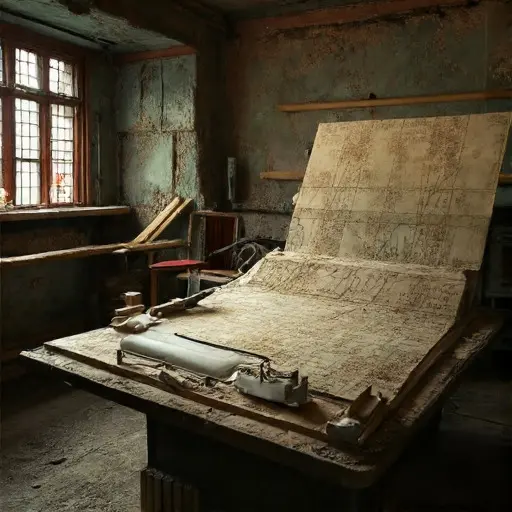
Maestro Thorne’s Step Notation Studio was the intellectual core of his obsession. Here, he worked to translate the fluid art of dance into a rigid, permanent code. We found his final, detailed Choreographic Compendium, bound in heavy, treated leather. His entries chronicled his escalating desperation to create a “Zero-Fault Sequence”—a dance so mathematically flawless that it could be recreated perfectly centuries later. His notes revealed that he had begun to believe the only way to achieve true permanence was to eliminate the dancer entirely, ensuring the floor itself held the perfect, final instruction. His final project, detailed meticulously, was the creation of a massive, unique, internal “Dance Map” of the central ballroom floor, designed to be the final, visible, eternal record of his perfect sequence.
The Imprinted Floor
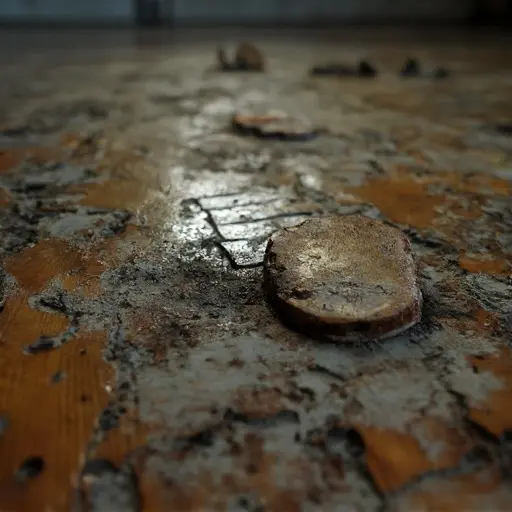
The most chilling discovery was back in the main ballroom. Tucked into a concealed, small panel near the entrance, we found a collection of heavy, steel-plated foot molds, shaped like a pair of high-heeled dance shoes, coated in a fine, white powder. Tucked beneath the molds was Maestro Thorne’s final note. It revealed the tragic climax: he had finally completed his perfect dance sequence, and to make it permanent, he coated the entire ballroom floor in a specially formulated, rapidly drying clear lacquer. He then performed the sequence one last time, wearing the steel-plated molds on his feet, creating a series of deep, indelible scars and depressions in the lacquer—a permanent, physical map of the dance. But upon finishing, he realized he was eternally bound to that single, static sequence. His final note read: “The movement is permanent. The rhythm is broken. The silence is the only applause.” His body was never found. The echoed step of Phasma-Sole House is the enduring, cold, scarred floor of the ballroom, a terrifying testament to a choreographer who achieved permanence for his art only by making the memory of his final, perfect performance static and visible, forever bound within the silence of the abandoned Victorian house.}