The Shadow Play of Quiver-Chord House
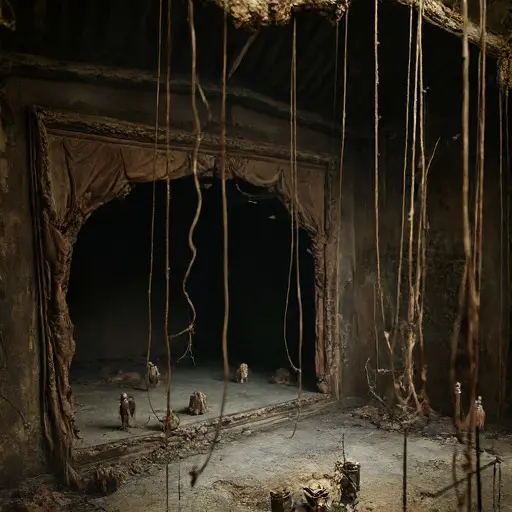
Quiver-Chord House was an architectural oddity: a mansion of dark, almost black brick, built with numerous internal balconies and a massive, recessed central well that resembled a theater-in-the-round. Its name suggested the combination of nervous tremor and musical harmony. The house sat deep within a perpetually shadowed grove, where the exterior light was always muted. Upon entering the vast foyer, the air was immediately thick, cool, and carried a potent, almost dusty scent of old velvet, sawdust, and a lingering, faint trace of greasepaint. The floors were heavily carpeted with thick, threadbare rugs that muffled all footsteps. The silence here was theatrical and chilling, the profound hush that enforces the suspension of disbelief, suggesting that the drama has been halted mid-scene. This abandoned Victorian house was a machine built for narrative, now frozen in its final, tragic act.
The Puppeteer’s Perfect Control
Quiver-Chord House was the secluded domain and elaborate workshop of Lord Julian Thorne, a brilliant but pathologically controlling puppeteer and playwright of the late 19th century. His professional life demanded impeccable manipulation, the flawless projection of voice, and the absolute control over narrative and character destiny. Personally, Lord Thorne was defined by an extreme fear of loss of control and a profound paranoia that all personal relationships were fundamentally unstable. He saw the House as his ultimate stage, convinced that by replacing real human interaction with the perfect, predictable movements of his marionettes, he could achieve a permanent, unchangeable form of emotional safety.
The Scriptorium of Alternate Endings
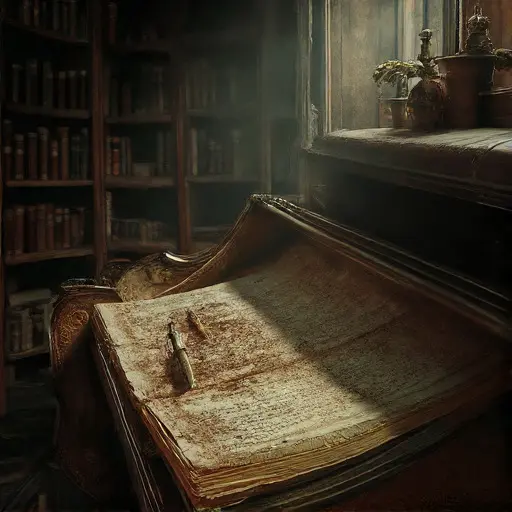
Lord Thorne’s Scriptorium was the intellectual core of his obsession. Here, among the endless stacks of scripts, we found his final, comprehensive Master Playbook, bound in dark, heavy leather. His entries chronicled his escalating desperation to write a script with a truly “safe” ending—one where the primary characters could not be separated or harmed. His notes revealed that he had begun to write his wife, Lady Clara, and his assistant, Mr. Davies, into his plays, simultaneously manipulating their real-life actions to mirror the script. His final project, detailed meticulously, was a script titled “The Unending Knot,” where the final act involved the characters becoming permanently tethered together, ensuring they could never leave the stage.
The Final Backstage Scene
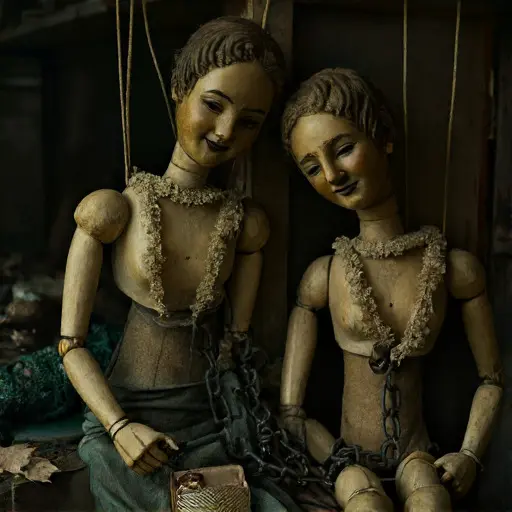
The most chilling discovery was made backstage, in the small, cramped area directly behind the proscenium arch. Here, amidst the ropes and pulleys, we found the “The Unending Knot” tableau. Resting on a low wooden bench were two life-sized, intricately carved marionettes, dressed in the formal attire of the play’s protagonists. Their limbs were articulated and their faces painted with expressions of serene, static joy. However, instead of strings, the two figures were physically connected by a thick, heavy, iron chain bolted through their wooden torsos, ensuring they were permanently joined. Tucked beneath the figures was Lord Thorne’s final note. It revealed the tragic climax: Lady Clara, terrified by his attempt to chain her to his reality, had fled the House, leaving her own marionette replica behind. Lord Thorne, unable to bear the imperfection, performed the final act alone, ensuring the theatrical version of his life ended with the perfect, unchangeable control he craved. His final note read: “The connection is solid. The fear is severed. The final curtain does not fall.” His body was never found. The shadow play of Quiver-Chord House is the enduring, silent scene on that hidden backstage bench, a terrifying testament to a puppeteer who, in his quest for control, permanently fixed the only love he had left, leaving the abandoned Victorian house as a monument to a static, unbreakable, wooden fidelity.