The Glass Cage of Eon-Whisper Manor
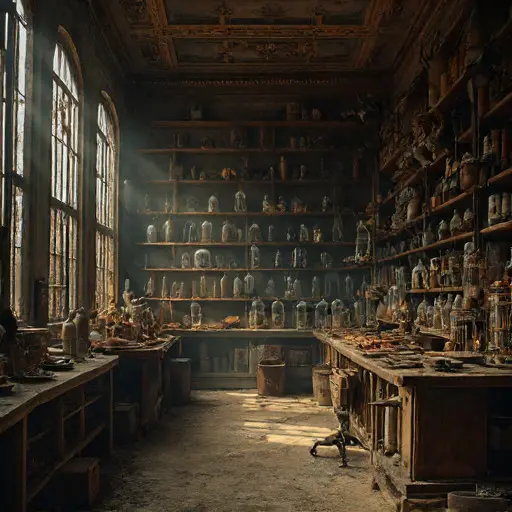
Eon-Whisper Manor was an architectural blend of elegance and macabre utility: a mansion of white limestone and numerous expansive, glass-covered wings. Its name suggested a blend of eternal time and faint, captured sound. The house stood on a rise overlooking a marsh, giving it a perpetually damp and misty atmosphere. Upon entering the main gallery, the air was immediately cold, dry, and carried a potent, almost chemical scent of dried spices, old leather, and preserving agents. The floors were covered in a thin, brittle layer of plaster dust and fine sand, muffling all sound. The silence here was uncanny, a profound quiet that felt less like absence and more like a permanent, careful containment of sound and motion. This abandoned Victorian house was a giant, fragile display case, designed to capture and hold life in a perfect, frozen state.
The Taxidermist’s Final Collection
Eon-Whisper Manor was the secluded domain and elaborate workshop of Dr. Elias Alcott, a brilliant but pathologically obsessive naturalist and master taxidermist of the late 19th century. His professional life demanded impeccable anatomical precision, the meticulous recreation of life-like poses, and the scientific preservation of organic matter. Personally, Dr. Alcott was defined by a crippling fear of impermanence and a profound desire to freeze the vibrant beauty of life before it inevitably decayed. He saw the Manor as his ultimate laboratory: a space designed to house his perfect, static collection, convinced that by achieving absolute physical stillness, he could achieve a permanent, visible form of immortality for his subjects.
The Articulation Studio
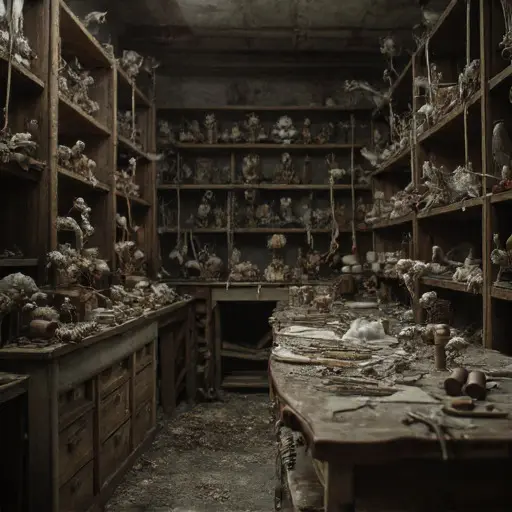
Dr. Alcott’s Articulation Studio was the nexus of his creative process. Here, amidst the skeletal armatures and surgical tools, we found his final, detailed Subject Log, bound in stiff, treated leather. His entries chronicled his escalating desperation to find the “Perfect Specimen”—a creature so exquisitely beautiful that its preservation would justify his entire life’s work. His notes revealed that he had begun applying his taxidermy techniques to non-biological items: leaves, moss, and even small fragments of lace, attempting to freeze them into a perfect, permanent state of life-like fragility. His final project, detailed meticulously, was the preparation of the most important subject of all: his own wife, Lydia.
The Cabinet of Stillness
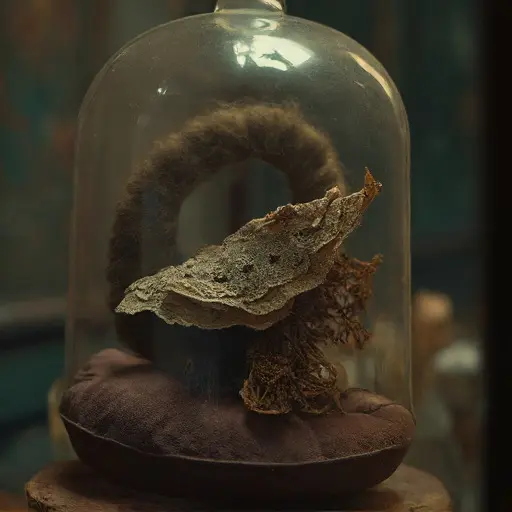
The most unsettling discovery was in Dr. Alcott’s private study, which contained a large, ornately carved wooden cabinet, locked and bolted. This was the “Cabinet of Stillness.” Inside, amidst numerous small, perfectly preserved bird specimens, rested a single, small, glass-domed display. Under the dome was not an animal, but a single, perfectly arranged cluster of Lydia’s lace handkerchiefs and a coil of her long, dark hair, all meticulously treated with preserving agents and arranged in a life-like manner. Tucked beneath the dome was Dr. Alcott’s final note. It revealed the tragic climax: Lydia, terrified by her husband’s obsession with preserved death, had fled the manor weeks earlier. Dr. Alcott, finding his ultimate subject gone, had turned his attention to her personal effects, preserving them as the ultimate “Specimen of Memory.” His final note read: “The movement is gone. The form is perfect. She is now forever visible.” His body was never found. The glass cage of Eon-Whisper Manor is the enduring, fragile silence of the multitude of preserved life, a terrifying testament to a man who, in his quest for eternal stasis, turned the memory of his lost wife into a final, heartbreaking museum piece within the silent abandoned Victorian house.