The Silent Witness of Ember-Cinder Keep
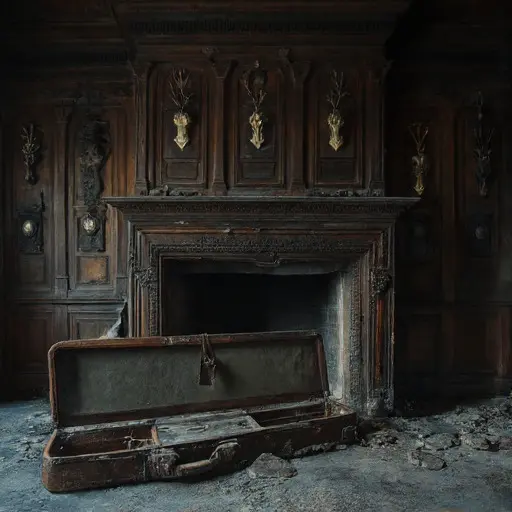
Ember-Cinder Keep was a massive, blocky structure built of rough-hewn, black volcanic rock, giving it a permanent, scorched appearance. Its name suggested the dying remnants of a fire—heat reduced to cold ash. The house was situated on a high, exposed ridge where the wind whistled constantly, yet the interior felt unnaturally still. Upon entering the main gallery, the air was immediately cold, dry, and carried a potent, mineral scent of burnt earth, aged tobacco, and a faint, acrid trace of gunpowder. The floors were rough, slate flagstones, amplifying every sound, yet the house itself was profoundly silent. This abandoned Victorian house was a fortress built to commemorate a specific, catastrophic event, its walls holding the memory of a blast.
The Military Engineer’s Calculated Absence
Ember-Cinder Keep was the fortified residence and personal armory of Major Elias Thorne, a brilliant but psychologically scarred military engineer and artillery expert of the late 19th century. His professional life demanded the precise calculation of ballistics, explosives, and structural resilience, focusing on controlled destruction. Personally, Major Thorne was defined by an extreme fear of leaving evidence after a disastrous, miscalculated military operation that killed several men under his command. He saw the Keep as his final, ultimate engineering project: a space designed not to preserve, but to perfectly erase all trace of his personal history, turning the mansion into a calculated, systematic void.
The Cartography Vault
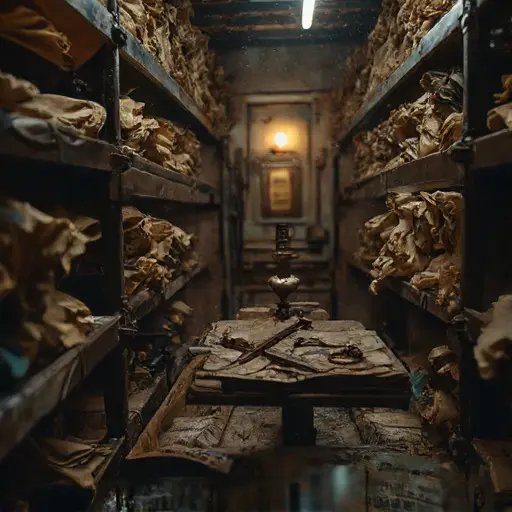
Major Thorne’s Cartography Vault was a sealed, air-locked chamber used for his strategic planning. Here, among the neatly shelved military maps, we found his final, meticulous Operational Journal, bound in thick, military canvas. His entries chronicled his escalating paranoia about the physical remnants of his past, which he termed “Persistent Data.” He began to view all objects in the house as dangerous evidence that must be neutralized. His notes revealed that he had begun a systematic plan to remove every personal item from the Keep—every photo, book, letter, and piece of clothing—and burn them in the central furnace, reducing them to untraceable ash. His final project, detailed in the Journal, was the preparation of a final charge—a small, precisely calculated explosive device—intended to destroy the last piece of “Persistent Data”: the Journal itself.
The Furnace Chamber of Void
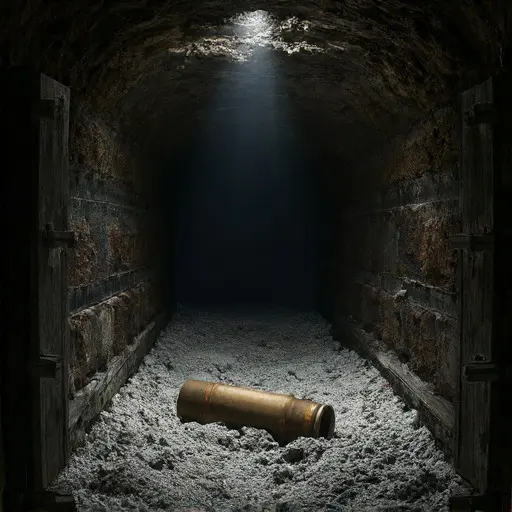
The most chilling discovery was in the massive, reinforced furnace room in the deep basement. The furnace itself was immense, its iron door open and its chamber filled with a thick layer of fine, silvery-gray ash. Scattered on the stone floor near the furnace mouth were numerous fragments of charred, brittle paper and linen—the remnants of the Major’s meticulous purge. Tucked deep inside the cold, dusty furnace, resting on the final layer of ash, was a single, heavy, brass artillery shell casing, dented and empty. Major Thorne’s final journal entry, found resting inside the shell casing, was a chilling, mathematical statement: “Data Points eliminated. System Integrity 100%. End State: Void.” His body was never found. The silent witness of Ember-Cinder Keep is the absolute, chilling emptiness of the rooms and the profound silence of the furnace, a terrifying monument to a man who, in his obsession with erasure, ensured his only enduring memorial was the meticulously engineered void within the abandoned Victorian house.