The Static Bloom of Gilt-Frayne House
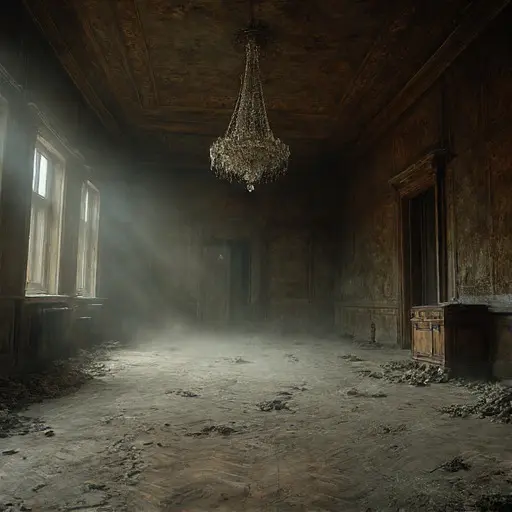
Gilt-Frayne House was a towering, excessively ornate mansion built of white marble and imported, richly detailed wood. Its name suggested a blend of superficial wealth and inevitable decay. The house stood on a prominent hill, highly visible yet profoundly isolated. Upon entering the vast reception hall, the air was immediately cold, thin, and carried a potent, almost chemical scent of old wax, dry plaster, and a faint, sweet trace of crystallized sugar. The floors were covered in a brittle, undisturbed layer of dust, silencing every footstep. The silence here was perfect and brittle, the unnerving stillness that follows a violent, instantaneous collapse of activity. This abandoned Victorian house was a temple to artifice, where a desperate attempt was made to freeze a moment of manufactured joy.
The Confectioner’s Frozen Joy
Gilt-Frayne House was the fortified residence and elaborate workshop of Lady Elara Thorne, a brilliant but pathologically controlling master confectioner and food artist of the late 19th century. Her professional life demanded impossible precision, the mastery of sugar chemistry, and the creation of elaborate, beautiful, yet inherently fleeting edible sculptures. Personally, Lady Elara was tormented by a profound fear of emotional chaos and the belief that all happiness was temporary and fragile. She built the House as her ultimate display case, convinced that she could capture and preserve perfect, crystallized moments of joy using her art, making her personal life as beautiful and unchangeable as a sugar sculpture.
The Sugar Laboratory
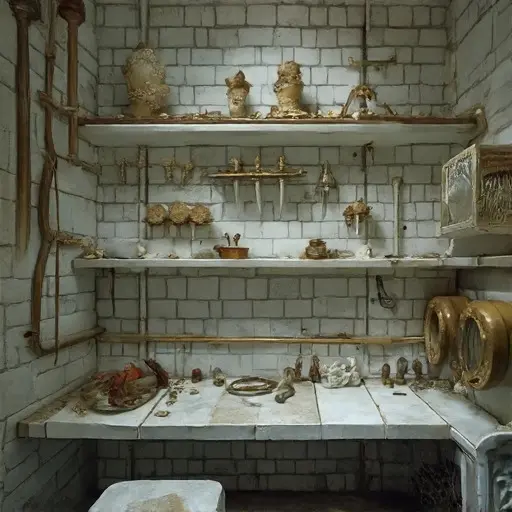
Lady Elara’s Sugar Laboratory was a sterile, brightly lit space that contrasted sharply with the rest of the house. Here, among the intricate tools and dusty chemicals, we found her comprehensive Artisan’s Ledger, bound in smooth white vellum. Her entries chronicled her escalating desperation to create a “Perfect Moment” sculpture—a tableau made entirely of crystallized sugar and edible lace that would capture the singular, ecstatic joy of her wedding day. Her notes revealed that she stopped creating edible art entirely and began using her sugar preservation techniques on non-edible items: clothing, lace, and dried flowers, attempting to freeze them into a perfect, permanent state of static bloom.
The Wedding Cake Monument
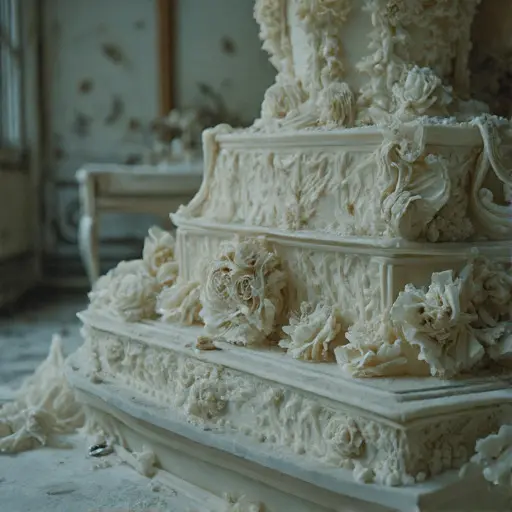
The final, most chilling discovery was in the grand ballroom. In the center of the room, on a circular, marble pedestal, stood a massive, towering wedding cake. It was not a real cake, but a life-sized, incredibly intricate sculpture made entirely of white, crystallized sugar. The sugar has solidified over decades, making it brittle yet unmoving. Tucked into the base of the sculpture was a final, sealed glass bottle containing her last note. It revealed the tragic climax: Her husband, Alistair, had left her shortly after their wedding, unable to live under the rigid control of her perfect, joyless household. Lady Elara, unable to accept the emotional reality, crystallized her entire wedding scene, believing that by preserving the appearance of the joy, she made the betrayal irrelevant. The final note read: “The sculpture is perfect. The moment is now eternal. I am finished with time.” The static bloom of Gilt-Frayne House is the visible, brittle proof of her self-imposed, sweet, and terrifying prison, where the ultimate joy was preserved as the ultimate, inedible artifact within the abandoned Victorian house.