The Invisible Stitch of Gossamer-Fell House
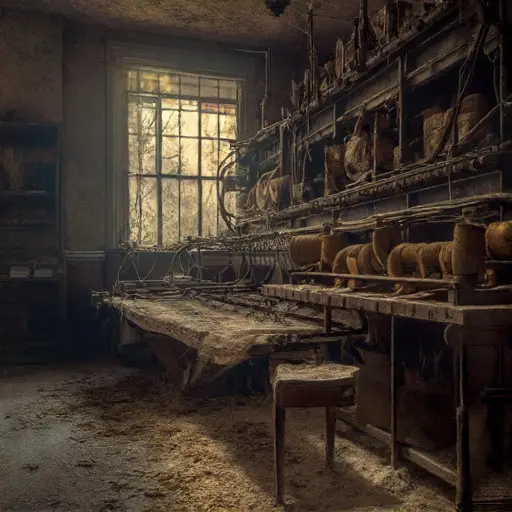
Gossamer-Fell House was an architectural contradiction: a mansion built of heavy, dark brick, yet featuring entire upper floors constructed of light, delicate wooden frameworks and glass. Its name suggested the combination of fine, ethereal thread and a solid, weighty drop. The house sat low in a valley, where the air was perpetually humid and cool. Upon entering the main workshop, the air was immediately thick, dry, and carried a potent, almost dusty scent of raw cotton, wool grease, and old machine oil. The floors were rough, uneven wood, scarred by heavy machinery. The silence here was profoundly unsettling, the complete absence of the relentless, rhythmic clatter and thump of the looms that once filled the space. This abandoned Victorian house was a factory of fragility, designed to create beauty, but ultimately consumed by its own delicate nature.
The Weaver’s Perfect Fabric
Gossamer-Fell House was the isolated residence and elaborate factory of Alistair Vance, a brilliant but pathologically obsessive master weaver and textile engineer of the late 19th century. His professional life demanded relentless precision, the control of tension and color, and the pursuit of invisible seams and flawless, delicate patterns. Personally, Alistair was defined by a crippling fear of flaw and the belief that all human imperfections were visible and permanent. He built the House around his elaborate looms, convinced that he could weave a fabric so perfect, so utterly without error, that it would transcend the material and achieve a kind of aesthetic invisibility.
The Pattern Vault
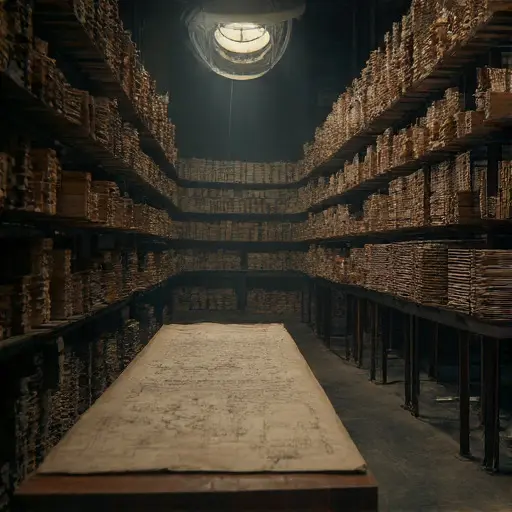
Alistair’s Pattern Vault was the brain of his operation. Here, among the endless stacks of punched Jacquard cards, we found his Technical Compendium, bound in heavy canvas. His entries chronicled his escalating desperation to eliminate all errors from his weaving. He began to believe that the pattern itself held the flaw, and he started designing fabrics that were purely texture, devoid of color or visible design—a kind of ‘un-pattern.’ His notes revealed his deepest secret: he was not weaving for commercial gain, but to create a shroud for his young wife, Eliza, who had died of tuberculosis years earlier. His goal was to weave a “Fabric of Absence” that would perfectly enclose her memory, making her visible only to him.
The Final Bolt
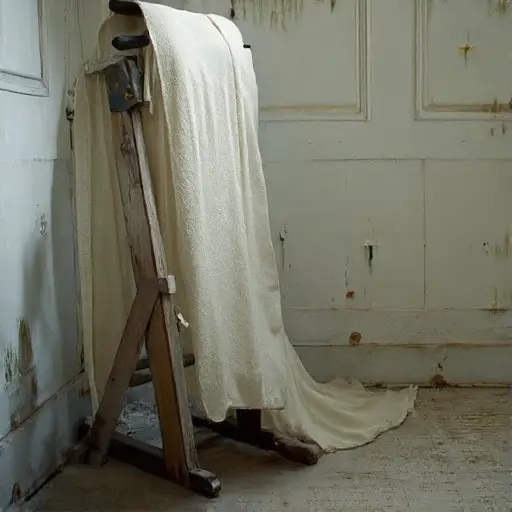
The most poignant and chilling discovery was in the smallest, final annex off the main loom room—a clean, white-painted space designed for final inspection. Here, resting on a small, elevated wooden trestle, lay the final product: a massive, perfectly rolled bolt of fabric. It was colorless, unbleached, and seemingly flawless. Tucked beneath the bolt was Alistair’s final diary entry. It revealed that he had finally achieved perfection in the “Fabric of Absence,” a texture so fine that the eye could barely register it. He had wrapped himself entirely in the bolt of cloth, convinced that by achieving a flawless, invisible aesthetic, he would finally join the perfect, invisible memory of his wife. The bolt was found partially unrolled and empty. The invisible stitch of Gossamer-Fell House is the profound stillness of the looms and the terrifying beauty of a final, empty, flawless textile that swallowed its creator whole, leaving the abandoned Victorian house as a testament to the fatal pursuit of invisible perfection.