The Veiled Garden of Veridian-Hearth
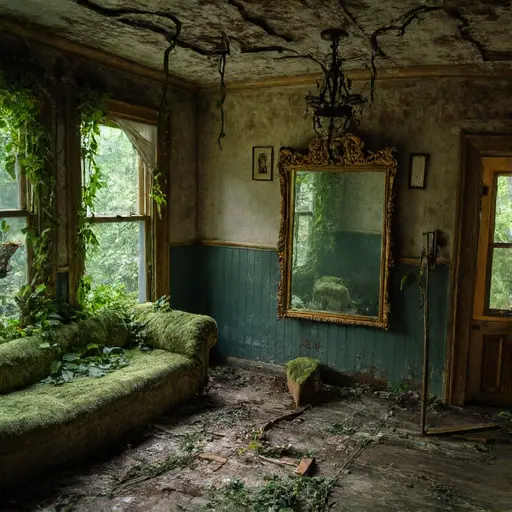
Veridian-Hearth was an architectural fusion of domestic comfort and untamed nature. The house was built of pale green-tinged stone and featured numerous interconnected internal courtyards and large, glass-covered passages. Its name suggested a blend of green life and central warmth. It sat in a lush, perpetually misty valley, where the boundary between the cultivated and the wild was always blurred. Upon entering the main hall, the air was immediately damp, heavy, and carried a thick, almost overwhelming scent of compost, wet leaves, and decaying wood. The floors were uneven, slate flagstones, often slick with moisture. The silence here was organic, broken only by the soft, intermittent drip-drip of water and the rustle of unseen life. This abandoned Victorian house was less a structure and more a biological experiment that had spiraled out of control, its human history suffocated by relentless growth.
The Gardener’s Endless Cultivation
Veridian-Hearth was the lifelong residence and ambitious project of Elara Thorne, a brilliant but deeply reclusive amateur botanist and obsessive gardener of the late 19th century. Her professional life was dedicated to the propagation of rare, exotic flora, particularly species that thrived in challenging, controlled environments. Personally, Elara was defined by an acute fear of external reality and the chaos of the outside world, seeing her garden as the only true, controllable paradise. She built the Hearth to encapsulate a perfect, self-sustaining ecosystem, convinced that she could achieve true, permanent serenity by eliminating all external variables and living entirely within the curated bubble of her abandoned Victorian house.
The Vivarium of Controlled Life
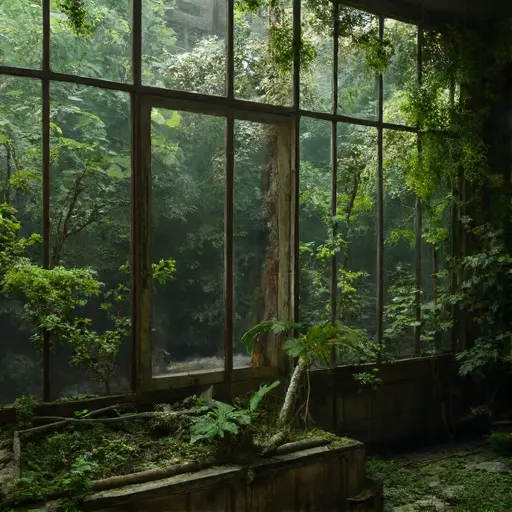
Elara’s Vivarium was the core of her isolated world, a massive glass box designed to hold her rarest, most delicate hybrid plants. Here, the temperature was once meticulously controlled. We found her comprehensive Botanical Ledger, bound in green leather, resting near the base of the vivarium. Her entries chronicled the success and failure of her hybrid attempts, but increasingly, they focused on her own life, referring to her husband, Julian, and their servants as “specimens” to be observed. She began to view the human inhabitants as part of her ecosystem, documenting their “growth” and “decay.” Her final entries detailed her decision to remove the vivarium’s climate controls, allowing the internal environment to become utterly wild, believing that the “only true control is letting go.”
The Root Cellar of Preservation
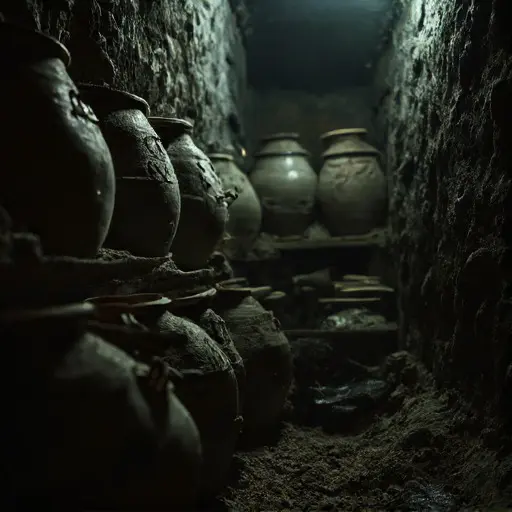
The most unsettling space was the root cellar, a cold, dark chamber beneath the kitchen pantry. This room was normally used for storing vegetables, but Elara had converted it. The shelves were now lined with dozens of small, earthenware pots containing not food, but preserved flower specimens, all meticulously sealed with wax and labeled. Tucked beneath the shelves was her final, personal diary. It revealed the tragic truth: Julian, exhausted by her isolation and her treatment of him as a mere “specimen,” had left her. Elara, unable to bear the loss of a key variable in her ecosystem, had performed her final, obsessive act. She had moved his personal belongings—his shoes, his leather gloves, his favorite pipe—to the root cellar, treating them with her strongest plant preservatives and sealing them in the pots. The final diary entry read: “The true perennial is the memory that is planted and sealed.” The veiled garden of Veridian-Hearth is the chilling, vibrant silence of a house where a woman sought to replace the chaotic nature of human life and love with the perfect, terrifying stasis of preserved, inanimate objects within the decaying, yet ever-growing abandoned Victorian house.