The Gilded Captivity of Lyra’s Grasp
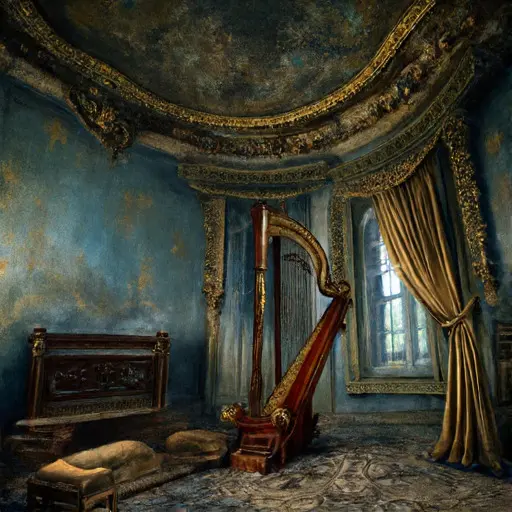
Lyra’s Grasp—a name that suggested both beauty and confinement—was an architectural marvel of the late Victorian era. Built of pale stone that seemed to hold a silvery sheen, the house was characterized by its delicate wrought-iron balconies and wide, segmented windows. It sat high on a bluff, perpetually shrouded in a cold, coastal mist, lending it an ethereal, yet profoundly isolated air. Entering the house was like stepping into a mausoleum of light: every room was grand, yet choked by heavy drapes and dust. The air was cool, dry, and carried the ghost of sea salt and dried lilies. The silence was absolute, a perfect vacuum where sound seemed unwilling to exist. This abandoned Victorian house was a stunning, delicate trap built for aesthetic perfection and emotional control.
The Collector’s Perfect Exhibit
The mansion was the personal collection and final project of Lord Alistair Sterling, a renowned, wealthy art collector and eccentric aesthete of the 1880s. His professional life was spent acquiring, restoring, and meticulously curating priceless objects—a relentless quest for perfect beauty and flawless form. Personally, however, Lord Sterling was pathologically controlling and deeply misanthropic, seeing people only as extensions of his property. He saw Lyra’s Grasp not as a home, but as his ultimate display case, designed to house his collection—including his family—as silent, beautiful objects of his possession.
The Portrait Gallery of Static Lives
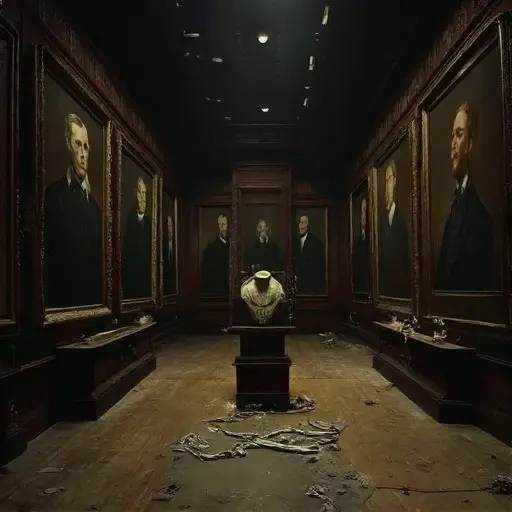
Lord Sterling’s Portrait Gallery was the central axis of his control. Here, he displayed not only acquired art but also portraits of his own family, including his wife, Lady Elara, and his son, Theodore. His journal, found hidden beneath a velvet display pedestal, detailed his perverse rationale: he believed that by having them painted in precise, stiff poses, he could capture their fleeting beauty and control their emotional expressions forever, freezing their lives into perfect, static art. The final journal entry, written in a clear, detached hand, described his ultimate ambition: to make the living subjects as permanent as their painted representations.
The Taxidermy Studio
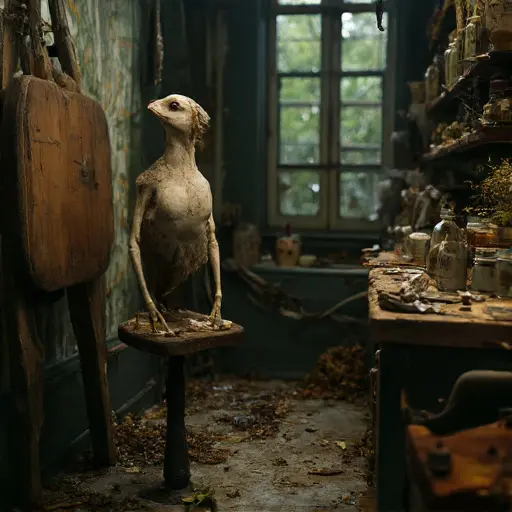
The most unsettling room was a small, heavily locked studio in the west wing, smelling faintly of chemicals and dried organic matter. Lord Sterling was not just a collector; he had secretly begun practicing taxidermy on exotic birds, preparing them for his final, private exhibit. We found his tools and chemicals neatly arranged on a workbench, all coated in dust. Among the dried herbs and borax powder, a small, intricate copper key was discovered. This key opened a hidden drawer containing his final, most terrifying object: a miniature, beautifully preserved porcelain doll, dressed exactly like his wife, Lady Elara. The accompanying note was a label written in his familiar, elegant script: “Elara Sterling. Permanent Exhibit. Never to be Moved.” The truth was that Lady Elara, unable to bear her husband’s control, had not merely abandoned the house; she had staged her own disappearance, leaving behind only the one thing Lord Sterling truly prized—an object he could fully possess. The gilded captivity of Lyra’s Grasp is the eerie silence of a collector who realized too late that the only way to keep the beautiful things he loved was to substitute them for artifacts, forever preserved inside the perfectly silent, decaying abandoned Victorian house.