The Eerie Silence of Quincefield Hold
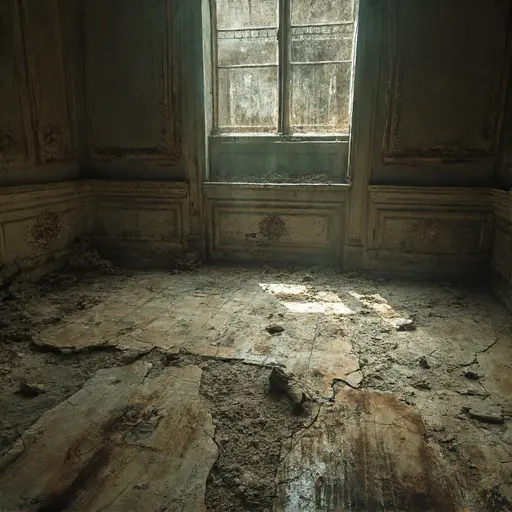
Quincefield Hold was a monument to wasted elegance, a house built for generations that never arrived. Its architecture was a heavy, ornate mix of Queen Anne and Gothic Revival, now softened by creeping decay. The imposing structure sat low among the whispering reeds of a desolate, brackish pond, reflecting a broken image of itself in the still water. The front doors, massive and studded with iron, felt impossibly cold to the touch. Inside, the grand hall was swathed in perpetual twilight. The air was dry, dusty, and held the distinct, faint scent of old perfume and mothballs. The silence was absolute, a profound pressure that seemed to listen more than it allowed sound. This abandoned Victorian house was a perfect preservation of the moment the music stopped and the guests vanished.
The Choreographer’s Final Bow
Quincefield Hold belonged to Seraphina Voss, a celebrated but fiercely private choreographer and instructor in the late 19th century. Her professional life was a relentless pursuit of perfect movement, demanding precise control, elegance, and emotional expression from her dancers. Personally, Seraphina was a woman consumed by the fear of being forgotten. She poured her considerable wealth into the Hold, creating elaborate rehearsal spaces and ballrooms, obsessed with leaving a tangible legacy that transcended the ephemeral nature of dance. Her connection to the mansion was total; it was the stage for her life, her art, and ultimately, her final, unrecorded performance.
The Rehearsal Studio of Stillness
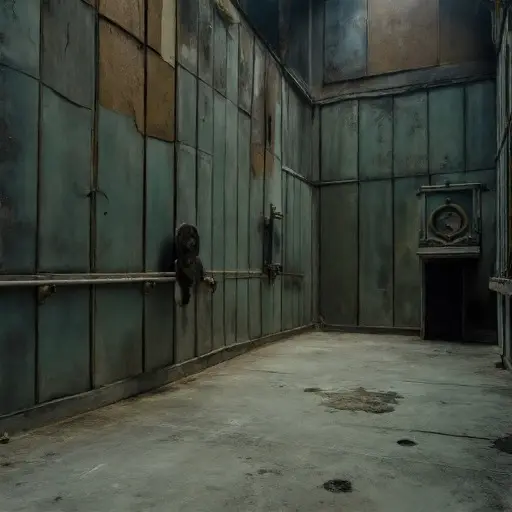
Seraphina’s private rehearsal studio was a vast, cold chamber that retained a palpable energy of intense physical effort. The mirrors, although clouded, offered distorted reflections of the decaying elegance. We discovered her final creation scribbled in a margin of a sheet music book: “The Dance of Retention,” a piece meant to be performed without sound, designed to make the audience feel the movement rather than hear it. Her choreographic notes detailed an increasing reliance on pauses and stillness—moments of holding breath, holding pose, until the pause became permanent. A single, intricately embroidered silk slipper was found near the barre, its ribbons trailing into the dust, marking the place where her final movement ended.
The Dressing Room of Fading Silk
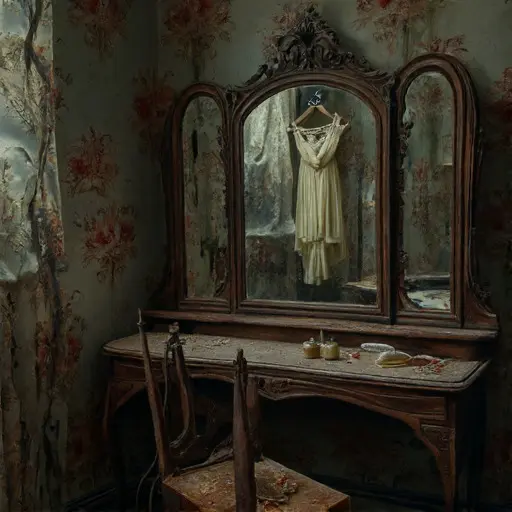
The dressing rooms adjacent to the ballroom were small, intimate spaces of vanity and preparation. Here, the atmosphere was saturated with the lingering, dry scent of old theater makeup and lavender. On a small, dusty table, among scattered hairpins and a broken comb, lay a meticulously preserved costume sketch. It was for the final, most crucial role in the Dance of Retention, a figure called “The Memory.” The costume was simple: a gown of white, translucent silk, meant to make the dancer appear as if they were fading into the scenery. Seraphina’s personal diary, found tucked inside a travel trunk, revealed a desperate final plan: she intended to become the ultimate, permanent “Memory.” She believed that by remaining absolutely still, by becoming one with the silence of the abandoned Victorian house, she would finally conquer her fear of being forgotten. The silk slipper in the studio and the lingering stillness of the Hold suggest she succeeded, her final, unmoving performance preserved forever within the walls of Quincefield Hold.