The Eerie Discovery at Ironheart Gauge
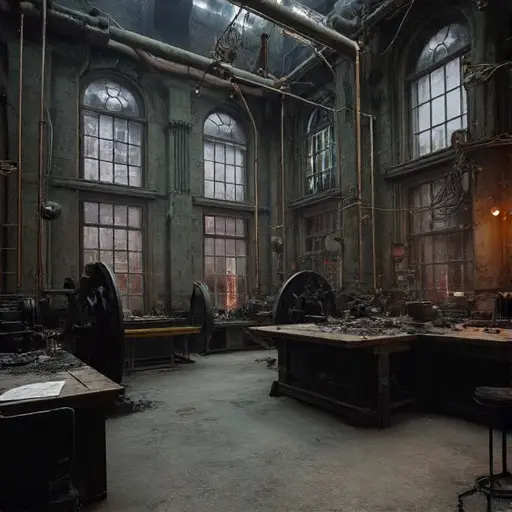
Ironheart Gauge stands like a grim, skeletal monument in the barren uplands, a stone anomaly among the gentle rolling hills. This abandoned Victorian house is singular not for its outward beauty, but for its unnerving functionalism. It is a house built around a profound, secretive task. The air inside is dry, almost arid, smelling faintly of mineral oil, rusted iron, and a lingering, acrid whiff of burnt coal—a scent that speaks of constant, intense labor rather than domestic comfort. The ground floor is a maze of unusually narrow corridors and heavily reinforced doors, leading away from the domestic wing and into the mansion’s true purpose. The atmosphere is one of profound, focused stillness, as if the entire structure is holding its breath after a catastrophic system failure.
Dr. Julian Vance: The Obsessed Experimentalist
The architect and sole resident of Ironheart Gauge was Dr. Julian Vance, a man of fierce, isolated intellect and a radical experimental physicist. Dismissed by his peers for his unorthodox theories on energy and temporal stability, Dr. Vance retreated to the secluded estate he built in 1890, dedicating his life to a singular, consuming project he called “The Chronometer.” He was a man of absolute routine and minimal human contact, described in old town archives as “brilliant, yet unnervingly intense,” known for working days on end with no sleep, his face always smudged with soot and oil.
Dr. Vance’s fate is a mystery sealed by steel. The last verifiable sighting of him was in the summer of 1905, just before a localized power surge blacked out the entire valley. When local law enforcement finally accessed the sealed residence, they found the house empty, but the internal machinery—the core of the mansion—was catastrophically damaged. The house now preserves the ghost of his obsession, the echo of frantic, dangerous work.
The Engine Room’s Frozen Moment
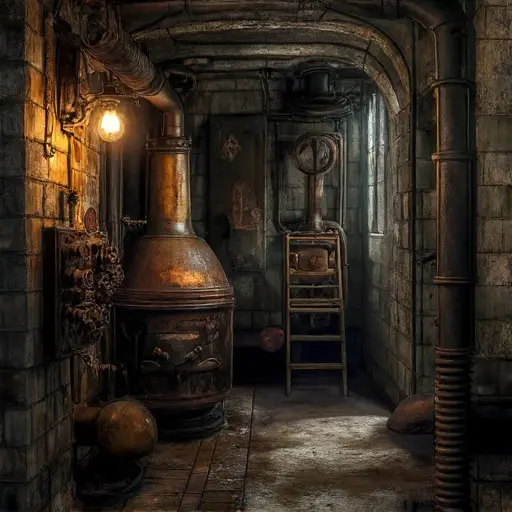
Below the workshop, accessible only by a reinforced service elevator now jammed halfway, lies the engine room. This subterranean chamber is the literal and metaphorical heart of the abandoned Victorian house. The air here is frigid and smells sharply of ozone and wet stone. The centerpiece is a colossal, bespoke steam engine, designed not for power, but for generating extreme, focused pressure. The boiler is ruptured, the brass fittings violently twisted, suggesting an explosion of immense, contained force.
On a small, bolted-down desk near the shattered controls, protected only slightly from the decades of damp, lies a notebook. The entries detail Dr. Vance’s desperate attempts to stabilize a feedback loop in his experiment. The final, scribbled words, scrawled with a grease pencil over the diagram of a complex relay, are profoundly melancholy: “The energy is perfect, but the stability is finite. The Chronometer is winding down to zero—and taking everything with it.”
The Observatory’s Final View
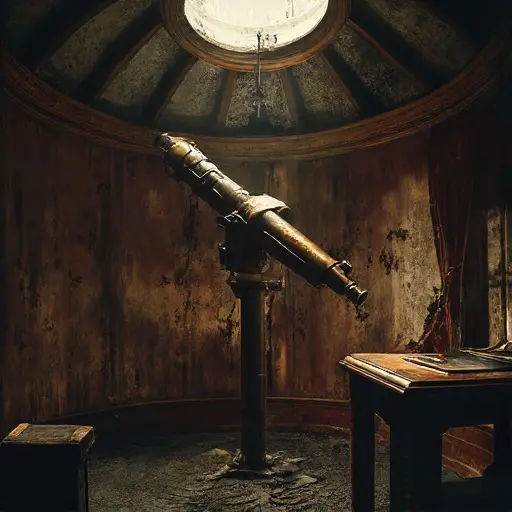
At the very apex of Ironheart Gauge is the small observatory, a room that served as Dr. Vance’s vantage point and perhaps the endpoint of his experiment. The room is circular, and the heavy brass telescope remains on its stand, but its barrel points not at the sky, but directly at the ceiling dome. The dome, once retractable, is now visibly splintered and blasted outward, with char marks surrounding the damage.
This room holds the climax of the mansion’s story. It was here, during that final power surge, that whatever Dr. Vance was trying to achieve either succeeded or, more likely, failed spectacularly. The only other object in the room is a heavy, lead-lined safe. It stands open and empty. Ironheart Gauge is not simply an eerie house; it is a meticulously constructed machine, forever stuck at the moment of its final, irreversible self-destruction, preserving the silence left by a scientist whose ambition was greater than the laws of physics.