Cursed Mirror: The Fading Face of Marble’s Visage
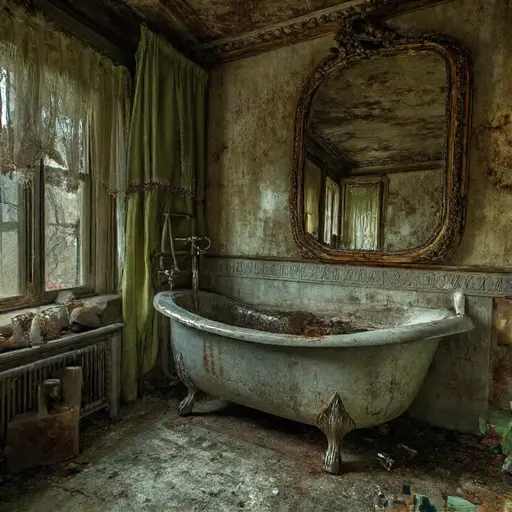
The very name, Marble’s Visage, suggests a beauty both fixed and cold. Perched precariously on a winding hillside road, this abandoned Victorian house is less a structure of wood and brick and more an elaborate frame for forgotten vanity. The atmosphere inside is intensely self-aware, smelling of stale powder, moth-eaten silk, and the heavy residue of expensive, long-expired perfume. The lighting, filtered through lace curtains that have disintegrated into hanging webs, is perpetually dim, as if the house fears bright exposure. Every surface—from the parquet floors to the silk wall coverings—seems to have been chosen for its reflective quality, emphasizing the owner’s singular obsession.
Cordelia Vance: The Painter of Light
The person whose life is intrinsically woven into the fabric of Marble’s Visage is Cordelia Vance, an exceptionally talented, yet tragically insecure, portrait painter. Cordelia’s genius lay in her ability to capture light—the fleeting glow on skin, the sparkle in an eye—but her personal life was consumed by an eerie fear of aging and an obsession with preserving her own perceived beauty. She inherited the mansion in 1898 and turned the entire upper floor into a massive studio, using the changing light of the day to work on her many self-portraits.
Cordelia never left the house after her fortieth birthday. She simply ceased all public appearances, becoming a legend in town—the beautiful painter who vanished into her own reflection. Her fate is a whispered tragedy, with the house acting as the vault for her desperate attempts to hold onto youth.
The Studio of Eternal Youth
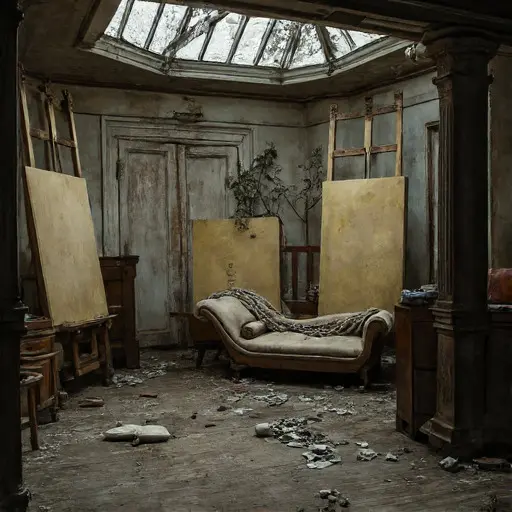
The studio is the core of the abandoned Victorian house. It is a cavernous space where light, though dimmed by decades of dust, once reigned supreme. Here, the memory of Cordelia Vance is most palpable. There are dozens of canvases, mostly covered, standing in silent ranks. Some of the visible ones are luminous, flattering portraits of high-society figures. But beneath the main skylight, standing alone, is the massive easel holding her final work.
The canvas is covered by a yellowed, heavy sheet. To pull it back reveals a horrifying truth: the painting is not of a beautiful woman, but a frenzied, unfinished self-portrait where Cordelia attempted to paint out every wrinkle, every shadow of age, leaving the face a grotesque, smooth blankness. A small ceramic cup beside the easel holds dozens of dried, stiff paintbrushes, and next to it, her diary is open. The last entry is short, frantic, and bolded by her despair: “The light has betrayed me. The mirror is a liar. There is no escaping the fading face.”
The Dressing Room’s Silent Witness
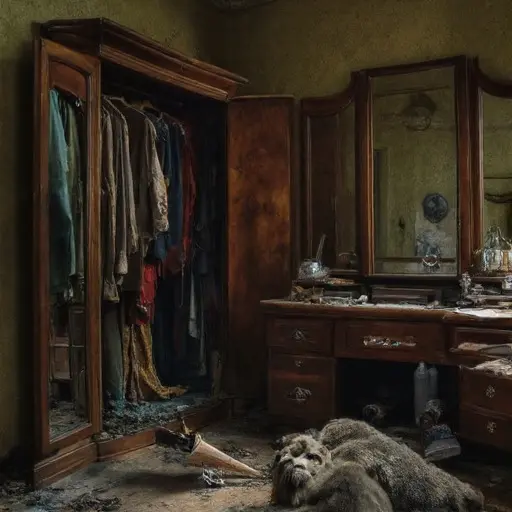
Off the main bedroom is the dressing room, a space intended for perfection. This small, ornate room is filled with the physical evidence of Cordelia’s obsession. Boxes of cosmetics, decades old, are scattered across the vanity. The air smells sharply of decay. The most compelling detail is the large, three-panel vanity mirror. Unlike the others in the house, this one is not cracked, but its center panel is entirely obscured by a thick, dark, opaque layer—as if someone deliberately painted over the glass to prevent a final, devastating look.
The house, with its countless reflective surfaces, was meant to be the canvas for her eternal youth. Instead, Marble’s Visage became the cage for her melancholy, a space where a brilliant artist tried desperately to paint herself out of the flow of time, leaving behind only the cold, haunting silence of her final, unreflected image.