The Shadowed Glass of Hearthstone Folly: A Piano Technician’s Melancholy
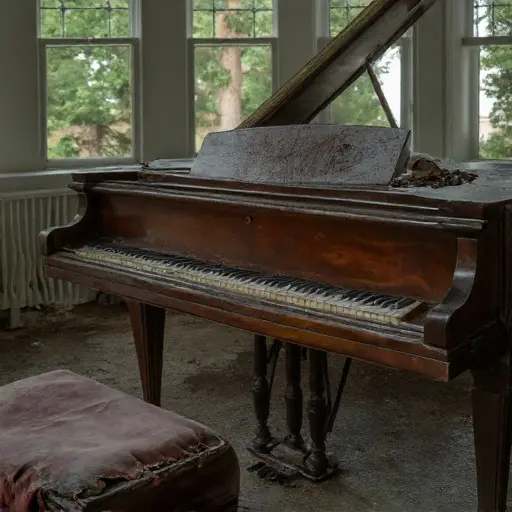
Hearthstone Folly was a large, acoustically complex house built in 1888. Its last true occupant was Mr. Giles Thorne, a professional piano maintenance technician whose specialized skill was the repair and tuning of the complex, sensitive mechanisms of grand instruments. Thorne, a bachelor, lived a quiet life dedicated to his craft until his death in 1921 from complications of lung illness, possibly exacerbated by the solvents and dust of his trade. Because he owned the house outright and left no immediate family, the property passed to a distant charitable trust, which simply boarded it up and forgot it for half a century.
The Workshop of Precision Failure
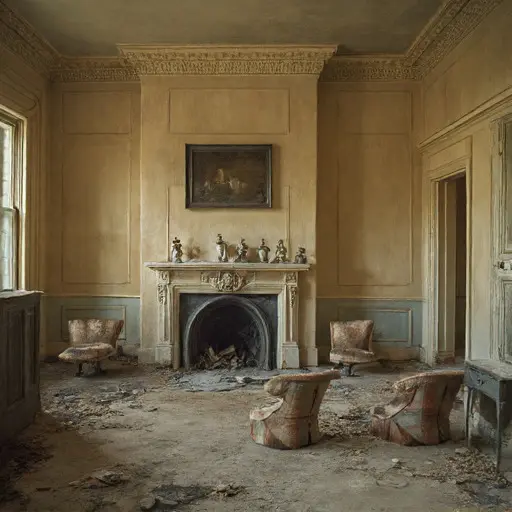
Thorne’s life was concentrated in a small, windowless ground-floor workshop adjacent to the music room, a space dedicated to his detailed labor. Here, an enormous wooden workbench dominated the room, its surface deeply scarred by tools and stained by various oils and polishes. Laid out across the bench were the disassembled internal components of an upright piano: rows of tiny, intricate brass and felt dampers, thin coiled wires, and small, specialized tools for regulating the action—all frozen in mid-repair and covered in a thick layer of dust and mineral particulate. A small, sealed tin sat near the edge, containing various shades of felt used for hammer coverings, the wool brittle but retaining its original vibrant colors. The air here was dense with the distinct smell of machine oil, beeswax, and cured wood, a chemical signature of his dedicated craft.
The Ledger of the Tuned Life
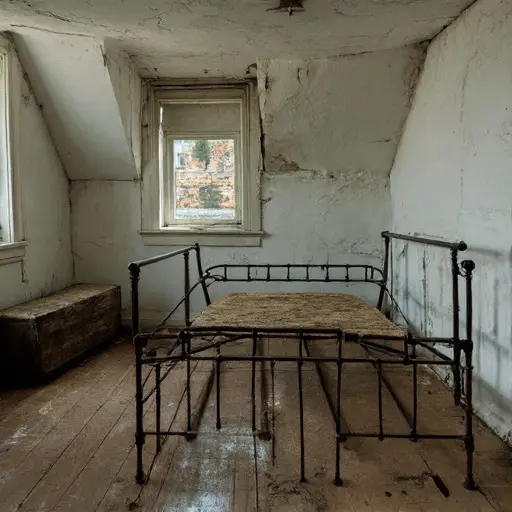
In a secure, locked drawer of the workbench, Thorne’s most telling possession was discovered: a massive, leather-bound tuning log. This was not a general record, but a detailed chronological account of every instrument he had ever tuned or repaired in the county. Each entry was meticulous, noting the exact date, the owner, the instrument’s serial number, and a series of cryptic, personal notes on the instrument’s ‘temperament’ or ‘disposition.’ He wrote of one piano being “melancholy but resolute” and another as “garrulous, requiring patience.” The final pages, however, were not about pianos, but a series of precise measurements and drawings for a complex, self-designed tool—a specialized hammer regulating jig he intended to patent, an ambition left forever unfinished.