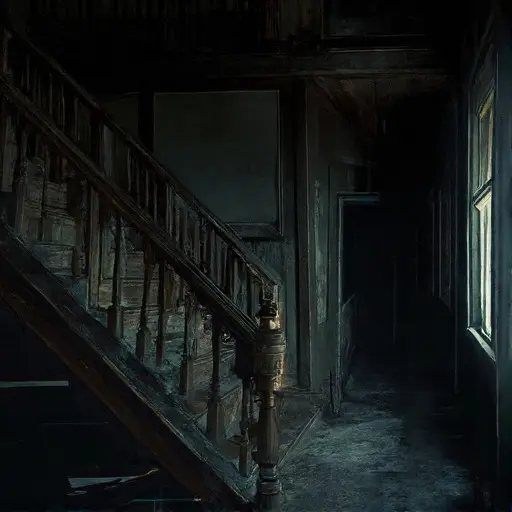
The Cursed Whispers of Stonehaven Manor
The door, heavy with peeling, black paint, yielded with a low, miserable groan, like a long-dormant beast being woken. Beyond it, the air in Stonehaven Manor was immediately colder, thicker—a pressurized silence woven from a century of forgotten hours. A single shaft of weak November light pierced the gloom of the foyer, setting the dust motes spinning in a furious, brief galaxy. The intricate mosaic floor was cracked, the grand staircase bowed with the weight of its own history, and the faint, unmistakable scent was of dried lavender mixed with the deep, cold smell of wood rot. It was beautiful, haunting, and every creaking floorboard underfoot was a deliberate, slow breath the house was taking. The walls felt like they were leaning in, quietly observing the one who dared to trespass upon their memories.
The Architect’s Obsession
Stonehaven was the grand, desperate legacy of Elias Thorne, a brilliant but reclusive architect from the late 1880s. Elias didn’t just design houses; he poured his volatile, perfectionist soul into them. He lived and breathed the lines of the Manor, convinced that straight lines and precise geometry held the secret to warding off the inherent chaos of the world. He was a man consumed by symmetry and light, a personality that brooked no error, and his connection to Stonehaven was one of tyrannical possession.
His downfall, whispered only in the briefest accounts, came after the completion of the eastern wing. He had built a flawless study, a room designed to capture the first rays of dawn, yet he was never satisfied. He believed a single, crucial design element—a specific, mathematically perfect curve—was missing. This unfulfilled quest became his madness.
The Sunken Drawing Room
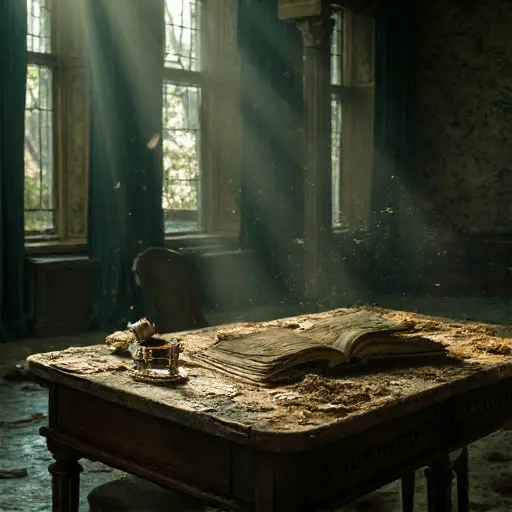
We found the first real clue in the sunken drawing room, a space meant for socializing but now tragically draped in white, dust-sheet shrouds, looking like ghosts waiting for a carriage that would never arrive. On a small, intricately carved side table, nestled next to a porcelain tea set frozen mid-pour, was Elias’s journal. Its leather cover was still remarkably supple.
The last entries were not about blueprints, but about the quality of the house’s silence. He wrote: “The line is gone, and now the quiet is wrong. It is not the quiet of absence, but the quiet of waiting. I hear her breathing in the walls.”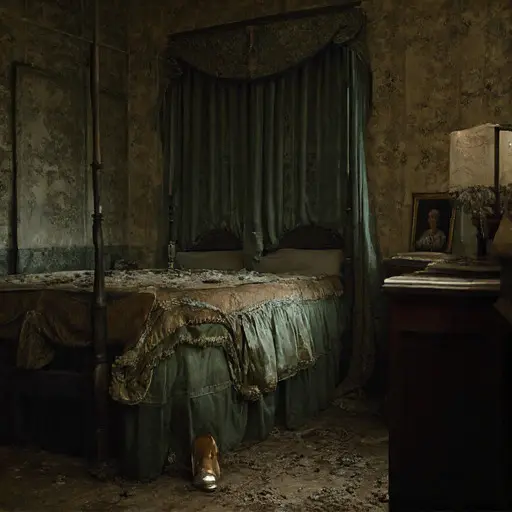
A Whisper in the Conservatory
The house had kept its former master’s secret well. As the story unfolded, it became clear the “her” Elias referred to was his wife, Isabelle, who had vanished shortly after the Manor’s completion. Elias’s journal entries turned from architecture to obsession with sound—believing he could hear Isabelle’s voice caught in the geometry of the house he built.
The Conservatory, a vast, skeletal space of broken glass and dead vines, offered the final, most poignant evidence. Here, where Isabelle once cultivated exotic orchids, we found a small, hidden indentation in the stone floor. It was a shallow, almost imperceptible curve, exactly the shape Elias had been seeking in his final, desperate days.
It was a curve of flawless, heartbreaking imperfection, a single line that proved the house did not need his geometry to be perfect, but his love. Elias Thorne never found his lost line, never found his wife, and in his despair, he sealed himself within the walls of his own creation, convinced that the sound of her memory was trapped there. Stonehaven does not echo; it retains. The house did not betray Elias, but merely preserved his anguish and Isabelle’s presence, an unending, quiet memory caught in the dust-filled air.